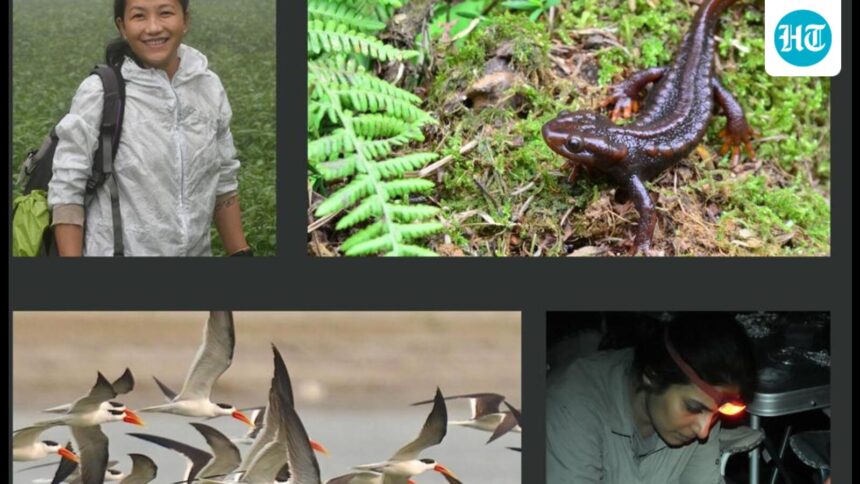
Indian conservationists Barkha Subba and Parveen Sheikh have won the prestigious 2026 Whitley Awards for their work protecting Himalayan salamander habitat and preserving endangered Indian skimmer nesting sites along the Chambal River through community-led efforts.

Subba, scientific advisor to the Darjeeling-based Federation of Societies for Environmental Protection (FOSEP), will lead the first coordinated grassroots effort to secure the future of the Himalayan salamander in Darjeeling.
The Himalayan Salamander is a species of lizard-like amphibian, found only in eastern Nepal and the Darjeeling region of India. This is the only species of salamander found in Nepal. Although it resembles a lizard, it lacks scales on its body.
Sheikh, a scientist with the Bombay Natural History Society, was honored for the community-led ‘Scrapper Guardians’ initiative on the Chambal River. Through recruitment of local nest keepers and ongoing scientific monitoring, the nest’s survival rate has increased to 27% from 14%, with the local population growing to about 1,000 individuals last year from 400 in 2017, the Whitley Trust for Nature said.
India is home to more than 90% of the world’s population of about 3,000 Indian skimmers, known for their bright orange beaks and skimming the surface of rivers to catch fish. The birds nest on sandbars – mid-river islands that appear seasonally – and even small changes in river flow patterns can lead to complete nesting failure.
Barkha suba and Himalayan salamander
The Suba Project plans to restore habitats, remove invasive species, screen for a deadly fungal disease, and engage local residents in outreach programs that promote sustainable land use and eco-friendly tourism.
“The main threat is habitat loss due to rapid urbanization, expanding tourism, modification of wetlands and invasive species,” said Soba, who is in London to receive the award on Wednesday.
There are approximately 30 Himalayan salamander breeding sites remaining locally, many of which are located outside protected areas. Through the Whitley Prize, Soba said, she will focus on seven of the most important breeding sites for rare and evolutionarily distinct amphibians.
Endemic to India, Nepal and Bhutan, the Himalayan salamander, which can grow up to 17cm long and live up to 11 years, is widespread across Darjeeling’s cool, shaded wetlands and forest edges. Meeting the salamander “feels like meeting a messenger from deep evolutionary time — a reminder of how long nature has endured and how quickly we can lose it,” Suba said in a statement.
Salamanders return to their birth site to reproduce and lay eggs—a process known as philopatry, which makes them highly vulnerable to changes in habitat and wetland health.
“The habitat of the Himalayan salamander in Darjeeling’s tea region is undergoing complex changes. Rising prices for Nepal tea, often marketed as ‘Himalayan tea’, have increased competition for properties at a time when climate change, erratic rainfall and aging plantations have reduced yields. Companies focused on profits and diversifying economic activity are also snapping up older properties. At the same time, the region faces increasing environmental challenges, including landslides and soil degradation,” a statement from the Whitley Fund for Nature said in a statement from the Whitley Fund for Nature. (UK-based WFN): “Erosion and shrinkage of freshwater sources linked to development.”
The Himalayan salamander-breeding wetlands are culturally revered bodies of water, associated with local gods and rituals. In many villages, disturbing them has historically been discouraged. This respect extends to all life forms supported by these wetlands, including the Himalayan salamander, according to Subba, who hails from an indigenous community in Darjeeling, and describes the salamander as resembling “a small dragon swimming calmly in a mountain pool.”
Globally, wetlands are disappearing faster than any other ecosystem, and a fifth of them may be lost by 2050.
Parveen Sheikh and the Indian scraper
With the Whitley Prize, Sheikh plans to strengthen protection in Chambal and expand the initiative to include key sites around Prayagraj, where the Ganges and Yamuna rivers meet.
Once widespread throughout Southeast Asia, the Indian skimmer has disappeared from most of its historical range amid widespread degradation of riverine habitats. Globally, wetlands are disappearing faster than any other ecosystem, with rivers showing an increasingly disturbed water cycle. According to a UN report, only a third of river basins had normal conditions in 2024, with water levels in two-thirds of them dangerously low or unusually high.
“Local guardians help identify new sandbars, monitor nests, and prevent disturbances during the breeding season. Some now proudly refer to the skimmers as ‘our birds,’ reflecting a growing sense of ownership. This change in perception from indifference to stewardship was one of the most important outcomes of the project,” Sheikh said in a statement.
“Our work is in Chambal. We want to try to expand it to Yamuna and Ganga and try similar initiatives there,” Parveen said from London. “A minimum flow rate is needed in all of these rivers during the peak nesting season to keep the sandbars isolated from the banks,” she added.