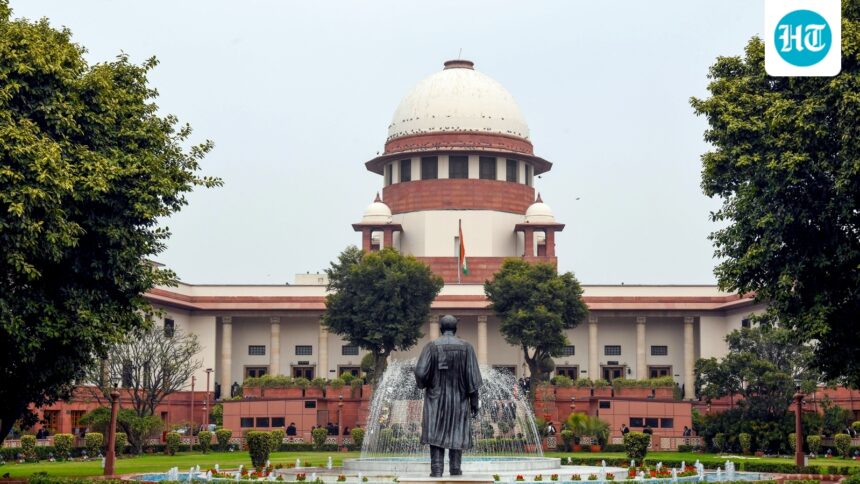
The Supreme Court on Wednesday reminded public figures of their duty to exercise restraint in public speech, holding that hate speech contradicts the constitutional value of brotherhood and strikes at the moral fabric of our republic.

After dismissing the petition filed by advocate Ashwini Kumar Upadhyay seeking separate offenses of hate speech and rumour-mongering, a bench of Justices Vikram Nath and Sandeep Mehta said: “In a constitutional democracy, public speech carries with it a duty of restraint and responsibility. Individuals, public figures and institutions alike must remain cognizant of the fact that words have consequences, especially in a diverse society like ours.”
The court held that current penal laws adequately address hate speech and called the petition “erroneous” by assuming that the field of hate speech remains “legislatively unoccupied.”
Meanwhile, the body said it would be open to the Indian Union and relevant legislative authorities to consider whether further legal or policy measures are needed in light of evolving societal challenges. It also asked the Center and states to consider appropriate amendments suggested by the Law Commission in its March 2017 report on hate speech.
Read also: Supreme Court disposes of activist Teesta Setalvad’s application for a passport
“Hate speech is not just a deviation from acceptable speech, it fundamentally contradicts the constitutional value of brotherhood and strikes at the moral fabric of our republic,” the bench said.
Such rhetoric goes against India’s civilized ethos, the ruling added, referring to the ancient principle of vasudhaiva kutumbakam – the idea that the world is one family.
She said it was “unconscionable” that citizens in such a country could be labeled or discriminated against on the basis of class, colour, creed, gender or any other label rooted in an “us versus them” mentality.
He added, “Hate speech, in this sense, is not merely an exercise of freedom of expression but a distortion of it, which undermines the constitutional promise of an inclusive and cohesive society by promoting hostility and discrimination against specific groups.”
The 125-page ruling, written by Justice Nath, said the idea of belonging to one nation cannot be conditional on selective inclusion or exclusion, but requires a collective commitment to common constitutional values. “Therefore, fraternity requires of every citizen to recognize and respect the equal dignity of others, regardless of differences, and to consciously avoid behavior that undermines social harmony,” she said.
Once this constitutional ideal is internalized, the court added, “the motivation to engage in hate speech will diminish.”
The ruling ruled on a batch of 13 related petitions citing instances of alleged hate speech where police and courts had failed to register FIRs. These included speeches at a Dharam Sansad event in Haridwar in 2023 that targeted Muslims.
Referring to the 2014 judgment in Lalita Kumari, the court said that the police are bound to register an FIR where a cognizable crime is unearthed. She added that aggrieved persons may also approach the courts under Section 156 (3) of the Code of Criminal Procedure, which enables judges to directly register FIRs.
The ruling clarified that while considering such complaints, the judge need not seek advance punishment under Section 196 or 197 of the Code of Criminal Procedure at the FIR stage, as punishment is required only when the charges are recognized.
The issue arose in one of the petitions filed by Communist Party of India (Maoist) leader Brinda Karat challenging the 2022 Delhi High Court ruling that granted relief to BJP leaders Anurag Thakur and Pravesh Verma.
The Supreme Court partially set aside the Supreme Court’s finding of prejudgment, but did not change its final finding that the speeches in question did not disclose a cognizable crime.
The court directed that a copy of the ruling be circulated to all high courts, leaving room for them to issue practical guidelines for implementation.
Many lawyers called for continued monitoring by the court, saying hate speech often goes unpunished despite existing law. Bench refusal.
She said, “Assuming the role of continuous supervisory oversight over executive or investigative tasks, especially in anticipation of possible negligence, will not only blur constitutional boundaries, but also amount to an impermissible expansion of judicial power beyond its legitimate limits.”
The court said that the problem does not lie in the legislative vacuum, but rather in the inadequacy or unequal use of existing legal procedures.
She added that policy making and legislative choices fall squarely within the scope of legislative authority, and that courts may only draw attention to emerging concerns.
The court also dealt with contempt petitions alleging police failure to register hate speech cases. While many of them were rejected, some matters awaiting responses were listed for further hearings on May 19.