A month after she updated her name and pronouns on her LinkedIn profile, 28-year-old Bengaluru-based Akira Mujwar has been laid off from her company, where she worked as a game developer. “Even then, I was on track to get a pay rise. I had planned everything – when to go out socially, when to start hormone replacement therapy (HRT), when to have surgery – and all of that was ruined. The problem is that I can never prove that I was fired from my job.” [for being a transwoman]She said.

It took Mujawar months to find another job that paid half her previous salary. “I was looking at myself in the mirror and saying, ‘I don’t want to age this way.'” So I started hormone replacement therapy in earnest, and started to transform socially and legally. But then this law passed and my plans were derailed again.
Like Mujawar, 26-year-old Maya (who goes by one name) worked hard to change her ID cards. For three years, she shuttled between Bengaluru, where she works, and Chennai, where she completed her education, to obtain her documents. “Even though the central government portal continued to reject my application for a transgender ID card, the Tamil Nadu government portal had a simpler and faster process. I was able to get my gender identity correct on my PAN and Aadhaar card. I also started saving for a surgery, which I wanted to have next year. Now, with the amended law, my world feels turned upside down. I feel like I don’t even exist,” she said.
Mujawar and Maya are among the people who have moved courts across the country challenging the Transgender Persons (Protection of Rights) Amendment Act, 2026, which amended key provisions of the Transgender Rights Act, 2019. Both of them approached the Karnataka High Court on April 9. At last count, four petitions were also filed in the high courts of Kerala and Delhi (two in each), while three petitions were filed in the Supreme Court.
On April 5, National Council of Transgender People president Lakshmi Narayan Tripathi and member Zainab Patel filed a petition in the Supreme Court challenging the constitutional validity of the law. “The petitioners assert that the court is now called upon to protect the right it had previously declared to be fundamental to dignity and personal autonomy under Article 21,” Tripathi and Patel’s petition said.
On the same day, two writ petitions were filed in the Kerala High Court. The petitioners, including a transgender woman named Neethu, said the hospital had stopped hormone replacement therapy (HRT), essential for gender-positive care, because of the new law. Advocate Arundhati Katju, who represented the petitioner, told the court: “Earlier there was an expanded definition of transgender. It has completely changed now. The treatment that used to treat my gender dysphoria has now been stopped by the private medical establishment.” On April 10, the court issued an interim order stating that treatment must continue.
Together, these people represent a new moment of danger for society in India, more than a decade after the landmark Supreme Court ruling in the 2014 case of Union of India v. National Legal Services Authority (NALSA) affirmed the rights of transgender communities. But now, changes in the 2019 law – which narrowed the definition of “transgender” to exclude multiple communities; the inclusion of several layers of medical bureaucracy in the process of obtaining transgender certification; Broad but vague provisions criminalizing those who cause someone to “assume” a transgender identity threaten to push society into an era of fear and confusion.
In 2014, there was a seismic shift in the lexicon
The NALSA ruling granted every citizen the right to determine their own gender, which was not based on biological characteristics.
It also expanded Article 21 of the Constitution, which relates to the right to life and personal liberty, to apply to the dignity inherent in one’s sex determination, and found that Articles 14 and 15, relating to equality and non-discrimination, must apply to all persons, including transgender persons. The ruling created a legally valid category of transgender rights, paving the way for access to social welfare, entitlements and rights that community members were unable to access due to entrenched stigma.
For most citizens, Supreme Court rulings play a small role in determining the ebb and flow of their daily lives.
However, for the transgender community, the NALSA ruling is a vital part of their daily lives. Almost every transgender person seeking to change their gender in their identity card encloses a copy of the ruling in order to sensitize and educate government officials.
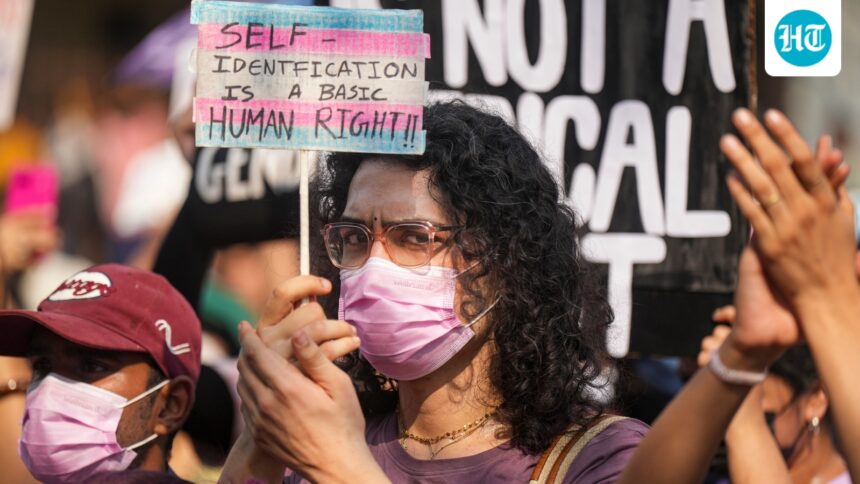
NALSA is part of the lexicon of gender and sexuality rights training in schools, colleges as well as professional offices. Between 2016 and 2019, when the Center introduced different versions of the Transgender Persons (Protection of Rights) Act, the transgender community rebelled against medical examination before obtaining legal documents, and used NALSA as a talisman to ensure the right to self-identification.
All the petitions rally around two main arguments against the amended law: First, that it explicitly contradicts the NALSA ruling, by linking the definition of transgender to differences between the sexes and differences in sexual development. The amended law also specifies the procedures for obtaining a transgender identity certificate, which includes verifying its authenticity by a medical committee, and the hospital assigns the information of a person who has undergone direct surgery to “change his sex, whether male or female,” to the relevant district judge.
The petitioners were influenced by some observations made by various courts. In Karnataka, Justice Sachin Shankar Magadum described the matter as a serious matter.
Justice Bichu Kurian Thomas of the Kerala High Court in his interim order on April 10 stated, “The change in the definition clause in the Act cannot, prima facie, affect what has already been initiated. The petitioner has averred that she had started HRT early in the year 2019. Considering the totality of the circumstances, this Court is of the view that sudden discontinuation of HRT which the petitioner has already started, would lead to adverse and absurd consequences. Deciphering such a thing from the legal provisions, as amended.”
The court asked the Center to submit a counter-affidavit regarding the defenses raised in the judicial petitions.
“The law criminalizes the support system that helps transgender people. If I shelter someone facing violence from their family of origin, I could be charged with ‘enticing’ or ‘coercing’ the transgender person. To commit any crime, criminal intent is required [intention of wrongdoing] It must be proven. “The law does not specify anything regarding criminal intent, and it is very vaguely worded,” said advocate Padma Lakshmi, counsel on record for the petitioners in the Kerala High Court.
NALSA gave us air; The amendments stifled us
Outside the courtrooms, the changes have brought disparate groups together in the fight against the bill.
Among them are Pavitra Nandgiri, Mahamandaleshwar of Kinnar Akhada. “When Nalsa was sentenced in 2014, it was a breath of fresh air. For the first time, we had agency. Property rights. The right to stay with parents. The right to enter the temple,” she said.
“But if NALSA gives us air, the amendments stifle us. They make rules about our bodies without talking to us. We don’t ask for a handout. The new generation of trans people has education and ambition; they need basic services, jobs, and dignity. My other brothers and sisters get these things without a doctor deciding whether they deserve them. Why should I be any different?”