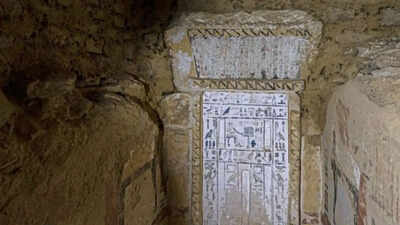
Deep in the sands of the Saqqara necropolis in Egypt, a discovery has begun to once again draw attention to the extent of the ruins that remain buried in plain sight. Archaeologists have reportedly discovered a sealed tomb containing a gold-covered mummy at the bottom of a deep shaft, untouched for more than 4,300 years.
The site is located near Cairo, in an area full of ancient tombs, but this tomb appears to have survived thieves and time in an unusual way. Experts say this discovery may provide a clearer glimpse into burial customs in the Old Kingdom, especially for elite figures. The mummy itself, wrapped and encased in gold elements, immediately stands out, but it is not only the shine that is important here. The surrounding artifacts, the sealed coffin, and the quiet stillness of the room add to an eerie sense of preservation that seems almost accidental.
Hidden under Egyptian Saqqara: The sealed coffin opens to reveal a mummy covered in gold
Saqqara is not a new name in archaeological circles. It is one of the oldest and largest tombs in Egypt, and has been used by royals, priests and officials over the centuries. This latest discovery was made deep underground, at the bottom of a shaft approximately 15 meters deep. It may seem almost unreal, but this is where the limestone sarcophagus was found, still sealed with ancient mortar.The burial chamber remained hidden in a way that protected it from the usual disturbances witnessed in the region.
Many of the tombs at Saqqara have long been opened, and some have even been stripped of cleanliness. But this feels different; This is most preserved in silence. Inside the limestone sarcophagus is the mummy of a man known as Heka Sheps, based on inscriptions in the burial chamber. Archaeologist Zahi Hawass reportedly described the moment he looked inside as amazing, noting that the mummy was still covered in layers of gold.The coffin itself remained sealed with what experts believe was ancient mortar, holding everything in place for thousands of years. This detail alone is extraordinary. Most burial sites from this era show signs of disturbance, even if minor.
Why gold was important in ancient Egyptian burials and what it reveals
Gold in ancient Egypt was not just an ornament. Experts say it was closely associated with divinity, and is often described as the “body of the gods.” This idea may seem far-fetched now, but at the time it had real meaning.
Thin sheets of gold were reportedly placed over the mummy’s wrappings and fixed with resin. It was a delicate process. Slow and deliberate. It is not something that is done casually or for show alone.It also appears that the gold may have had another purpose. Some researchers suggest that it helped preserve the body, at least visually, slowing the effects of decay over time. Whether this was intentional or symbolic is still up for debate. Either way, seeing a face covered in gold inside a sealed tomb is not something archaeologists come across very often.
Especially not in Saqqara today.
Who was Hika Chips?
Heka-shepes remains a bit of a mysterious character. Based on the quality of the burial, he was likely part of the elite, and may have been associated with royal administration or religious roles during the Fifth or Sixth Dynasty of the Old Kingdom.This does not completely limit it. Status in ancient Egypt was not just about wealth. It may have included influence, proximity to authority, or roles in temple life.
Experts say people like him often hold multi-layered identities that cannot be easily defined in modern terms.
What nearby discoveries at Saqqara reveal says about elite life and burial practices
The grave did not stand alone. Nearby structures revealed statues, pottery, and smaller items such as amulets and stone vessels. Some of the statues are associated with individuals such as Vitek, who are believed to have served as symbolic statues of the dead. These things were not random. They had roles in funerary belief systems. Offerings were presented to them, as if they were carrying the presence.There were also the remains of a royal pyramid priest and a palace official in the wider area. This suggests an elite neighborhood buried beneath the sand, and each tomb is connected in some way to the power structures of the time.