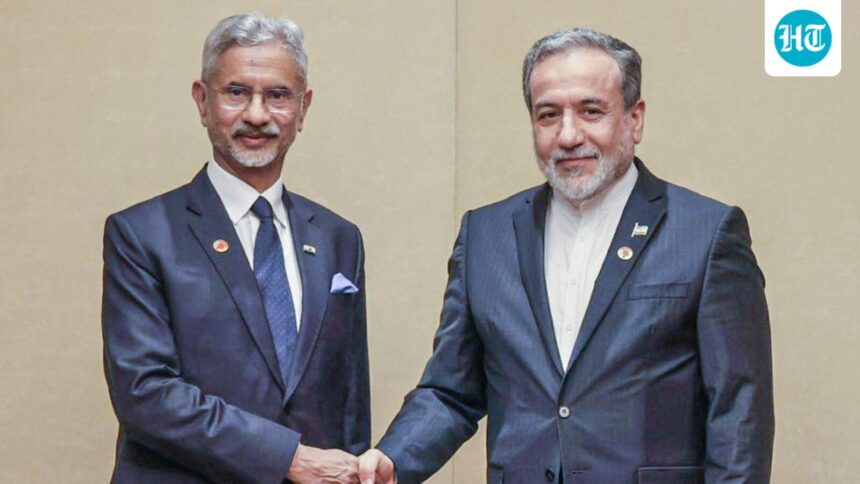
Iranian Foreign Minister Seyed Abbas Araqchi held a phone call with External Affairs Minister S Jaishankar on Wednesday to discuss the conflict in West Asia and efforts to end the war.

The two foreign ministers have spoken by phone more than six times since military strikes launched by Israel and the United States on Iran on February 28 sparked the conflict. The latest invitation came after Araghchi’s visits to Pakistan, Oman and Russia as part of efforts to end the war.
“I received a phone call from Iranian Foreign Minister Seyed Abbas Araqchi this evening,” Jaishankar said on social media. “We had a detailed conversation about various aspects of the current situation. We agreed to remain in close contact.”
A post on Araqchi’s Telegram channel said that the two foreign ministers held consultations on “the latest developments related to the ceasefire, bilateral relations, and regional and international developments.”
A statement issued by the Iranian Foreign Ministry said that Araqchi briefed Jaishankar on the consequences of US actions that “threaten international freedom of navigation” and the latest trends in negotiations to end the war.
Araqchi said that the insecurity imposed on the Persian Gulf and the Strait of Hormuz is “a direct result of the aggressive actions” carried out by the United States and Israel against Iran, and “stressed the need to hold them responsible for the security and economic consequences of their actions on the entire world.”
The Iranian reading said that Jaishankar affirmed India’s principled position of supporting diplomacy to end the conflict and resolve disputes.
Araqchi also spoke with Polish Foreign Minister Radoslaw Sikorski and Kenyan Foreign Minister Musalia Mudavadi on Wednesday.
President Donald Trump indefinitely extended a ceasefire agreed to by Iran and the United States on April 7, largely halting hostilities. Iran’s Fars News Agency reported over the weekend that Iran had sent “written messages” to the United States via Pakistan, which were “about some red lines…for Iran, including nuclear issues and the Strait of Hormuz.”
Iran closed the vital strait, cutting off supplies of oil, natural gas and fertilizer and sending prices soaring. In response, the United States imposed a blockade on Iranian ports.