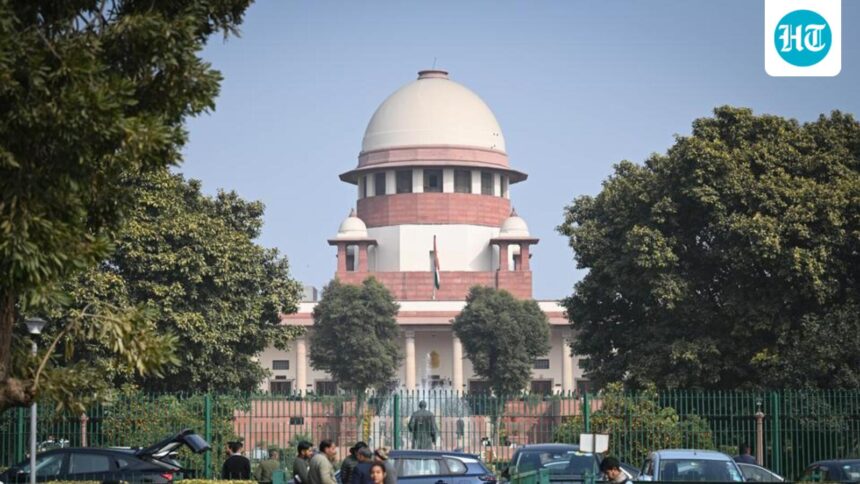
The Supreme Court said on Wednesday that the law is sufficient to punish hate speech, as it rejected a petition to declare the law and rumour-mongering as separate crimes under the penal code, saying constitutional courts cannot force the legislature to enact laws, highlighting the implementation deficit.

“Creation of criminal offenses falls within the legislative domain. The judiciary cannot create new offenses in keeping with the separation of powers under the Constitution,” a bench of Justices Vikram Nath and Sandeep Mehta said.
Lawyer and BJP leader Ashwini Kumar Upadhyay had filed a petition in 2021 seeking to declare hate speech as a separate crime. The court has since heard appeals related to hate speech, including during the 2023 Haridwar Dharam Sansad. It issued interim orders directing the police to compulsorily register cases in such matters.
The court rejected all petitions in this regard, saying that they did not arise from a deficiency in the law but in implementation. “The claim that hate speech is an unoccupied area of law is a misconception. Current legislation is sufficient to deal with hate speech because there is no legislative vacuum.”
The bench said hate speech and rumour-mongering affect the constitutional ideals of brotherhood. She added that the matter would be open to the government to consider appropriate amendments to the law. The bench stressed that the police are obligated to register cases in such matters, citing the Lalita Kumari judgment (2013), which mandates registration of cases if there is any information revealing the commission of a cognizable offence.
“The aggrieved person can also approach the court to register an FIR [first information report]”, he said to the bench. He added that the legislative structure is complete. The court held that the judge was empowered to direct the FIR as an advance sanction required under Bharatiya Nyaya Sanhita Sections 196, 197, 298 and 302 of the BNS, which deals with words or actions intended to incite religious sentiments or promote hostility, and applies at the time of confession of the charge and not at the pre-knowledge stage.
The court ordered a copy of the ruling to be circulated to all high courts. It was left open for the High Courts to consider issuing practical guidelines for implementing the ruling.