In the 2022 Punjab Assembly elections, the BJP polled 6.6% votes and won two of the 117 seats, when the AAP won 92 seats and ousted the Congress from power.

When six of the AAP’s seven Punjab Rajya Sabha MPs joined the BJP last week, they gave the party something it had never achieved in Punjab through elections alone – a dominant presence in the upper house of Parliament from a state the party had never won alone. General Assembly elections are scheduled to be held in about 10 months.

The numbers are stark. In the 2022 Punjab Assembly elections, the BJP polled 6.6% votes and won two of the 117 seats, when the AAP won 92 seats and ousted the Congress from power.
This was after decades of the BJP not in alliance with the Shiromani Akali Dal (SAD). The Congress Party won 18 seats, the Social Democratic Party only three seats, followed by the Bharatiya Janata Party with two seats, and the rest of the small parties or independents. After the polls conducted since then, the AAP seat now stands at 94 seats, and the Congress seat has come down to 16 seats.
Hence, the BJP, considering its numbers, has not fielded any Rajya Sabha members from Punjab. Its senior Punjabi face and Union Minister Ravneet Singh Bittu, who came from the Congress and lost the 2024 Lok Sabha elections from Ludhiana, represents the party in the Rajya Sabha from Rajasthan.
AAP got people nominated for all seven seats, and its selection of relative outsiders like Chadha and some wealthy businessmen has raised eyebrows.
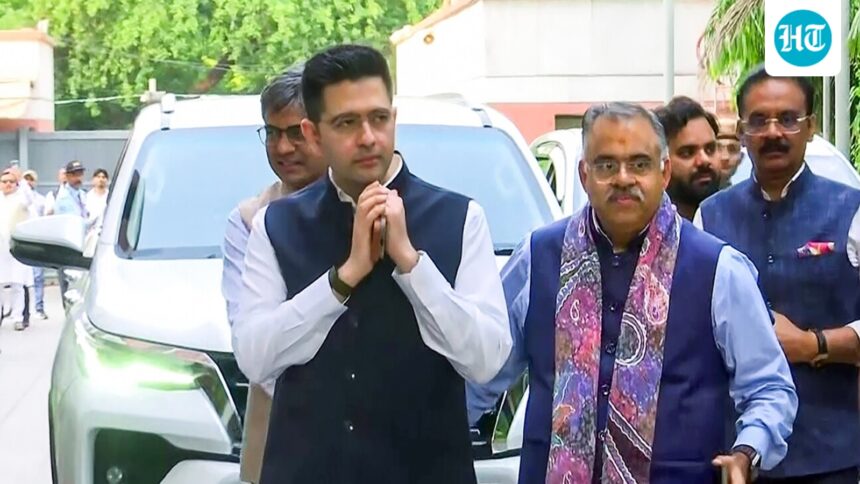
Now through the “merger” of RJD MPs – Raghav Chadha, Sandeep Pathak, Ashok Mittal, Vikramjit Singh Sahni, Rajinder Gupta and Harbhajan Singh from Punjab, along with activist-turned-politician Swati Maliwal from Delhi – the BJP holds six of the seven Rajya Sabha seats in Punjab.

Of these, Chadha and Pathak were AAP’s strategists for the 2022 polls, both of whom were described as “outsiders” by the opposition. Mittal, Sahni and Gupta have large companies. And Harbhajan Singh is a former spinner of Team India.
Environmentalist spiritual leader Balbir Singh Seswal, still a member of the AAP, has maintained that Chaddha had “a great deal of power” and allegedly did not speak in Parliament on Punjab issues.
Historical high, anachronism
Congress treasurer Ajay Maken spoke about the arithmetic on Monday: “How will the BJP face the people? The MPs from Rajya are chosen through the votes of the MLAs. The BJP has only two MLAs.”
He said this would reinforce “the separatists’ argument that people are not being heard and are not getting justice.” “Today, the BJP did exactly what the separatist forces want to prove,” Maken said at a press conference in Delhi on Monday. “How will Narendra Modi and the BJP leaders explain this to the people of Punjab?”
BJP national general secretary Tarun Chugh, who was present at the joining ceremony on Friday in Delhi and has roots in Amritsar in Punjab, said, “These MPs (AAP) have left a party in which corruption has been institutionalized and they have been stifled. Their joining the BJP fold will definitely be beneficial for the party. The trumpet has been blown against evil in Punjab.”
Punjab BJP chief Sunil Jakhar described it as “the beginning of AAP’s decline”.
As for the BJP, the data shows that between 1998 and 2022 alone, the party had MPs from Punjab, only four MPs over 24 years. This is largely because the party, as the junior alliance partner of the Shiromani Akali Dal (SAD), contested at best only 23 of the 117 Assembly seats, winning 19 at one point nearly two decades ago.
Their alliance collapsed in 2020 when SAD supported the farmers’ protest against the agriculture-related laws passed by Prime Minister Narendra Modi which were later repealed. In the 2022 elections, both parties lost heavily.
What the BJP gains – and what it doesn’t
In the 2024 Lok Sabha elections, which it contested alone, the BJP got about 19% of Punjab’s votes but did not win any seats.
But Punjab Chief Bhagwant Mann, at a press conference in Chandigarh on Friday, dismissed the dissident MPs as people who “were not mass leaders” and said “none of them are capable of becoming even a village sarpanch.”
Asked why Labor chose these MPs at all – the opposition parties even dubbed Chadha a “super CM” until 2024, after which he drifted out of the party – Mann said: “They were all eminent people in their fields. However, there is no mind-reading machine.”
Congress MP Manish Tiwari, speaking in Chandigarh on Monday, referred to his years as a Punjab MP and his stint as a Union minister, to say the dissidence would backfire on its architects. “Punjab does not like such things, and this will directly benefit the Congress party in the upcoming elections in Punjab,” he added.
SAD leader Bikram Singh Majithia even demanded a floor test in the Punjab Assembly, claiming that the AAP government was now in the minority – a claim the AAP rejected, given that the defections involved Rajya Sabha MPs, not MLAs, so far. Majitia also criticized the AKP for its protests outside the homes of dissident MPs.
A Congress member from Punjab, who spoke to HT earlier on condition of anonymity, had mentioned the limits of the BJP’s new acquisitions. “None of the seven had a voter base that the BJP could rely on,” he said.
He identified two immediate advantages that the BJP was counting on: a boost in parliamentary numbers, and a potential image improvement ahead of the second phase of the West Bengal assembly elections on April 29.
The benefit in the medium term is the possibility of Chadha and others convincing AAP MLAs in Punjab to defect, he said. Manish Sisodia, AAP in-charge in Punjab, reportedly spoke to state ministers and MLAs to keep the flock together, reports said.
Chadha called Punjab his “soul”, but did not clarify whether he or others would contest in Punjab. He last voted in the Anandpur Sahib segment in the LS polls of 2024. AAP MP there, Malwinder Singh Kang, said the party should have chosen ground-level workers for the RS seats in the first place. Seswal and even Mann said Chadha “enjoyed power from Kothi No. 50”, an official address in Chandigarh.

Arish Chhabra is an associate editor on the Hindustan Times online team, where he writes news reports and explanatory features, as well as overseeing the site’s coverage. His career spans nearly two decades across India’s most respected newsrooms in print, digital and broadcast. He has reported, written, and edited across formats—from breaking news and live election coverage, to analytical long-reads and cultural commentary—building a body of work that reflects editorial rigor and a deep curiosity about the community for which he writes. Areesh studied English Literature, Sociology and History along with Journalism at Punjab University in Chandigarh, and began his career in that city, eventually moving to Delhi. He is also the author of Little Big City: What Life is Like from Chandigarh, a collection of critical essays originally published as a weekly column in the Hindustan Times, which examines the culture and politics of a city that is much more than just its famous architecture – and in doing so, holds up a mirror to modern India. During his stints at BBC, The Indian Express, NDTV and Jagran New Media, he has worked across formats and languages; Mainly English, as well as Hindi and Punjabi. He was part of the crack team for the BBC Explainer project which was replicated around the world by the broadcaster. At Jagran, he developed editorial guides and trained journalists on integrity and quality content. He has also worked at the intersection of journalism and education. At the Indian School of Business (ISB) in Hyderabad, he developed a website to streamline academic research in management. At Bennett University’s Times School of Media in Noida, he taught students the craft of digital journalism: from newsgathering and writing to social media strategy and video storytelling. Having moved from small town to larger town to megalopolis for education and work, his intellectual passions lie at the intersection of society, politics, and popular culture—a perspective that guides his writing and worldview. When he’s not working, he’s constantly reading long-form journalism or watching cerebral content, sometimes both at the same time.Read more