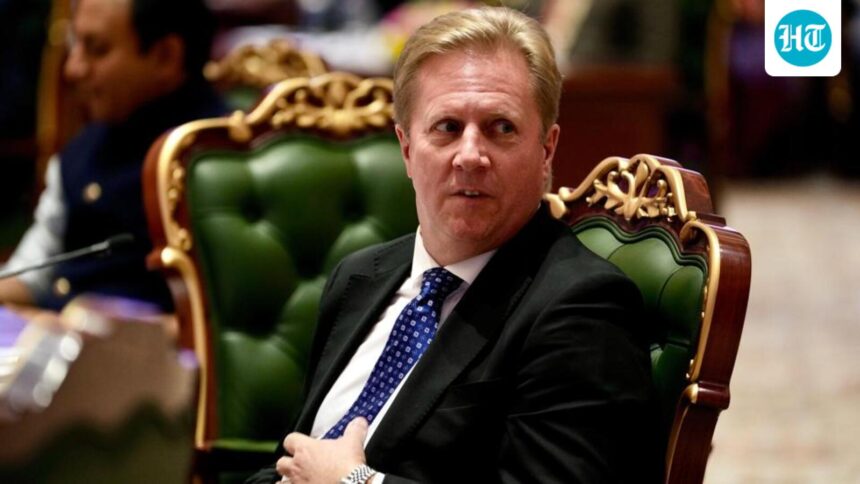
New Zealand Trade Minister Todd Maclay said on Monday that the free trade agreement signed by India and New Zealand will create certainty at a time when the global trading system is facing many challenges and will rapidly boost two-way trade from the current level of about $2 billion.

The FTA, which is expected to be implemented by the end of the year, is unlikely to face any hurdles despite opposition from some New Zealand political parties, Maclay told HT in an interview shortly after the deal was signed. He said the deal would also result in 5,000 temporary visas being granted to Indian professionals in sectors such as ICT, healthcare and construction. Edited excerpts:
How will the FTA change trade and investment relations between India and New Zealand?
Well, very significantly. If you look at our economy, our trade is down and out, and I think we’ll see that getting stronger. Whenever New Zealand signed a free trade agreement, two-way trade skyrocketed. We concluded an agreement with the United Arab Emirates a year ago; In the first six months, our two-way trade grew by 34%. We have a free trade agreement with the European Union; In the first eighteen months, an additional $2 billion in trade was done. I believe that the free trade agreement we have with India is of high quality, comprehensive, balanced and recognizes the sensitivities of both sides. I believe that two-way trade and investment will grow very rapidly and this will do nothing but bring our countries closer together.
Do you have a winning figure that you are looking to grow the business over the next five years?
Well, we haven’t done that yet. The models on both sides are very modest and rely on existing trade. But we know that when India entered into a free trade agreement with Australia, Australian exports rose by 50% to 100% in many areas in the first 12 to 18 months. I can see that happening very easily. But the most interesting thing is the exports of Indians to New Zealand. We are a country with a population of only five million people. Our number one trading partner is China, and we buy more than $20 billion worth of goods and services from China every year. From India, it’s only about $1 billion or so. New Zealanders love choice, competition and competitive prices. I think you will see an increase in exports from India, across the board, to New Zealand, just as New Zealanders will be looking to that market to be able to come and establish themselves and build long-term relationships and trade.
There has been criticism of the NZ First FTA, and Labor has also expressed concern about commitments on private investment. Do you think this will be an obstacle to implementing the agreement?
No, it won’t be. New Zealand and India are both democracies. We may be the first democracies in the world to believe in the parliamentary process. We also believe in open dialogue and freedom of expression. The agreement is 700 pages long and is very detailed and complex. So that’s right, the parties should understand that well. These are some of the discussions you’ve seen in New Zealand. But we have an overwhelming majority in Parliament to pass the free trade agreement with India. The two major parties are bipartisan when it comes to trade. As with most of our agreements, it will be passed into law very quickly and very easily. It’s very simple – New Zealanders love trade, we are a trading nation, and for a very long period of time New Zealanders have wanted to get a deal with India. In just nine months, we have negotiated one of the highest levels of quality [FTAs] Every country did. It will continue to be very beneficial for both sides.
Is there a time frame you are looking to execute the deal?
We hope that this will be done before the end of this year. Today we signed. Tomorrow, the agreement will be presented to our Parliament and will be subject to national analysis. It goes to a panel, where they ask for the public’s opinions. They report very quickly, it’s a fixed period of time. And then we have to put implementing legislation in place, which pretty much reduces the tariff rates on everything that India could export or wants to export to zero on day one, and puts in place some quota management systems and some other things. It’s not a very big piece of legislation. We will advance very quickly. It is a public parliamentary process, but we believe we can implement it before the end of this year.
How will a free trade agreement help as countries around the world deal with disruptions caused by U.S. trade and tariff policies?
Well, there is a lot of global uncertainty around trade. There are many challenges facing the global trading system, but a free trade agreement with India will help in two ways. First, it gives certainty. Today, the two governments put pen to paper to take rights and obligations. We have said publicly that we love each other and trust each other. The business community in each of our countries can now take this as a commitment, which reduces the risks. If you are investing effort or product in India or New Zealand, the rules are very, very clear. You can rely on it, and therefore you have certainty, not uncertainty. Secondly, it offers options for both India and New Zealand. Our job as a New Zealand government is to negotiate trade agreements and then New Zealanders decide where they want to put their efforts, based on where they think they will get a return or where they see the risks.
This is the ultimate strategy. We want to trade with many parts of the world. We have a lot of trade agreements, with India. Today, this means that Indians and New Zealanders can take on the commitments, build sustainable trade relationships, and we will see two-way trade grow very quickly.
Prime Minister Narendra Modi spoke of the free trade agreement leading to deeper global engagement. You said it would lead to economic security. You mentioned that you have a fairly large trade partnership with China, and there are those who believe that this free trade agreement could help reduce dependence on a particular geographic area.
For many countries, China is a very important partner and this is an important economic relationship between us. But we have concluded trade agreements over the past few years with the United Kingdom and the European Union [and] United Arab Emirates, completed [a deal] With the Gulf Cooperation Council, including with Saudi Arabia, we have many trade agreements and what that does is it allows for choice. I don’t think New Zealand is dependent on any part of the world, although oftentimes, relative to geographical location, we trade more with one part. It is not a question of saying that we prefer one country over another. We support New Zealanders to make those decisions themselves, but at the end of the day, trade agreements set very clear rules, and if you respect them, economies grow. As economies grow and people get richer, they have more choices. This is the basic essence of the India-New Zealand FTA – balanced, to give opportunities to businesses in both countries, and you will see a very significant achievement as a result of what we have negotiated and completed today.
The deal includes 5,000 temporary visas for Indian professionals. Can you shed more light on that?
We have agreed to create a special visa for skilled Indian professionals, where in our economy, we need the ability to work in New Zealand for three years. These are the areas that were We have a shortage of it. Some people have already come from India, but this is a special visa for India only. We will now put the details of that in place. For example, in the areas of healthcare or ICT, where India has a real advantage, it also comes down to engineering and construction – an opportunity for young, qualified Indians to work in New Zealand, gain some experience and come back home to continue to help build your economy. We see that as a win-win. These are modest numbers, although they are significant for New Zealand, but we need these people [as] It helps our economy grow. What it also does is bring people together, break down barriers, and create more friendship. We think it’s a very important achievement.
Does New Zealand plan to work with India and other regional partners to deal with disruptions caused by conflict in West Asia?
I think this trade agreement does that and we will bring it into force very quickly and then we should promote it and help our companies understand it. Some commitment on both sides will make trading much easier. We will bring more trade missions to India but we invite Indian companies to come to New Zealand. Some organizations [and] The companies were talking about what to do even before the agreement was signed. There is a real desire on our part and there are many areas in which we would like to work with India. We do that very well at the WTO already. There will be opportunities in the region, in the Pacific region. The conclusion of the FTA negotiations is actually the beginning of a much larger relationship, and what you will see across the board is not just greater engagement, but greater achievement together.