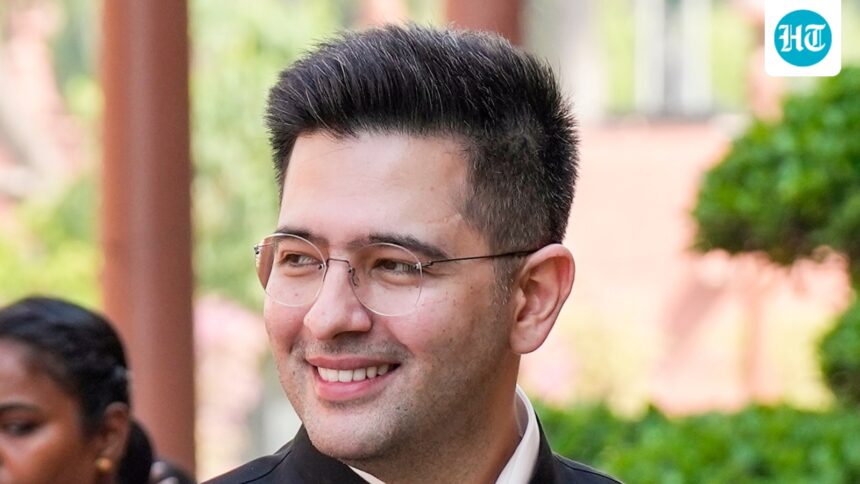
Raghav Chadha, the latest entrant to the BJP, said on Monday that he left the Aam Aadmi Party (AAP) due to a “toxic work environment”.

Member of Rajya Sabha He defected from the AAP along with six other leaders last week. CP Radhakrishnan, Chairman of the Upper House of Parliament, accepted their merger with the party. The AAP accused the departing leaders of “treason”. Chadha has now explained his reasons for his exit from the high profile in a video posted on Instagram.
“Some people want to know the reasons behind my decision,” he began, “so today’s video is for them.” Chadha said he joined politics after leaving a successful career as a chartered accountant. He said he was one of the founder members of AAP and devoted nearly 15 years of his “pioneering youth” to the party.
“I have given 15 years of my youth to this party. I have worked hard for this party with my blood, sweat and tears. But today, this party is not the old party. This party has a toxic work environment. You are out of work,” he said in the video.
He said the AAP had turned into a “toxic work environment”, where members were allegedly not allowed to function properly or speak freely. “You are banned from speaking in Parliament.”
He claimed that decision-making within the AAP had shifted into the hands of “corrupt and vulnerable” people. “This political party is now in the hands of some corrupt and compromising people. They are not working for the country, but for their personal gain,” he claimed.
I had three options: Raghav Chadha
Chadha said he considered three possible paths: leaving politics entirely, continuing within the AAP to try internal reform, or joining another political platform to “practice positive politics”.
“I felt like maybe it was me “The right man, but in the wrong party,” he said, describing his final decision as a collective decision taken by seven MPs who left together. The seven MPs are Ashok Mittal, Sandeep Pathak, Vikramjit Singh Sahni, Harbhajan Singh, Swati Maliwal and Rajender Gupta.
He said, “For this reason, I am not alone, not one, not two…but seven representatives decided to sever our relationship with this political party. One person could be wrong, two could be wrong, but not all seven.” “And these countless educated and intellectual people who were attached to the dream of this political party, and all these people who left this party, could they all be wrong?”
Chadha drew an analogy to explain his departure, saying people should “try to understand it that way,” and compared his experience in politics to a workplace scenario.
“If your workplace became a toxic place, if its environment became toxic, how much work would you be able to do? Would you be able to work there? If you were prevented from working there, if your hard work was suppressed, if you were silenced, what would you do?” He said.
He added that in such circumstances, “the right decision is to leave this workplace.” He also addressed public queries on whether he would continue raising citizens’ issues after joining the BJP.
“Many of you have asked me if I will continue to raise your issues… I want to assure you that I will continue to raise your issues with more energy and enthusiasm,” he said.
Raghav Chadha’s BJP has shifted under anti-defection laws
Replace Chadha before next year The Punjab elections have sparked a political row over the future of the AAP, after the BJP defeated the party, which had been dominant in Delhi for 11 years, in 2025.
Chaddha’s move has left AAP facing a serious numbers crunch after it lost seven out of 10 Members of Rajya Sabha. This development also raised the possibility of a protracted legal battle under the anti-defection law.
The Tenth Schedule of the Constitution allows legislators to change parties only if at least two-thirds of party members agree. It is a safeguard aimed at preventing politically motivated defections. If the threshold is met, MPs can merge with another party or act independently without losing eligibility.
In this case, the required number was seven representatives, and with the defection of Chadha and six others together, the group met the legal requirement.