The two words, which mean ‘traitor’ and ‘outsider’, are being used by multiple quarters simultaneously, with ‘Chadha’ causing the latest disintegration in the party currently ruling Punjab.

Two words have dominated political conversations in Punjab since Friday, when seven Aam Aadmi Rajya Sabha MPs announced they were leaving the party to merge with the BJP. One is ‘gaddar’ – a Hindi/Urdu/Punjabi word of Arabic origin meaning ‘traitor’. The other is “bahri”, which is of Persian origin and means “outside”.

Both words have a history beyond their origin as well, and both are being deployed by multiple political parties simultaneously, after Raghav Chadha caused the recent rupture in the party currently ruling Punjab.
How things happened on the ground in Punjab
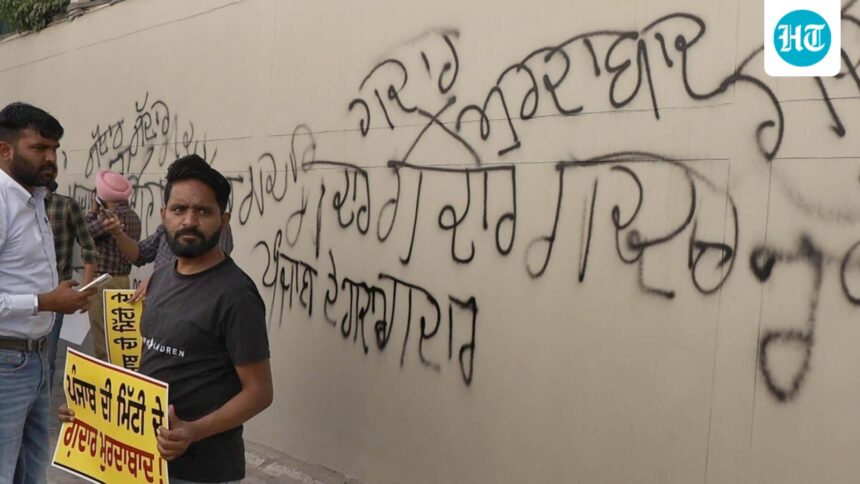
on saturday, AAP workers spray-painted the word ‘gaddar’ – though they used various spellings – on the outer walls and main gate of former cricketer Harbhajan Singh’s residence in Jalandhar; On the walls outside former AAP strategist Sandeep Pathak’s house in Ludhiana; And at the main entrance of the Phagwara campus of Lovely Professional University, owned by industrialist Ashok Kumar Mittal.
The demonstrators also raised slogans of ‘Punjab di Gadar’ (‘Traitors of Punjab) outside the residence of Rajinder Gupta, another industrialist sent to Rajya Sabha by Arvind Kejriwal’s party.
The AAP’s Punjab unit shared videos of the protests on
CM Bhagwant Mann, the comedian-turned-politician known for his pranks, used the same words — “traitors of Punjab — in Chandigarh on Friday. “These six or seven MPs were not the party. They were not mass leaders. None of them are able to even become a village sarpanch!”
Man Sabzi’s sarcasm, Chadha’s defence
He later posted on Facebook in Punjabi: “Ginger, garlic, cumin, fenugreek powder, red pepper, black pepper, coriander – these seven things together make a great dish, but they can’t make sabzi on their own.”
He described the entire issue as “Operation Lotus” engineered by the BJP, a popular term referring to the poll symbol of the ruling party at the Centre.
In Delhi, where the switch took place, AAP Rajya Sabha MP Sanjay Singh said: “Unless it is given to… [these leaders] By the public and AAP? We were stabbed in the back. The people of Punjab will not forgive this betrayal.”
“Some traitors have made a deal with the hard-earned blood and sweat of Punjab workers,” wrote Manish Sisodia, who posted on X from Gujarat, where he said he had been working for the party for three days. “Punjab never forgives traitors,” he added.
Kejriwal only posted one line, saying: “Punjabis have been betrayed.”

Raghav Chadha, for his part, rejected the ‘wall’ frame directly. “Those who say this – especially the Aam Aadmi Party leaders – we left out of fear: We left not out of fear but out of disillusionment with the party. We left not out of fear but out of disgust,” he told news agency ANI on Saturday. He called the party and its leaders “Corrupt and vulnerable.”
“Bahri” resonates in 2022 as well
the ‘Intruder The argument has a longer tail – going back specifically to March 2022, when the AAP won 92 of the 117 seats in the Punjab Assembly, and went on to fill Rajya Sabha nominations.
Two of her first choices drew immediate criticism: Chadha, a Delhi resident who is ethnically Punjabi Hindu, and Pathak, from Chhattisgarh.
The other candidates were Harbhajan Singh, and businessmen Ashok Mittal and Sanjeev Arora, all Punjabis but largely outside the political sphere or the RJD.
Navjot Singh Sidhu, then Congress leader, posted on X the same week, “New batteries for remote control in Delhi. It’s blinking.” He listed Harbhajan as an exception. Sidhu happens to be a former cricketer as well. “Betrayal of Punjab!” Sidhu wrote.
Aya Musiwala is back
Singer Sidhu Musiwala, who contested the 2022 Assembly elections on a Congress ticket from Mansa and lost, released a song titled “Scapegoat” in April 2022, days after the nominations were announced.
Two lines from it, in Punjabi – “Tell me who is responsible for what happened with the Rajya Sabha? People, tell me now, who is the traitor?” – It was posted without comment on Facebook on Friday by Musiwala’s father, Balkur Singh, hours after the defection was announced. The song, which has more than 65 million views on YouTube, was written by Musiwala, who was killed by gangsters in May 2022.
Palkur Singh used the same lines in a similar political context in 2023, when Sandeep Pathak made remarks on the Sutlej-Yamuna Link Canal issue that had drawn criticism in Punjab for allegedly giving Haryana a political toehold on the issue.
“I have known him since 2022.”
Opposition parties in Punjab said on Saturday that the defection was expected since the 2022 nominations.
“They have failed to curb corruption and are themselves deeply mired in it, with Rajya Sabha tickets said to have been sold out… People are not blind; they have already made up their minds long before the 2027 elections,” said Shiromani Akali Dal (SAD) leader Maheshinder Singh Grewal.
“The RJD has no ideology. This was normal,” said Amarinder Singh Raja Waring, president of the Punjab Congress, the main opposition party in the assembly.
He added:These representatives have no importance in Punjab. AAP must be kept informed that 50 MLAs may join BJP next!
Partap Singh Bajwa, Leader of the Opposition in the Punjab Assembly, described the defection as an internal power struggle for the AAP “rather than an ideological shift”.
Some criticism came from within the AAP as well.
said Malvinder Singh Kang, Lok Sabha Member of Parliament from Anandpur Sahib Indian Express On Saturday, the party had mistaken Chadha specifically.
“I feel the party has made a mistake by giving too much power. We should have kept an eye on Raghav Chadha, there are no two opinions on this,” he said. We have put Raghav Chadha on a pedestal.”
Kang also said he had personally observed Chadha interfering in CM Mann’s decisions – something the party has denied in the past when opposition parties dubbed Chadha a “super CM”.
Kang also said the party should have considered “ground-level leaders from Punjab” for the Rajya Sabha seats.
One remains, why did the others leave?
Of the AAP’s original seven Punjab MPs in the Rajya Sabha, only one remains: Balbir Singh Seewal, a Padma Shri award-winning environmental activist from Jalandhar district is known for organizing the clean-up of the 160-km-long Kali Bean river. No public statement has been made regarding the split yet.
Among the seven who defected, Rajinder Gupta is also a Padma Shri awardee, having received the honor in 2007 for his contributions to trade and industry. Oh. Gupta, founder of the Trident Group, was elected to the Rajya Sabha from Punjab only in November 2025, unopposed, after Sanjeev Arora switched to the state government as a minister and became an MLA.
When there is no strong ideology, “and people are selected on the basis of wealth, business background or influence… such attitudes are bound to rise,” said political analyst Harjeshwar Singh, professor of history at Sri Guru Gobind Singh College, Chandigarh.
Metal, for example He recently faced raids by the central agency ED on his businesses, after he was appointed deputy RS leader in AAP to replace Chadha.
What are the gains for the BJP, Bittu said
The Bharatiya Janata Party, which currently has two MPs in the 117-seat Punjab Assembly, welcomed the dissident MPs. Punjab BJP chief Sunil Jakhar said they “chose at the right time to leave the sinking ship of AAP”.
However, note that Union Minister Ravneet Singh Bittu – a BJP recruit from the Congress like Jakhar – only last week said there was “no need” for Chadha to join the BJP as he was “already doing the work he is doing”. He also mocked Chadha “The man who does the modeling” – a reference to Chadda walking the ramp at Lakme Fashion Week in 2022.
Bittu encountered the word “traitor” recently, when Congress leader Rahul Gandhi told him outside Parliament: “Hello, my traitorous friend.” Bittu and the BJP claimed that it was an insult to Sikhs.
The BJP has announced that it will contest the 2027 Punjab Assembly elections alone, a position stated by Union Home Minister Amit Shah at the Moga rally in March.
The BJP got about 19% of Punjab’s votes in the 2024 Lok Sabha elections, but did not win any seats. It now has six representatives from the state, surprisingly. The seventh AAP MP to make the switch is Delhi’s Swati Maliwal, who has had an ongoing dispute with Kejriwal for two years already.
AAP’s Punjab Youth Wing leader Parminder Goldie, who led a protest outside Rajinder Gupta’s residence on Saturday, said the BJP was “trying to destabilize” the party.
Meanwhile, the party has filed a complaint with the Rajya Sabha Speaker seeking the disqualification of the seven MPs. Legal experts have noted that the two-thirds threshold the group relied on would likely protect them from action under the law The Tenth Schedule of the Constitution.

Arish Chhabra is an associate editor on the Hindustan Times online team, where he writes news reports and explanatory features, as well as overseeing the site’s coverage. His career spans nearly two decades across India’s most respected newsrooms in print, digital and broadcast. He has reported, written, and edited across formats—from breaking news and live election coverage, to analytical long-reads and cultural commentary—building a body of work that reflects editorial rigor and a deep curiosity about the community for which he writes. Areesh studied English Literature, Sociology and History along with Journalism at Punjab University in Chandigarh, and began his career in that city, eventually moving to Delhi. He is also the author of Little Big City: What Life is Like from Chandigarh, a collection of critical essays originally published as a weekly column in the Hindustan Times, which examines the culture and politics of a city that is much more than just its famous architecture – and in doing so, holds up a mirror to modern India. During his stints at BBC, The Indian Express, NDTV and Jagran New Media, he has worked across formats and languages; Mainly English, as well as Hindi and Punjabi. He was part of the crack team for the BBC Explainer project which was replicated around the world by the broadcaster. At Jagran, he developed editorial guides and trained journalists on integrity and quality content. He has also worked at the intersection of journalism and education. At the Indian School of Business (ISB) in Hyderabad, he developed a website to streamline academic research in management. At Bennett University’s Times School of Media in Noida, he teaches students the craft of digital zine lism: from newsgathering and writing to social media strategy and video storytelling. Having moved from small town to larger town to megalopolis for education and work, his intellectual passions lie at the intersection of society, politics, and popular culture—a perspective that guides his writing and worldview. When he’s not working, he’s constantly reading long-form journalism or watching cerebral content, sometimes both at the same time.Read more