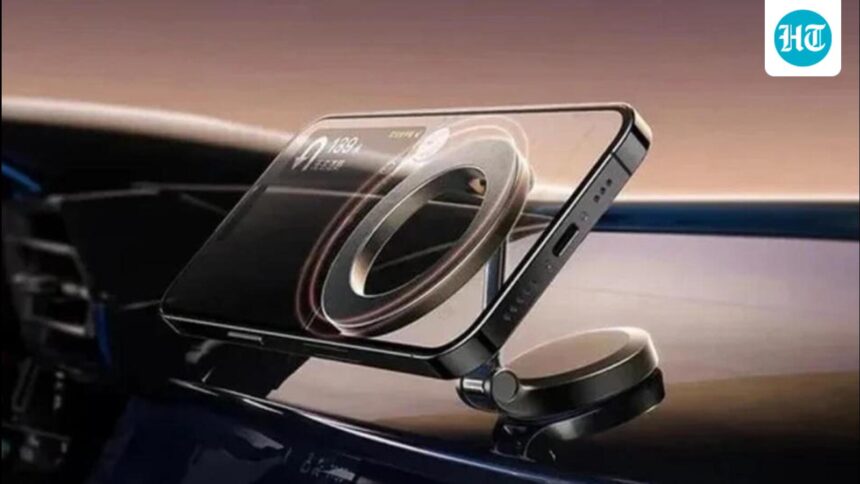
I wasn’t looking to buy a phone holder for my car. But Instagram snuck an ad for one of these into my feed. It showed a small device pressing against the car’s dashboard. The phone settled into place. Then boom: “It sticks anywhere.” It wasn’t a product demo, it was a demonstration of frictionless living. The brand was Auriglo.

Now, curiosity is an occupational hazard. You clicked on the ad, and it did what you’d expect from a modern direct-to-consumer (D2C) brand: clean design, deep discounts, and priced products, e.g. $5999 now available for $999, uniformly enthusiastic reviews, and the feeling that you’ve found something special and urgent.
Something about this product stuck, not because it was exceptional, but because there was a question that refused to go away: What exactly was I paying for? Since there were no answers, I reached out to Vaibhav Aggarwal, co-founder of Auriglo. The questions I asked him were the kind that technology journalists like to ask: about materials science, points of failure, sourcing practices, and the proximity between the D2C brand and white-label global supply chains.
For example, what is the hardness of silicon shore when the Indian summer temperature reaches 60°C inside a parked car? Is there any intellectual property that separates Auriglo from a cheaper version? And if sourcing is done through global B2B platforms, how can this be reconciled with the “delicate, handcrafted luxury” language that appears on their Instagram account?
Aggarwal responded frankly that Auriglo is not a patent-driven company. “We never claimed that.” But he pushed back on the quality questions: “A cheaper market version and $1,999 Auriglo holder is not the same product. They share a form factor, not specifications. We import materials higher in the specification hierarchy, at a significant cost compared to the cheapest standard available from the same suppliers, because the two things that determine whether the magnetic mount actually works over 18 months in Indian driving conditions are the strength of the magnet and the integrity of the vacuum seal. These are the specifications we refuse to compromise, even when cheaper levels are available from the same manufacturers.
This is the space that Origello is betting on. The same factory can produce completely different products depending on what the buyer is willing to pay for. Two products may look identical, but they behave very differently over time. Auriglo cares about quality.
But then, there are limits to this defense as well. Auriglo acknowledges that it has not conducted independent third-party stress tests under Indian conditions. They operate within supplier specifications and internal quality checks. “When our Instagram copy used ‘precise’ or ‘manually included’, that was a stretch, and I’ve reviewed and tightened it across our channels this week. Thank you for highlighting it live. Those adjustments had to be made, and they did.”
This is where the story becomes less about one brand and more about the system. The D2C ecosystem in India is not built on invention. It’s about identifying what can be sourced, improving it marginally, and selling it convincingly. So Instagram is not just a marketing channel; It’s your storefront, demo, and conversion engine. What Auriglo does is implement this cleanly.
They select from a global supply base, select higher specification levels, enforce a layer of quality control, and wrap them in a brand narrative that resonates with a specific consumer. This consumer is not necessarily looking for the cheapest option. They are looking for a decision that feels validated. “Auriglo’s differentiation versus white label equivalents is not engineering superiority. It is the specification class, the quality control discipline, the brand, the warranty and the service class,” says Aggarwal.
Which brings us back to the phone holder. Does it work? In controlled circumstances, very likely yes. Does it hold up over time, through cycles of heat, dust and the textured reality of Indian dashboards? The answer is less certain, not because Auriglo is uniquely flawed, but because the underlying technology has known limitations.
The more interesting question is whether this uncertainty matters. For a certain category of buyers, this does not happen. Buying is not just about functionality. It’s about comfort, ease of discovery, and the quiet confidence that comes from buying something that feels organized rather than worn out.
For another category of buyers, it is. They will look at the same product, recognize the shared DNA with cheaper alternatives, and conclude that the premium is unjustified.
Both positions are defensible.
This brings us to the difference between legacy retail and online retail. In the past the question was: Is this good? The new question is: Is this good enough, given how it got to me? Perpetual engineering has been trading on the altar of dopamine that well-targeted advertising offers. And somewhere in this transformation lies the real story – not the story of the phone holder, but the story of an economy that increasingly depends on the ability to capture attention and convert it into belief.
(Charles Assisi is co-founder of Founding Fuel. He can be reached at assisi@foundingfuel.com)