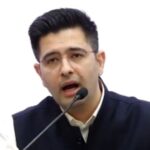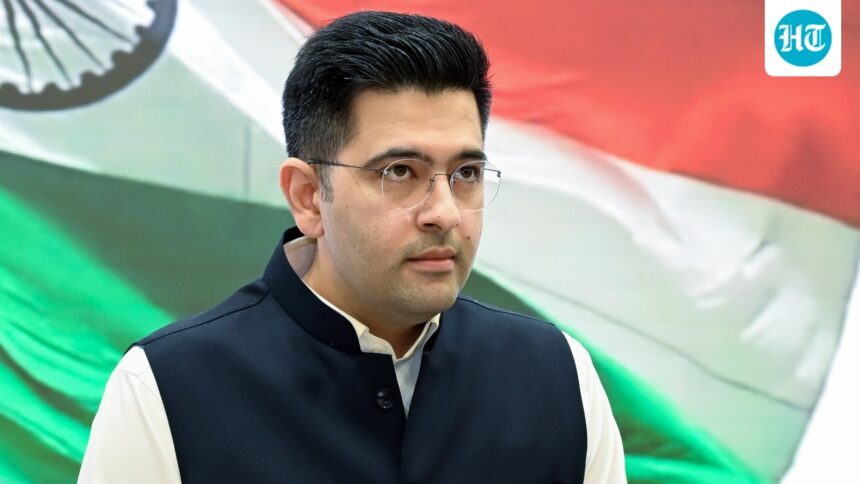
Raghav Chadha announced that the AAP has 10 Rajya Sabha MPs, seven of whom have now been “merged” with the ruling BJP at the Centre.

Days after his public spat with the Aam Aadmi Party, Rajya Sabha MP Raghav Chadha on Friday left the party he co-founded, “merging” with the ruling Bharatiya Janata Party at the Center – as did six other AAP MPs from the upper house of Parliament. The verb “merge” is important here.

Had Chadha quit the AAP on his own, he would have lost his Rajya Sabha membership under the anti-defection law. The general rule is that a legislator becomes disqualified if he or she renounces party membership, or votes against the party whip.
Number 7
But under the Tenth Schedule of the Constitution, a member of the Rajya Sabha is exempt from disqualification for anti-defection if two-thirds of the legislators belonging to his party agree to merge with another party.
AAP has 10 Rajya Sabha MPs, seven of whom – that is ⅔ – are gone now, Chadha announced, flanked by fellow Socialist MPs Sandeep Pathak and Ashok Kumar Mittal.
He said he received a letter to form a bloc and merge with the BJP from four other Rajya Sabha members of AAP.
Thus, he included himself, along with Mittal who was recently appointed Deputy Leader of the AAP in the upper house of Parliament in place of Chadha; Sandeep Pathak, Harbhajan Singh, Rajinder Gupta, Vikramjit Singh Sahni, and Swati Maliwal.
The three who have remained with the AAP, so far, are Sanjay Singh, Balbir Singh Seekhwal and ND Gupta.
Why couldn’t AAP fire him?
Chadha reiterated the constitutional stance in his post on
The law also stipulates that if a party dismisses a member of Parliament, it retains its membership; This is why AAP did not sack Chadha as he would have remained a member of the Rajya Sabha while being anti-AAP, unless the party can prove its anti-party activities which is a longstanding subjective issue that has to be decided by the Rajya Sabha Speaker.
Therefore, this impasse can be resolved if Chad can gather sufficient numbers. Which he did on Friday, April 24.
Great meaning for Punjab
Among those seven who changed sides are six MPs from Punjab, who were elected in 2022 after the AAP secured an overwhelming majority in the Vidhan Sabha elections there.
This starkly means that the AAP now has only one Punjab Rajya Sabha MP left: environmental spiritual guru Balbir Singh Seeshwal.
This is a major setback for the ruling party in the state, as there are only 10 months left for the Punjab Assembly elections.
All of them have a Rajya Sabha term of six years until April 2028.
Swati Maliwal has finally exited AAP
The seventh to resign is Delhi’s Swati Maliwal, who has been in public disagreement with the AAP leadership since 2024 but did not resign because she would have lost her membership. The party did not expel her because that meant she could remain a Rajya Sabha member nonetheless.
Maliwal needed a two-thirds group of AAP members in the House. This has become possible now as Raghav Chadha and others have come together to switch together. Maliwal term until 2030.
Who are the ones who left, and who are the ones who stayed
Brief biographies of AAP Rajya Sabha members who converted to the BJP reveal that many of these are essentially non-politicians or businessmen.
Raghav Chadha and Swati Maliwal are two activists who were part of the founding team of AAP in 2012 after their involvement in the anti-corruption movement faced by Anna Hazare.
Sandeep Pathak remained the party’s national general secretary and, along with Chadha, was credited with the Punjab victory. However, he was viewed as an ‘outsider’ when he was sent from the state to the Rajya Sabha.
Chadha, who is ethnically Punjabi but is actually from Delhi, was seen as an outsider to be rewarded by the party at the expense of local Punjabis.
Former Team India cricketer Harbhajan Singh remains an apolitical figure, while the party sought to show that the hero from Punjab’s politically inclined Doaba district – Jalandhar to be precise – commands respect for the Rajya Sabha seat. However, he has remained largely aloof on political issues, except for the occasional spat on social media over nationalist issues.
The man who replaced Chaddha also goes
Industrialist Ashok Kumar Mittal, who was appointed deputy leader of AAP RS in place of Chadha – the public breaking point between Chadha and AAP – also went with him to the saffron party. Mittal, founder of Lovely Professional University (LPU) and a sweets and car dealership empire, was recently raided by central probe agency ED over his sources of income. The party described the raids as a pressure tactic.
Vikramjit Singh Sahni is known as an industrialist and philanthropist, whose base has largely remained in Delhi, but he is active in social projects in Punjab.
Rajinder Gupta of Trident Group in Ludhiana is another businessman. He was elected in a by-election to the Lok Sabha just six months ago, in October 2025, after another industrialist, Sanjeev Arora, moved to the state Assembly and became a minister in Bhagwant Man’s regime.
Sandeep Pathak is an IIT congressman turned political activist like party chief Arvind Kejriwal, who was in-charge of Punjab.

Arish Chhabra is an associate editor on the Hindustan Times online team, where he writes news reports and explanatory features, as well as overseeing the site’s coverage. His career spans nearly two decades across India’s most respected newsrooms in print, digital and broadcast. He has reported, written, and edited across formats—from breaking news and live election coverage, to analytical long-reads and cultural commentary—building a body of work that reflects editorial rigor and a deep curiosity about the community for which he writes. Areesh studied English Literature, Sociology and History along with Journalism at Punjab University in Chandigarh, and began his career in that city, eventually moving to Delhi. He is also the author of Little Big City: What Life is Like from Chandigarh, a collection of critical essays originally published as a weekly column in the Hindustan Times, which examines the culture and politics of a city that is much more than just its famous architecture – and in doing so, holds up a mirror to modern India. During his stints at BBC, The Indian Express, NDTV and Jagran New Media, he has worked across formats and languages; Mainly English, as well as Hindi and Punjabi. He was part of the crack team for the BBC Explainer project which was replicated around the world by the broadcaster. At Jagran, he developed editorial guides and trained journalists on integrity and quality content. He has also worked at the intersection of journalism and education. At the Indian School of Business (ISB) in Hyderabad, he developed a website to streamline academic research in management. At Bennett University’s Times School of Media in Noida, he taught students the craft of digital journalism: from newsgathering and writing to social media strategy and video storytelling. Having moved from small town to larger town to megalopolis for education and work, his intellectual passions lie at the intersection of society, politics, and popular culture—a perspective that guides his writing and worldview. When he’s not working, he’s constantly reading long-form journalism or watching cerebral content, sometimes both at the same time.Read more