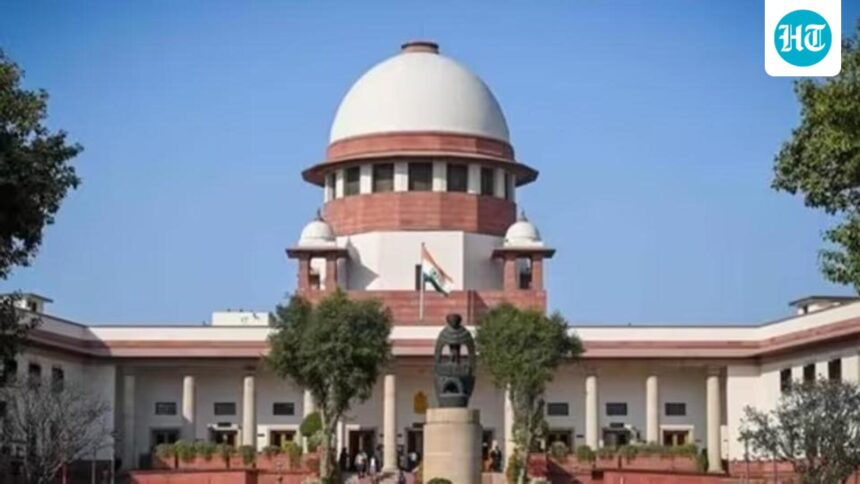
The Supreme Court on Friday lauded the over 92% voter turnout in the first phase of the West Bengal Assembly elections, stating that democracy is strengthened when citizens actively exercise their right to vote.

A bench comprising Chief Justice of India (CJI) Surya Kant and Justices Joymalia Bagchi and Vipul M Pancholi made the remarks while hearing a batch of petitions challenging the Special Intensive Review (SIR) of the electoral roll in the state.
“As an Indian citizen, I was very happy to see what percentage of people… realize their power in democracy through their ability to vote. So, when people exercise their right to vote, it strengthens the democratic structure,” the ICJ said, describing Thursday’s vote turnout of 92.25% as “good.”
The court also noted the relative absence of violence during polling, a recurring concern in the state’s electoral history. Justice Bagchi noted that “almost no violent incidents occurred,” prompting the bench to stress the importance of peaceful democratic participation.
“When people recognize their power to vote, they do not indulge in violence,” the ICJ observed, with Solicitor General Tushar Mehta joining senior lawyers Kalyan Bandopadhyay and Menaka Guruswamy, who represent the petitioners in the case, in hailing the turnout as “historic”.
The first phase of polling on Thursday covered 152 of the state’s 294 constituencies, including key areas of North Bengal as well as districts like Murshidabad, Nadia, Birbhum and Hooghly. This phase is being closely monitored in terms of electoral trends, especially in politically important seats like Nandigram.
Even while acknowledging strong participation, the body has refrained from intervening directly in grievances arising from the SIR exercise, which has led to widespread deletions from the electoral roll.
Senior advocate Kalyan Bandopadhyay noted that only a small portion of the appeals, 139 out of nearly 2.7 million appeals, were approved for voting on Thursday, demanding urgent intervention. The court asked the parties to approach the Chief Justice of the Calcutta High Court to take administrative measures to expedite the hearings.
“We have already asked the courts to address such matters outside the scope of their role, taking into account their urgency,” the bench said, stressing the need to use the established appeal mechanism effectively.
The SIR led to the removal of more than 9.1 million from the electoral roll in West Bengal, resulting in a nearly 12% drop in voter numbers ahead of the elections. Districts such as Murshidabad, Nadia, Malda, Cooch Behar and Uttar Dinajpur have reported widespread deletions, raising legal challenges.
Earlier, invoking its powers under Article 142, the Supreme Court had directed that voters whose appeals were allowed by the appellate courts at least two days before polling would be put back on the list through supplementary lists, enabling them to vote. At the same time, the court made clear that simply continuing appeals would not entitle individuals to vote, balancing concerns about election integrity with the right to vote.
In a related appeal, some electoral officers approached the court alleging that their names had been deleted from the rolls despite being assigned polling responsibilities.
Appearing before the petitioners, senior advocate M. R. Shamshad said that about 65 officers were affected, as their voter ID numbers were no longer valid, depriving those conducting the elections of their right to vote.
The authority refused immediate relief and directed them to resort to the courts of appeal. “The most valuable right to remain on the lists will be preserved,” Judge Bagchi said, acknowledging that they may not be able to vote in the ongoing phase.
The court postponed the case for at least a week, given that the second phase of the elections is scheduled for April 29.
The proceedings unfolded in a flurry of petitions challenging the SIR in West Bengal, an unprecedented exercise that saw judicial officials adjudicating more than six million claims and objections – all identified by ECI under the controversial logical inconsistency category – on a compressed timeline.
To address concerns about wrongful exclusion, the Supreme Court had earlier established a two-tier appeal mechanism. Persons excluded from the list can approach first the judicial officers, and then the Courts of Appeal, which include former Chief Justices and senior judges of the Supreme Court.
The April 16 order allowing people cleared by the appellate courts to vote gained significance because the state’s first and second phase electoral rolls were frozen on April 6 and April 9 respectively, effectively disqualifying those whose claims were not adjudicated in time. At that time, the two tribunals were barely functioning, and only two names were acquitted. The court’s intervention thus created a narrow but crucial window for their inclusion.