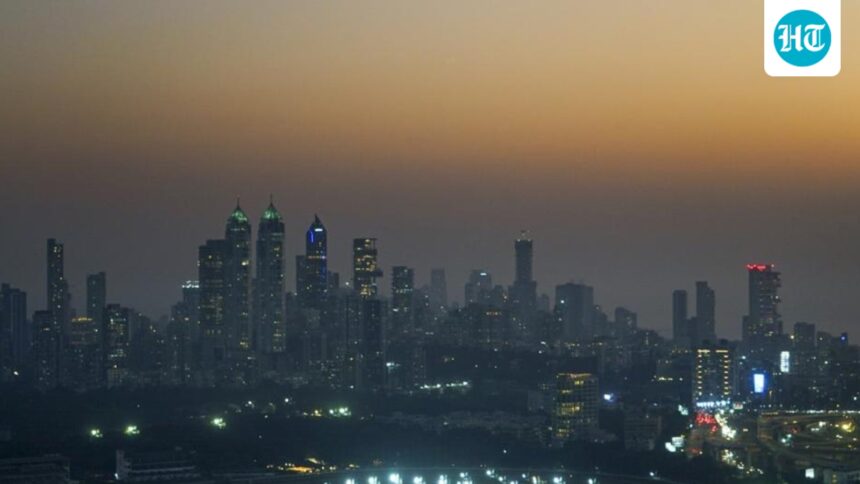
With a budget of one million dollars (approx $9.4 lakh crore) now buys less property in Mumbai than it did five years ago, underscoring the city’s deteriorating affordability, even for the affluent.

But this is not the case in India’s two other cities, Delhi and Bengaluru, where the area of purchasable properties increased by $1 million in this period, even if marginally. These are the results of the 2026 Wealth Report, which was released by international real estate consultant Knight Frank on Thursday.
The report reveals that in Q4 2025, 96 sq m (1,033.33 sq ft) of properties were purchased in Mumbai for $1 million, down from 106 sq m (1,140.97 sq ft) in Q4 2020. This decline in purchasing power was driven by limited land availability, coastal restrictions and strong appeal of global investors, the report said.
In contrast, affordability has improved in other metro areas. In Delhi, the $1 million purchasable area increased slightly from 202 sq m (2,174.30 sq ft) in Q4 2020 to 205 sq m (2,206.60 sq ft) in Q4 2025. Bengaluru saw a similar trend, with purchasable area increasing from 351 sq m (3,778 sq ft) to 357 sq m (3,842 square feet) during the same period.
Mumbai remains the center of wealth in India, accounting for 35.4% of the country’s wealthy population. The report noted that the 38% expansion in India’s GDP over the past five years has accelerated the process of wealth creation, especially in technology, industry and capital markets. In 2025 alone, the city recorded 56 new residential transactions in the sector worth more than $5 million.
Read also | Rohit Shetty is being targeted by Lawrence Bishnoi’s gang over the director’s ties with Salman Khan, says Mumbai Police
Compared to other cities globally, Mumbai’s 9% decline in purchasable area for $1 million between 2020 and 2025 is not a steep decline. The report data shows that Dubai recorded the largest decline of 66%, followed by Tokyo (41%) and Miami (40%). In contrast, London saw a 7% increase, while Melbourne posted a modest 4% gain and Hong Kong remained flat.
Super-rich residents
Between 2020 and 2025, the number of individuals worth more than $30 million rose sharply by 63%, from just over 12,000 to 19,877. This makes India the sixth-largest market for ultra-high-net-worth individuals (UHNWI) globally. A high net worth individual is one who has at least $30 million in investable assets, excluding personal assets such as primary residences and collectibles.
Looking ahead, Knight Frank’s wealth scaling model projects a further 27% increase in India’s wealthy population, rising from 19,877 in early 2026 to 25,217 by 2031.
“Mumbai’s continued dominance of India’s UHNWI landscape reflects a deeper structural shift in the country’s wealth creation cycle,” said Shishir Baijal, International Partner, Chairman and Managing Director, Knight Frank India. “Mumbai, in particular, benefits from its role as India’s financial nerve centre, where proximity to business, lifestyle and prime real estate creates a strong value proposition,” he added.