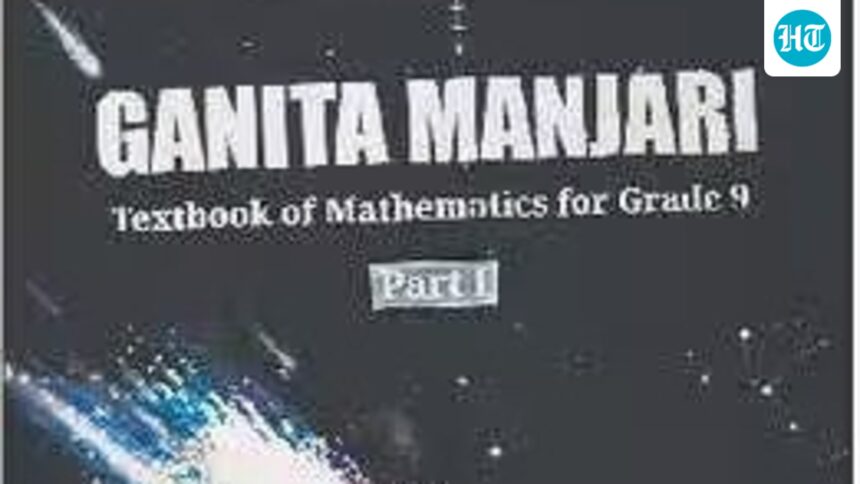
The new class 9 mathematics textbook released by the National Council of Educational Research and Training (NCERT) describes the Indus-Sarasvati civilization as having the first systematic use of grid-based thinking, says Ujjayini (Ujjain, Madhya Pradesh), whose central meridian is the ancient world’s meridian, and credits the Rigveda with paving the way for the modern number system.

The 196-page textbook titled Janita Manjari Part I – which prominently displays ancient mathematics techniques and the works of several ancient Indian scholars – was released on Tuesday.
The previous book contained only limited references to ancient India. But the new book integrates the Indian Knowledge System (IKS) extensively and begins with a verse from the Vedanga Jyotisha, which according to NCERT is “among the world’s oldest texts on astronomy.”
Read also | NCERT launches new science book for class 9th
The textbook credits the ancient Indian mathematician Buddhayana with “laying the foundation of coordinate geometry” and states that while the 14th-century mathematician Madhava “generated the field of mathematics, known as calculus,” the ancient Indian thinker Brahmagupta “formalized the idea and use of zero and negative numbers as algebraic entities.”
The former ninth-grade mathematics textbook cited the Indus Valley Civilization, highlighted the “highly developed and extremely well-planned” cities and practical use of measurement, and referred to the Sulpasutras — “guides to geometric constructions” — from the Vedic period used to build ritual altars. However, the text described these developments as largely “practically oriented” and “unsystematic.”
The “grid-based thinking” and geometry required to determine the locations of points in space “already have deep roots in the Bharat region,” the new textbook says, where the first systematic use of grids occurred thousands of years ago “on a massive urban scale — in the Indus-Sarasvati civilization, where city streets were built with astonishing precision…and this was a coordinate system in practice.” The textbook states that Buddhadhayana later used the east-west and north-south lines in his “deep geometric constructions, developing the Buddhayana-Pythagorean theorem, and thus laying the foundation for coordinate geometry.”
Read also | The now-deleted chapter on judiciary from NCERT was a team effort, the professor tells the Supreme Court
A paragraph in the same chapter states: “Ujjayini was described in the ancient world at least as early as the 4th century BCE in the early Siddhantas – as the point defining the central meridian from which all other locations were measured.”
The chapter also states that it would be “impossible” to study the four-quadrant Cartesian planes without the work of Brahmagupta in which he “formalized the idea and use of zero and negative numbers as algebraic entities.”
The discovery of zero was not discussed in the old textbook. The new textbook traces the origins of zero to ancient Indian thought, noting that the Rigveda “paved the way for a number system based on powers of 10.”
He adds that the development of place value “paved the way” for “the concept of zero,” described as “perhaps the most important mathematical invention.” In contrast to other civilizations such as the Babylonians and Mayans who used placeholders, the book credits Brahmagupta with transforming space into number, a “huge leap” influenced by Indian philosophical traditions.
The textbook links the concept of zero to philosophical traditions, noting that in the Upanishads and Buddhist literature, shunyata or “emptiness” was a “deep state” associated with meditation and stillness. He explains that shunya (zero) and “zero” reflect the idea of “emptying the mind.”
Read also | NCERT has been given university status and is considered by the Center to award its own degrees
The text adds that the idea of “nothingness as a concept” developed beyond philosophy and eventually entered mathematics through the works of Aryabhata and Brahmagupta. “Thus the philosophical concept of the void in mathematical zero crystallized,” he says.
While the old textbook briefly referred to Aryabhata’s work in a chapter on number systems, the new textbook states that in 499 AD, the ancient mathematician introduced the value 62832/20000=3.1416 for π and described it as “asana i.e. ‘approaching’ or ‘approximating’ – a profound insight indicating that the ratio cannot be given exactly as a single simple fraction.”
The new textbook states that Brahmagupta proposed the use of 3.1622 for π which “…became the dominant approximation in the Arab world and medieval Europe for centuries thereafter.”
The textbook also states that Madhava’s formula presented in the form of an “infinite series” was a “radical shift in mathematics.”
“By moving from the geometric cutting of circles to the analytical addition of numbers, Madhava created the field of mathematics known as calculus. His infinite series enabled him to calculate π to 11 decimal places (3.14159265358), proving that the relationship between the circumference of a circle and its diameter was a window into an entirely new field of mathematics,” the textbook states.
The old textbook had stated that “the Greek genius Archimedes was the first to calculate numbers in the decimal expansion of π.”
In the introduction, NCERT Director Dinesh Prasad Saklani wrote, “This textbook also highlights the rich history of mathematics in India, spanning thousands of years. By learning about mathematical developments in India and around the world, students can develop a deeper sense of cultural rootedness…”
In line with the National Curriculum Framework for School Education (NCFSE) 2023 and the National Education Policy (NEP) 2020, the textbook has been developed by a 26-member Textbook Development Team (TDT), including Professor Manjul Bhargava from Princeton University, who also serves as co-chair of the 20-member National Curriculum and Teaching Materials Committee (NCTC).
The first part, consisting of eight chapters, will be implemented from the 2026-27 academic session, replacing the previous Grade 9 Mathematics textbook that was first published in 2006 and later reduced from 15 to 12 chapters in 2022-23.
Some experts disagreed with the textbook’s claims.
Buddhayana’s statement on the Pythagorean theorem was neither in terms of coordinate systems nor even in terms of lengths, but in terms of areas, said Professor S G Dhani of the UM-DAE Center of Excellence in Basic Sciences (CEBS), University of Mumbai. “So the similarity drawn here is completely false,” he said.
Amber Habib, professor of mathematics at Shiv Nadar University (SNU), Noida, has questioned some of the claims about Brahmagupta. He added: “It is wrong to portray Brahmagupta as the creator of negative numbers. Chinese mathematicians were using negative numbers to solve systems of linear equations a thousand years before Brahmagupta.”
Habib said the work of Madhava and other scholars was a major precursor to modern calculus. “However, this was not an early development in this field. This distinction is widely attributed to the Greek mathematician Archimedes, nearly 16 centuries ago.”