The high-octane campaigning for the Tamil Nadu Assembly elections for 152 seats in West Bengal ended on Tuesday, with the National Democratic Alliance making a strong push to penetrate opposition strongholds in the southern and eastern parts of India.

Voting for the second phase of 142 seats in West Bengal is scheduled to take place on April 29. The votes will be counted on May 4, along with those from Kerala, Tamil Nadu, Assam and Puducherry. Sporadic clashes broke out in Bengal.
Last week, election campaigns in the two states centered around the Constitution Amendment Bill, which aimed to expand the lower house of parliament (Lok Sabha) to implement 33% reservation for women but failed to get the required two-thirds majority. The Bharatiya Janata Party (BJP) accused the opposition – especially the Trinamool Congress (TMC) and the Dravida Munnetra Kazhagam (DMK) – of conspiring against women. The Opposition alleged that the BJP was trying to impose demarcation of assembly boundaries and Lok Sabha seats under the guise of reservation for women. In Tamil Nadu, Prime Minister M K Stalin, All India Anna Dravida Munnetra Kazhagam (AIADMK) general secretary Edappadi Palaniswami, Prime Minister Narendra Modi and TVK chief Vijay intersected between the 234 seats.
Modi criticized the DMK and Congress for “obstructing the women’s reservation bill”.
“A noble effort has been derailed because of the DMK and Congress,” he said and sought to know why the DMK and Congress were “bothered” to see “ordinary women rising up”.
Also read: Saffron shadows silent, vision scattered: TMC leads BJP on one front in Bengal battle | Ground report
Palaniswami, who heads the NDA party in the state, asked people to oust the “corrupt DMK regime” and end “dynastic rule” in the state. The AIADMK targeted the DMK over dynasty, deteriorating law and order, heavy debt burden, alleged spread of drugs, and lack of safety for women and children.
Contesting from Kolattur in Chennai, Stalin repeatedly accused the Center of not allocating funds to the state, not allocating metro rail projects to Madurai and Coimbatore, and trying to impose Hindi under the guise of the National Education Policy.
Stalin had threatened a nationwide agitation over the Constitution Amendment Bill on expansion of the Lok Sabha. He accused Modi of trying to use the bill as a “weapon” against the opposition.
“For the past five years, people have placed their trust in me as Prime Minister, and I have risen to the occasion by distributing welfare aid and even defending the interests of the state,” Stalin said.
Also Read: Bengal Assembly Elections: Congress hopes to regain lost ground in 4 districts
“During the Assembly elections in 2021, people said that Stalin is more dangerous than Kalaignar. He can never be compared. I have addressed him more as a leader than a father. One thing comes to my mind when they say that. I will always remain a danger to those who want to cheat Tamil Nadu and hinder its growth,” he added in a video message.
During the campaign, Narendra Modi and Shah targeted the DMK and alleged that it was only interested in family rule rather than public good, and that law and order was deteriorating under the DMK. Tamil Nadu has 57,343,291 voters, including 28,030,658 men and 29,304,905 women.
In Bengal, the campaign revolved around the controversial Special Intensive Review (SIR) of electoral rolls, corruption, and the dietary choices of voters in West Bengal, as the fish-eating habit of Bengalis moved from humble home dishes into politics.
Reports of violence – including on the final day of campaigning for the first phase – marred the run-up to the polls on Thursday. “There have been some incidents. Necessary action is being taken,” Manoj Agrawal, the state’s chief electoral officer, told the media. Reports of political violence poured in from Durgapur in West Burdwan, Dantan in West Midnapore, and Kanning in South 24 Parganas. While Durgapur and Dantan go to the polls on Thursday, elections will be held in Canning in the second phase on April 29.
There were no reports of any death or serious injury.
Voting is scheduled to take place on Thursday in 152 assembly constituencies across north Bengal, most of which are BJP strongholds, and several areas in the southern part of the state, where the TMC is considered to be in a better position. About 36 million voters qualify at this stage.
At least 2,450 companies of central paramilitary forces comprising nearly 250,000 personnel have been deployed by the Election Commission (EC) to conduct the elections in two phases in Bengal.
On the last day, Home Minister Amit Shah issued a warning to the ruling party at its first rally in Darjeeling hill district.
“The EC has sent Central Armed Police Forces (CAPF) this year. Any violence will not be tolerated. No one can touch BJP workers,” Shah said in Kurseong. Shah also promised that the names of the Gurkhas that were allegedly deleted during the special intensive review of electoral rolls would be restored if the BJP forms a government in Bengal.
Also Read: Why Dhaka is closely monitoring the Bengal elections
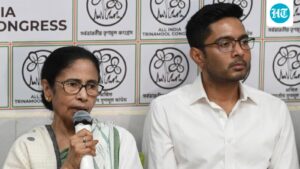
In West Burdwan’s Kulti district, a mining belt, Shah promised that all leaders accused of corruption would be behind bars after May 5. “Mamata is only worried about Baipu (his nephew). After the elections, she will put Baipu in her seat but her dreams will never come true,” Shah said, without naming TMC national general secretary Abhishek Banerjee.
In Lalgarh in Jhargram district, Abhishek said: “People are watching how a chief minister, a home minister, a host of central ministers, chief ministers of dozens of states, the EC and the CAPF are all here to stop just one woman. She is facing them alone.”
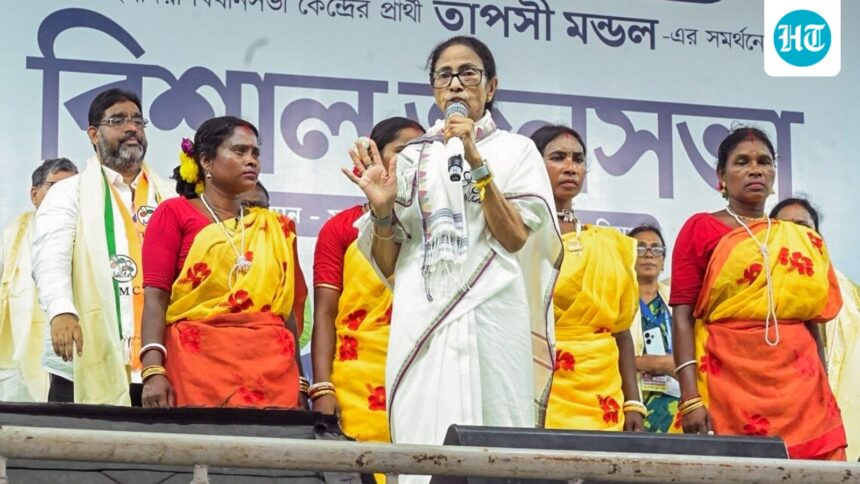
In all the rallies she addressed on Tuesday, Chief Minister Mamata Banerjee claimed that Bengalis will no longer be allowed to have fish and meat if the BJP comes to power. BJP central leader Anurag Thakur Banerjee faced off in Kolkata over having fish curry and rice with BJP workers.
In Tamil Nadu, 4,023 candidates representing various political parties are competing for the 234 Assembly seats. The DMK is led by the Secular Progressive Alliance (SPA) and the AIADMK is led by the National Democratic Alliance. The DMK is contesting 164 seats with 70 remaining for allies including Congress. The AIADMK is contesting 169 seats, while the remaining 65 seats are being shared with allies including the BJP, which is contesting 27 seats. The election also sees the entry of actor and politician C Joseph Vijay, whose party is contesting all 234 seats.