An Amazon package arrived at my door a few days after the Eaton and Palisades fires. It contained a small air purifier, sent by friends who were concerned about the city’s air quality. She emphasized that despite my address on the Miracle Mile, I was not immune to the consequences of the fire. Even if I couldn’t see or smell them, microscopic particles were being blown across the state by strong winds that would enable the fires to burn 38,000 acres, incinerating 16,000 buildings along with their contents — Hoka Bondi, Tesla car batteries, Magna tiles, Vitamix blenders, iPads, Stanley cups, HiSport pants — the stuff of 21st-century life. This air purifier is still running, and every filter we change reminds us that nothing in the device, designed to keep me safe, is recyclable. It’s a microcosm of the dilemma facing homeowners as rebuilding slowly begins across the city. How do we weigh sustainability versus personal safety, durability versus the future of the planet, and convenience versus conscience? As interior designer Oliver Furth asks: “Isn’t the most sustainable choice the one that survives?”
Architect Dustin Brammell, founder of Case Study: Adaptation, a program created in response to the fires, is on board. His reconstruction uses RSG-3D, manufactured from layers of wire-reinforced foam sandwiched between wire mesh with a shotcrete exterior. I am surprised by the inclusion of concrete, which is generally thought to have a detrimental effect on the atmosphere. “It’s a balancing act,” Bramell admits. “Although concrete has slightly higher levels of embodied carbon to begin with, building with it ensures that our home will be incombustible, earthquake-resistant and energy efficient, allowing embodied carbon to be amortized over centuries, not decades.”
How long it will take to build the project and how much waste it will generate also affect the homeowner’s decision. Builder Bevyhouse is trying to address these concerns by rethinking the entire building process, combining the efficiency of factory construction (also known as prefab construction) with the beauty of a custom home. Founder Brian Henson compares them to children’s building blocks. “We fabricate the interiors, the boxes that make up the home’s rooms, in the factory while the foundation is poured on site. We deliver them, put them in place and finish construction on site, adding decks, garages and details.” YellowstoneJosh Lucas, who watched his home installed, was impressed. “Seeing the pieces fit perfectly together, already plumbed and insulated, puts you five months ahead of traditional construction.”

Henson’s experience with the Santa Barbara, Montecito, and Malibu fires and his background in sustainability (he taught classes at UC Santa Barbara) influence his approach to construction: Ventless attics and crawl spaces—which protect the home from flying embers—are standard. Customers are encouraged to add energy recovery ventilators, which replace stale air with fresh, filtered air, reducing the load on the HVAC system. Instead of wood, homes are built of fiber cement boards. The multi-purpose material — a mixture of cement, sand, and cellulose fibers that is non-combustible, fire-resistant and considered sustainable because of its longevity and low maintenance — also won the admiration of architect Barbara Bestor, whose client list includes heavyweights such as Michael Govan, CEO of LACMA, and Oscar-winning composer Ludwig Göransson. Bestor admires his versatility: “You can do asides, you can do novelty, you can do short stories.” Bestor and architect Tim Barber, who counts Matt Dover and Ramin Djawadi as clients, use Densdeck ceiling panels and Densinglas panels, matte fiberglass gypsum boards considered sustainable due to their durability and recycled content, in their work. “It also adds additional, invisible layers of fire protection,” Barber notes.
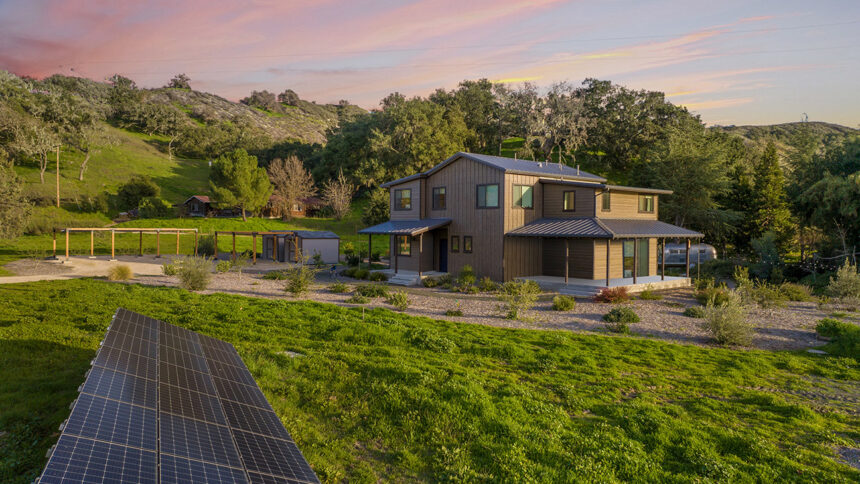
Some architects, including William Hefner, replaced wooden framing with steel, which is fireproof, recyclable, and durable. “My clients want to live and build in more energy-efficient and conscientious ways,” Hafner asserts. While the ban on gas appliances has been lifted for homes being rebuilt, he is preparing for the future by installing solar panels and electrical systems: heat pumps that, despite their name, also cool the air, water heaters, dryers, and induction cooktops. Interior finishes have also undergone a recalibration with interior designers and clients focusing on B-Corp brands (companies certified by the independent, non-profit B-Corp Lab to meet their high standards for environmental and social responsibility) such as Alkemis single-coat metallic paints, Fireclay locally made tiles, Armadillo natural fiber rugs and Parachute bedding. Rachel Pollock of Lawn points out that even small moves, such as multi-paned windows, can make a big difference in a home’s energy efficiency and its ability to withstand fires.
“My vision is not just to rebuild structures; it is to take our communities back for another century,” says architect Mai Song, expressing a sentiment that underscores all conversations about rebuilding. Isn’t this the sustainability we’re all after?
This story appears in “Hollywood Reporter”Sustainability issue for 2026. Click here to read more.