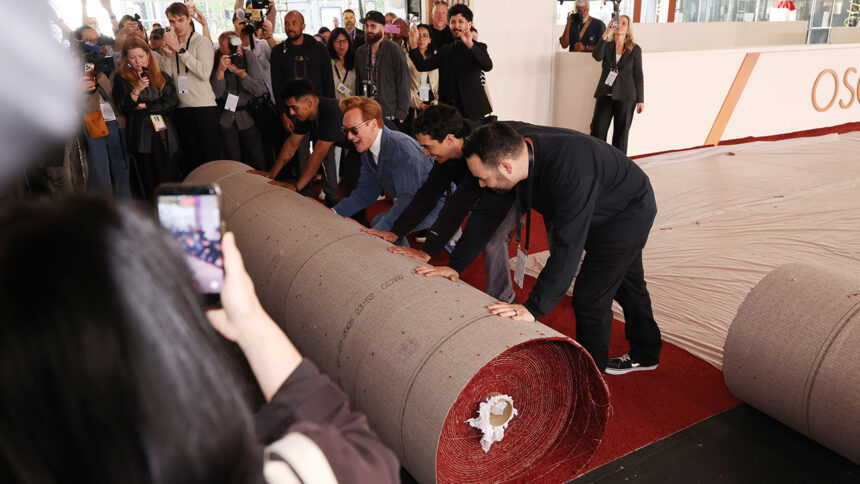
The red carpet received a lot of attention at the Oscars this year, but it wasn’t just because of who was walking around on it.
On March 16, the day after the 2026 ceremony, production assistant Paige Thalia posted a TikTok video of herself arriving at the Dolby Theater. When the crew dismantled the award show setup, she hoped to take a piece of the rug home to use as a rug in her apartment. The video follows her stumbling through trash cans that have rolls and rolls of the Oscars red carpet inside and pulling one section back into place as precious new decor (after a good vacuuming).
The TikTok app quickly went viral, garnering more than 6 million views, with hundreds of commenters expressing their shock and horror that an Oscars carpet would only be used for a few hours and then thrown away. Suddenly, the Academy found itself under attack on social media as another ugly example of Hollywood’s wasteful ways.
As it turns out, though, there’s a little more to the story.
For starters, trash cans filled with Oscars red carpet material were on their way for recycling, confirms Rob Theis, co-director of CARE’s California program (Carpet Recovery Efforts of America). says Theis THR that CARE has worked with Event Carpet Pros Inc., which supplies the Oscars carpets, for the past four years; From Dolby, the carpet is transported to the Los Angeles Fiber Carpet Recycling Center in Vernon, where it is broken down into pellets. These carpet beads can be made into about 125 different products, including computer cases and car parts, Theis says.
The Academy adds that the Oscars carpet itself is made from recycled materials.
Unfortunately, this kind of environmental awareness is not the norm. Hollywood holds hundreds of events every year — premieres, galas, FYC events — and more often than not those red carpets don’t get recycled. More often than not, they end up in the trash, especially those with custom designs, logos, and pieces that make them difficult to reuse.

“A lot of people still don’t know that carpets are recyclable,” Theis says. CARE supports more than 179 public carpet drop-off locations throughout California (which is well ahead of other states in this initiative) and collects 80 million to 90 million pounds of carpet annually, but most of that comes from residential sources. So he’s gunning for Hollywood, too, having already struck a deal to recycle carpets for next year’s Super Bowl in Los Angeles, in addition to his work with the Oscars. But because entertainment events are so fragmented — with different studios, broadcast companies, event planners, and carpet companies involved in each — there has been slow movement to organize the carpet recycling system for the larger industry.
“Quite frankly, it’s really low on the totem pole when it comes to dollars and cents on the front side and making sure production runs smoothly,” Theis explains. “When it comes to breakdown, it’s just ‘get it out of here, move on to the next,’” he admits, and it’s “not a glamorous thing” to think about.
Sheila Morovati, founder and CEO of the environmental nonprofit Habits of Waste and a longtime advocate for making Hollywood more sustainable, points out that carpet doesn’t necessarily need to be broken down into pellets for reuse. She points out that rugs can easily be donated to schools or homeless shelters after their big moments. Or perhaps more likely in the bottom-line-driven entertainment industry, she suggests studio storage facilities — much like warehouses used for costumes — where “the red carpets can sit and live and be clean and ready to be installed. And then they roll them back up and take them back to these warehouses so the studio holds them,” saving the cost of getting a new carpet for each event.
Debbie Levine, CEO of the Environmental Media Association, also advocates for the increased use of rentals: “I don’t see why renting a rug wouldn’t be the perfect solution because then it’s constantly being reused. They have all the colors in the world, and you don’t really need a logo on the rug because [photographers and press] Don’t shoot that. “There are a lot of materials that go into making carpet, and not all of them are made of the best materials, so at least if you use them 50 times, you might feel better about it,” she adds.
It will, of course, take a little more thought and planning to make this happen, which can be a tough ask for a company that focuses more on large on-camera backgrounds rather than on how to get rid of the background properly afterwards. But, as Theis points out, disposal is key, especially for carpet materials that “don’t decompose for 100 million years; don’t produce methane; can’t be harvested for energy. It’s just runaway material filling up our space.”
“We have to think about our future, or our children or grandchildren, and what we are leaving behind,” he continues. “How many landfills do we have covered, and how much material is there that won’t decompose? So [it’s about] Really focusing on that and then taking those materials and turning them into new products.
This story appears in “Hollywood Reporter”Sustainability issue for 2026. Click here to read more.