

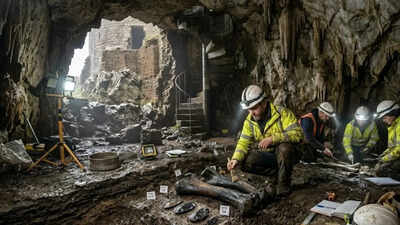
Archaeologists have discovered a ‘once in a lifetime’ treasure trove inside Wogan Cavern, a massive subterranean chamber hidden directly beneath 11th-century Pembroke Castle.
While Victorian explorers had previously dismissed it as empty, recent small-scale excavations conducted between 2021 and 2024 have revealed remarkably intact sedimentary layers. According to the University of Aberdeen, these deposits contain an extensive prehistoric archive, including stone tools and fossils of extinct species such as mammoths, woolly rhinos, and hippopotamuses dating back about 120,000 years.
Led by the University of Aberdeen, a new large-scale five-year investigation aims to use advanced techniques, such as ancient DNA analysis and high-resolution dating, to map human occupation and ecological transformations spanning more than 100,000 years of British history.
A rare prehistoric cave has been found beneath a Welsh castle, containing fossils and rare stone tools
The discovery of Wogan Cavern is a prehistoric archive of unparalleled importance to British archaeology. Accessed using a spiral staircase and part of the medieval castle at the top of the hill, this cave contains a very important and relatively rare permanent record of prehistoric life through layers of history.
As noted in a study conducted at the University of Aberdeen, preliminary analysis puts the material in this cave back to a time between about 45,000 and 35,000 years ago, when early Homo sapiens likely inhabited parts of Britain, and it may also contain evidence of Neanderthal presence before that date.
Because the sediments are preserved in layers (layers), this cave may provide scientists with an unusual opportunity to look at the effects of climate on the types of ecosystems that existed in different time periods by studying animal and plant life through microfauna and ancient DNA.
This discovery reconstructs ancient climates and prehistoric survival
Scientists have also discovered hippopotamus bones that likely date back to the last Ice Age (about 120,000 years ago) in cave sediments. This may indicate that temperatures in Wales were much lower and climatic conditions were warmer than previously thought. The cave contains extensive evidence of reindeer, wild horses and a wide range of Pleistocene fauna, and may provide an accurate timeline of the shifts in climatic conditions that occurred in Wales.
Ultimately, researchers hope this data will help provide answers about how prehistoric hunter-gatherers survived the dramatic environmental changes that occurred as the last Ice Age came to a close and as warmer, more temperate climates began to develop across parts of Europe.
Unlocking human history through DNA analysis of sediments
The upcoming five-year excavation project, scheduled to begin in May 2026, will use advanced scientific methods with the help of the Caliva Foundation and the Pembroke Castle Foundation. The research team will focus on analyzing genetic material from sediments, which can identify the presence of humans and animals when bones are not available. Analysis of these high-resolution data points should enable reconstruction of the precise sequence of human activity in the region and facilitate advanced understanding of the transition from Neanderthals to modern humans in Britain.