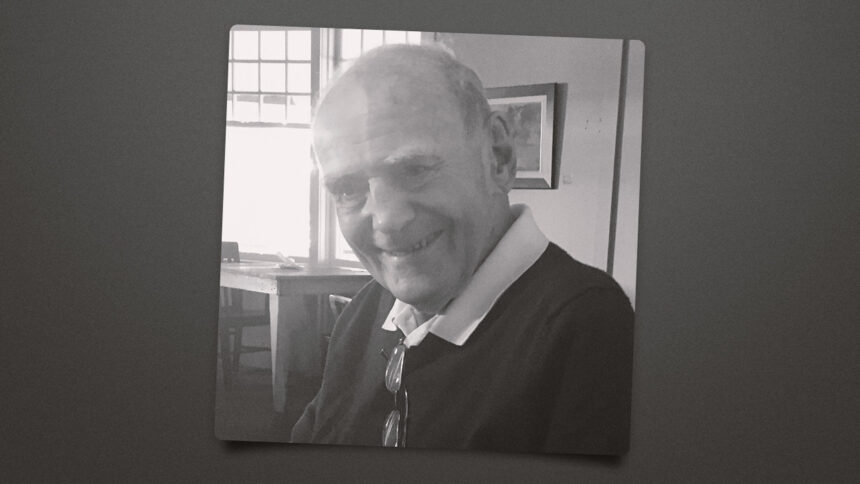
Pip Wedge, the broadcasting pioneer who helped shape the British and Canadian private television companies when they first launched, has died. He was 97 years old.
His wife, Liz Wedge, confirmed that Wedge died peacefully and unexpectedly on April 15 in Toronto of natural causes after feeling unwell and taking a nap from which he never woke up. Hollywood Reporter. “After nearly 61 years of marriage, I miss him terribly,” she said in a statement.
Wedge was born on 2 December 1928 in Forest Hill, south-east London, UK, and was named Philip by his parents so they could name him Pip, after Charles Dickens’ character in the classic novel. Great expectations a novel. After attending high school during the turbulent Second World War, in May 1946 Wedge took a job as a clerk and switchboard operator at an advertising agency in London, before joining the British Navy as a telegraph operator.
As Wedge monitored the airwaves around Port Glasgow on a Navy ship, he also listened to the US Forces Network radio station as American entertainers such as Doris Day, Joe Stafford, and Johnnie Ray performed on the air. This interest in pop music eventually brought Wedge to the attention of the veteran British musician and broadcaster Musical Express Writer Steve Reese.
In a 1994 profile in Playback magazine, Wedge recalls mustering up the courage to approach Race, whom he had already met and walked out with a handful of jukebox LPs in his arms. When it came time to return the records a few months later, this time Wedge came forward with a job offer after offering some helpful writing advice during their conversation.
“During our second meeting, Steve was writing his book Musical Express Column, I looked over his shoulder, and he made some comments, which he put in the article. “We’ve really made progress,” Wedge recounted. In June 1950, Wedge began writing concert reviews at Musical Express For Race, in June 1952 he became a reporter and eventually assistant editor.
However, by 1955, Wedge heard from Rees that he was part of a license application to launch the British commercial television station Associated-Rediffusion to compete against the public broadcaster BBC. So Wedge joined the television station, helped set up the music department and then moved into light entertainment. This included production in the rough and tumble world of early television quiz shows such as Double your money and Choose what suits you.
In the spring of 1962, Wedge felt the need to get out of producing UK game shows: “I had settled down and had little hope of success,” he recalled in a 1994 profile about any further career advancement. But this exit came when Wedge was asked to produce Double your money Pilots in Canada and Australia.
In Toronto, he set up studio space at CFTO-TV and found contestants, before doing the same in Sydney, Australia. By 1964, Wedge was producing 42 half-hours Double your money for the privately owned CTV television network in five cities across the country, while editing the series in Toronto.
A year later, Wedge made the decision to accept a job offer at CTV, first in Montreal in August 1965 and then at headquarters in Toronto starting in August 1967 as a producer under Murray Chirkover, the network’s executive vice president and head of programming, Arthur Weinthal.
In 1970, Wedge was promoted to director of development. Suddenly, he was no longer seen quite as a music man or producer as he had been in the segregated UK, but as a television executive asked to help lead a Canadian television network. “This was a much more democratic environment than I had known in London. They took me seriously. They knew what I was doing, and none of my background mattered. This was a key element in my happiness with CTV,” Wedge recalled in the 1994 profile.
He worked at CTV for 28 years until his retirement in June 1994, and his duties included producing Canadian variety and daytime programs such as a trio of Petula Clark television specials and the early seasons of television series. W5the network’s flagship news magazine series.
Wedge bought CTV’s foreign programming, including American studio series such as… Rowan and Martin laughed, soapy and Love boat It was acquired every year in Los Angeles shows, where he ran the network’s schedule. After leaving CTV, Wedge did consulting work for the network and industry associations such as the Canadian Association of Broadcasters.
In November 2006, he was inducted into the CAB Broadcasting Hall of Fame, and a year later became a 10-year arbitrator for the Canadian Broadcast Standards Board, which helped regulate taste and standards on Canadian television for the CRTC, the industry regulator.