Director Antoine Fuqua and screenwriter John Logan don’t exactly break the mold MichaelAnd they do not fill it with major discoveries. But they tap into the feelings of melancholy that underlie stratospheric success that are surprisingly affecting. The online mob will be sharpening its pitchforks given the film’s failure to address the child sex abuse accusations that tarnished Michael Jackson’s legacy. But the filmmakers get around this by focusing on the beginning of his career, which ended in 1988 bad A world tour concert in London, years before the allegations first surfaced. The epilogue card that says “His story continues” does some heavy lifting.
Whether it will continue in a second film remains an open question, though it depends MichaelIt seems safe to assume that the sequel is ultimately unlikely to address the thorny issues head-on. However, ignoring the scandal certainly didn’t hurt the Broadway musical MJnow in its fourth year in addition to a national tour and multiple international appearances. It also did not stop Kenny Ortega’s film after his death in 2009. This is itwent on to become the highest-grossing documentary film of all time.
Michael
Bottom line Typical on the surface, thoughtful and intimate underneath.
release date: Friday, April 24
He slanders: Jafar Jackson, Colman Domingo, Nia Long, Juliano Valde, Kaylin Durell Jones, Laura Harrier, Jessica Sula, Miles Teller, Larenz Tate, Kendrick Sampson
exit: Antoine Fuqua
screenwriter: John Logan
Rated PG-13, 2 hours and 9 minutes
These and other signs of Jackson’s enduring popularity suggest that die-hard fans of his music — some of us used to wait hours for “Billie Jean” to reappear on MTV — will still seize the opportunity to celebrate the legendary streak that took him from childhood Motown stardom to pop royalty, with the three certified banger albums produced by Quincy Jones. outside the wall, stir and bad.
If you’ve made up your mind about Jackson by the tabloid feeding frenzy that began in 1993, and damning scandals like the 2019 HBO two-part documentary Leaving Neverland, Michael It probably won’t do much to change that. But if you’re even remotely nostalgic for a time when his songs were ubiquitous on the pop charts, at parties, and on dance floors around the world, the film will be a warm rush of joy.
The irrefutable truth about Jackson is that he was a musical genius driven by a clear vision for his career. Logan and Fuqua celebrate his emergence as the diminutive leader of the Jackson 5 alongside his older brothers at the tender age of 10, with perfect pitch and charismatic stage presence (he was played in those early years by the great Giuliano Valdi). In his twenties, he developed impeccable instincts about the material that suited him best and the ideal ways to present it – from precise stage choreography to groundbreaking music videos in the early days of the format.
In an entertaining cameo, Mike Myers plays CBS Records president Walter Yetnikoff, who in 1983 threatened to pull all of the company’s major artists if MTV didn’t break away from its elimination programming and put “Billie Jean” on high rotation, making Jackson the first black artist to get that exposure.
Unlike Spike Lee’s meticulously detailed 2012 ABC film, the film doesn’t delve into the development of his signature look, his distinctive dancing style, or the genesis of his biggest hits. Bad 25. Everything seemed to come completely from his mind. The closest thing comes is when he watches an old Vincent Price horror film or watches a news report on Los Angeles TV about the tensions between The Bloods and The Crips and then incorporates these elements into his music videos for the songs “Thriller” and “Beat It” respectively.
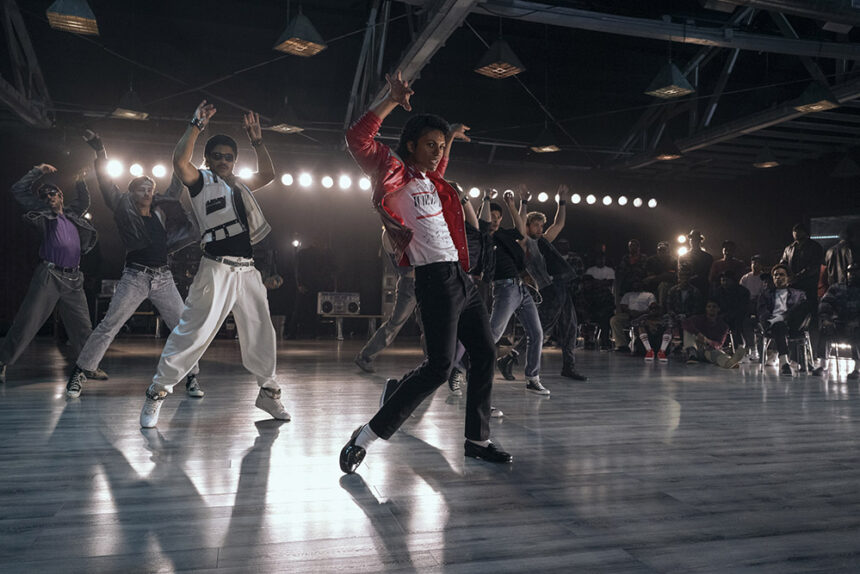
What makes all of this compelling is the degree to which Jaafar Jackson, the son of Michael’s older brother Jermaine, disappears into the role of his famous uncle. While the film wisely sticks to the original singing, the young actor delivers an eccentric recreation of Michael’s dancing skills – not just the signature moves of Moonwalk, Robot, Spin or Toe Stand, but the unique blend of fluidity and snappy angle that helped make him one of the greatest stage performers of all time.
Jafar brings out the sweet, gentle voice with which Michael exudes a childish, vulnerable innocence, but also the single-minded focus with which he has propelled his career forward. We see his natural affinity for children in his interactions with fans or his hospital visits to pediatric cancer wards.
The film’s main conflict is between the protagonist and his father, Joe Jackson, played by Colman Domingo in a powerful performance as an arrogant, selfish man, with a hint of maniacal menace. Joe is the toughest of supervisors, booking tour dates for the Jackson 5 while they were still in school and forcing them to come home and rehearse late at night after shows that left them exhausted. Michael’s tendency to talk resulted in him being repeatedly whipped with his father’s belt.
Even more than a decade later, when his work with his brothers was overshadowed by Michael’s solo stardom — not to mention his earning power — Joe remained a controlling bully, insisting that his most famous son continue to tour with the Jacksons, as they became known when Jermaine left to pursue a solo career with Motown.
Michael is saved to some extent by the love and devotion of his mother, Katherine, played with touching warmth in a terrific performance by Nia Long. We see what it costs her when she keeps her hands tied instead of opposing her disciplining husband, and when she finally acts enough to speak up for her son. Her heartache was evident when Joe impatiently asked the doctors how long before Michael could return to performing when he was barely out of the ICU after sustaining severe burns and nerve damage during an accident while filming a Pepsi commercial.
The film ends before his personal relationships, aloof nature, eccentricities and extensive plastic surgeries – not to mention more serious controversies – become the butt of jokes for many. (Only primary rhinoplasty is included to reshape his nose.) But even as his fame soars, the picture here is of a damaged man, whose sharp professional instincts seem at odds with his gentle demeanor.
Even the well-known fascination Peter Pan Neverland, and a bizarre obsession with collecting exotic animals like a llama, python, and giraffe — and yes, the chimpanzee Bubbles makes an appearance — seems to stem from a self-protective childhood that perhaps begins when Motown boss Berry Gordy (Larenz Tate) insists on lowering his age from 10 to 8.
From early childhood, Michael was told that he was special, which seemed to hinder his ability to make friends. Hence his claims that animals were his friends. Perhaps his most notable friendship is with his loyal bodyguard Bill Bray (Caelin Durrell Jones) and, to a lesser extent, his clever boss John Branca (Miles Teller in a distracting wig).
Considering that it charts Michael Jackson’s astonishing rise to become one of the greatest pop stars the music industry will ever know, this is by no means a picture of a happy life. The deep undercurrent of sadness gives the film an emotional depth that helps counter its relatively routine style.
The reported friction between Michael, Geordie, Jones and Jermaine was not mentioned, and it seems significant that Janet Jackson has been largely erased from the picture. She is also one of the few family members not to receive an executive producer credit, along with Michael’s daughter, Paris Jackson.
The film leaves itself open to accusations of saintifying Michael, which won’t sit well with canceled audiences. If you are not willing to separate the art from the artist, this is not the film for you. But for lifelong fans who cherish the music, the film is a hit. Simply as a celebration of Jackson’s songs and stagecraft, it’s extraordinary, shot by Dion Beebe with visual electricity in the performance sequences. Music has never sounded louder or better.