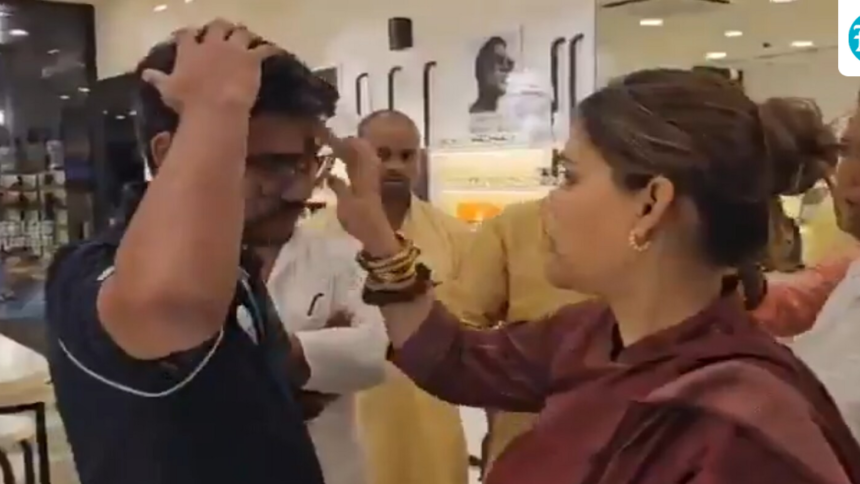
Optical retailer Lenskart witnessed another row when BJP leader Nazia Elahi Khan entered one of its showrooms in Mumbai and applied tilak on the employees. The incident comes amid allegations that the company has restricted certain forms of religious expression.

In a video circulating on social media, the BJP leader was seen confronting store staff, including floor manager Mohsin Khan, over allegations of discouraging Hindu symbols like Tilak and Bindi. She was also seen directing her entourage to apply tilak to the staff, tie sacred threads (kalawa) on their wrists and raise slogans.
Khan can be heard stressing that there is “no shame” in expressing religious identity and warning of a boycott if the company does not respond.
HT was unable to independently verify the authenticity of the viral video.
What sparked the confrontation?
The incident comes against the backdrop of controversy over the alleged dress code for staff at Lenskart which appears to allow some religious symbols while restricting others.
According to claims that have surfaced online, the company’s previous style guide allowed things like hijabs and turbans, but banned tying, tilak and sacred threads. The issue gained momentum after political commentator Shefali Vaidya pointed out the alleged disparity on social media, sparking widespread controversy and backlash.
During the dispute, some employees also alleged that they were directed during training not to wear religious signs like Tilak or Kalawa, which further fueled the controversy.
Company response and updated policy
Amid mounting criticism, Linskart moved to clarify its position. Founder and CEO Peyush Bansal said that the controversial document is outdated and does not reflect the company’s current policies.
Subsequently, the company issued a revised store style guide that explicitly allows for a wider range of religious and cultural symbols, including bindi, tilak, sindoor, kalawa, mangalsutra, kada, veil and turban. It also issued a statement in which it expressed its regret for any confusion that occurred and stressed that employees are free to express their faith at work.
From online debate to on-the-ground protest
The chain of events began earlier in April when evidence of alleged grooming surfaced online, sparking accusations of religious bias. Despite the company’s clarification and updated policy, criticism continued, with some social media users questioning the delay in issuing a clear apology.