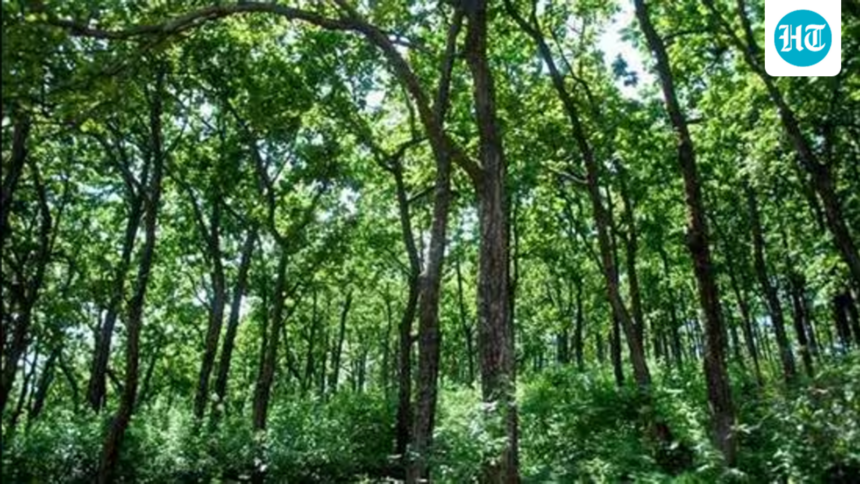
Carbon stored in India’s forests is expected to grow as temperatures and rainfall increase due to climate change, a new study has found. The largest gains in carbon biomass are expected to occur in desert and semi-arid regions, followed by the Himalayas, the Indo-Gangetic Plain, and the Deccan Peninsula. The increase will be modest for the Western Ghats, Northeastern and Himalayan forests.

Across India’s forest regions, the study predicts that average carbon stocks will rise by about 35%, 62% and 97% by 2100 under low, medium and high emissions. They will remain broadly similar until around 2030, then diverge under different emission pathways by 2050. This is not necessarily good news, said the Indian Institute of Tropical Meteorology (IITM), BITS Pilani, KK Birla Goa Campus, Lund University and Kerala Agricultural University, published in the research by IOP Environmental: Climate.
One of the study’s clearest findings is that precipitation matters more than temperature at the national level. Rainfall has the strongest overall impact on carbon changes in forests across India.
Models predict an increasing trend in temperatures and precipitation in India, along with intensification of monsoon rainfall and increased soil moisture availability. These factors are expected to account for physiological changes in vegetation and enhancement of vegetation productivity under increasing CO2 level, according to previous studies mentioned in the study.
Rising carbon dioxide in the atmosphere enhances photosynthesis in vegetation, leading to increased biomass and increased carbon uptake by the terrestrial ecosystem. But as temperatures rise, pest and disease outbreaks are likely to become more frequent, putting forest ecosystems at greater risk. The study said that many plant species are struggling to survive in their current environment and begin to migrate to more suitable locations, a phenomenon known as “shifting vegetation belts.”
Climate change alters phenological patterns in plants, which may disrupt pollination and affect plant reproduction. The study said that increased heat waves and prolonged periods of drought can lead to water stress, harming plant growth, productivity and survival, which should be taken into account.
Using the LPJ-GUESS vegetation model and climate projections from CMIP6, the researchers examined how carbon will change from the recent past to the near, middle and late 21st century under different emissions scenarios. The researchers took into account carbon stored in living forest plants, including trunks, branches, leaves and roots.
The study said its findings highlight the urgent need for region-specific climate adaptation strategies, as trends in plant carbon biomass (VCB) are highly sensitive to changes in both temperature and precipitation. “The implications for forest management and carbon sequestration policies are significant, especially as different regions may face different responses to future climate shifts,” the report said.
“Future research should focus on understanding the long-term consequences of these changes, with an emphasis on identifying ecological thresholds and exploring potential mitigation strategies for areas most at risk.”
IITM climate scientist and co-author Roxy Matthew Cole said India’s forests are not responding to climate change uniformly. “Some regions may store more carbon in living biomass, but that does not mean climate change is helping forests. A warmer world also brings greater risks from drought, fires and other disturbances. What this study shows even more clearly is that rainfall matters, and that future forest planning must be regional, climate-conscious, and rooted in risk prevention.”
Pramit Deep Burman, an IITM scientist, said deserts and semi-arid regions show the largest increase in forest carbon biomass, consistent with emissions scenarios. “Growth in the Himalayas and Western Ghats remains lower. Overall, rainfall remains the main driver. However, its impact is diminishing with emissions, and warming is taking over, which needs to be taken into account for nature-based mitigation management.”
India has 16 groups of primary forest types and 221 groups of subspecies, based on features such as structure, function, flora, climate, humidity, rainfall, temperature, biogeographic zone and elevation. It ranks tenth among the most forested countries in the world. Overuse of forest resources, rapid population expansion, climate change, and industrial development are all factors that reduce the size and area of forests.
Over the past two decades, the greening of the world has increased dramatically, with India emerging as the second largest contributor among tropical regions since 2000.