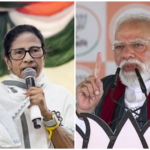
These are 5 parties that the Prime Minister mentioned by name in his “Address to the Nation”. Bengal CM Mamata Banerjee emphasized gender ratio in TMC as she denied ‘anti-women’ charge

Of the 75 women currently elected to the 18th Lok Sabha — about 14% of its 543 members — 11 belong to the Trinamool Congress (TMC), the ruling party in West Bengal. It just means less than 38% of the TMC’s total 29 members are women, the highest percentage of any major party in the House of Representatives.

The ruling party in Tamil Nadu, the Dravida Munnetra Kazhagam (DMK, comes in second place, with four women out of 22 MPs, or just over 18%.
the The Samajwadi Party (SP) in Uttar Pradesh is third on this list, with five of its 37 members of Parliament being women, or 13.5%.
These are the official statements at a time when there is a lot of controversy over how and when the 2023 law granting a 33% quota to women in the Lok Sabha and assemblies will be implemented.
The two largest parties in the Lok Sabha – the ruling Bharatiya Janata Party and the main opposition Congress – occupy the next two positions.
The Congress Party is in fourth place with 14 women out of 99 MPs – 14.1% – after Priyanka Gandhi Vadra won the by-election from Wayanad in November 2024.
The Bharatiya Janata Party (BJP) has 31 women MPs in the Lok Sabha. This is the highest in terms of absolute numbers. But when viewed as part of the total 240 representatives, women make up 12.9%.
Names of the Prime Minister in “Address to the Nation”
These are also the five parties that Prime Minister Narendra Modi mentioned by name in his address to the nation on April 18, after he accused the opposition of being anti-women, as mentioned in the Constitution (131st Amendment) Bill, 2026. He was defeated in Lok Sabha.
TMC-ruled Bengal, which is currently led by a woman, and DMK-ruled Tamil Nadu are both in the middle of elections at the moment, while elections in BJP-ruled UP are scheduled for early next year.
The amendment bill, which fell, sought to bring about an immediate increase and change in Lok Sabha seats, but opposition parties insisted that although they had already agreed to the women’s quota – approved unanimously in 2023 – they did not want to reorganize the Lok Sabha yet, a process called delimitation.
Before this debut, they want to ask questions about them Regional distribution and class shares are also addressed.
Prime Minister Modi described them as anti-women and said they are only hiding behind “excuses”.
“I was deeply saddened to see, when this women welfare proposal was defeated, dynastic parties like Congress, TMC, Samajwadi Party were clapping with joy,” he said.
He repeated this charge at election rallies against the TMC in Bengal on Sunday.
Modi is looking forward to the elections
The opposition parties claim that Prime Minister Modi only wanted to brand it as anti-women with his eye on the elections. Congress leader Mallikarjun Kharge said Prime Minister Modi mentioned his party 59 times in his speech on April 18 alone. He was referring to the official English text of the speech, in which the TMC was mentioned at least eight times; SP 11 times and DMK seven times.
The position of the opposition parties, which was repeated in Parliament and outside it, was that the objection was to the demarcation of the border, and not to the quota that was approved three years ago but has not yet been implemented.
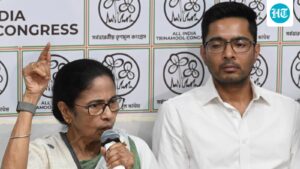
West Bengal CM and TMC supremo Mamata Banerjee has alleged that the BJP-led NDA government planned to use the women quota amendment as a “front” to demarcate boundaries that would “divide the country into parts”.
“Women are not stupid. They can see the truth of these actions,” said Priyanka Gandhi Vadra of the Congress party.
She said the government could only bring back the 2023 law. “Convene Parliament on Monday, present the bill and let us see who is anti-women. We will all vote and support you,” she said, requesting removal of demarcation and change of seats as a warning altogether.
The government said the increase in seats is necessary so that the current leaders do not lose out while more women also get opportunities. He promised – although not as part of the text of the bill – that there would be a flat increase of 50%, and thus no change in the states’ proportional shares.
The opposition believes that border demarcation should take place after the completion of the current population census, which is expected to be completed next year, and caste data is also available, especially on the population of the region. Other Backward Classes (OBCs), for more equitable distribution.
Why not in house 543?
On Saturday, the DMK introduced an alternative bill as well, for reservation in the current 543-seat Assembly for now. But the parliament session was postponed and this matter was not addressed.
TMC MP Kalyan Banerjee even “dared” the BJP to make 50% reservation instead: “And The position of Prime Minister is also reserved for women, on a rotating basis. Do it. Bring it now.”
One of the opposition’s demands even in 2023, when the original law was passed – and again during the special session to try to demarcate boundaries now – was to implement reservation within the existing 543 seats without a new delimitation exercise.
Leader of the Opposition in Lok Sabha, Congress MP Rahul Gandhi, said the bill was an “attempt to grab power through delimitation and cheating”. Sonia Gandhi, president of the Congress parliamentary party, described the demarcation proposal as “extremely dangerous” and an “attack on the Constitution itself.”
However, TMC MP Mahua Moitra pointed to her party’s record in the ongoing West Bengal Assembly elections, posting on
As for women’s representation, the trend data for the Lok Sabha over time provides a broader context.
Women’s representation grew from 8.3% in the 14th Lok Sabha (which was formed with the 2004 elections) to a peak of 14.4% in the 17th Lok Sabha (2019), before falling to 13.8% in 2024, the 18th Lok Sabha.
(In the 2024 elections, 74 women won, and the number later rose to 75.) Rahul Gandhi vacated the Wayanad seat to retain Rae Bareli, and his sister Priyanka Gandhi Vadra made her election debut by winning Wayanad.)
In percentage terms, women’s representation in the Lok Sabha remains well below the 33% required once the Women’s Reservation Act is enforced.
Currently, the 2023 law remains in force but dormant, as its activation hinges on a border demarcation process that the opposition insists cannot be rushed. The Prime Minister’s speech did not explicitly address this, although he described it as a “technical”. Bahana“, or pretext, by Congress in its address to Parliament

Arish Chhabra is an associate editor on the Hindustan Times online team, where he writes news reports and explanatory features, as well as overseeing the site’s coverage. His career spans nearly two decades across India’s most respected newsrooms in print, digital and broadcast. He has reported, written and edited across formats—from breaking news and live election coverage, to analytical long-reads and cultural commentary—building a body of work that reflects editorial rigor and curiosity. deeply about the society for which he writes. Areesh studied English Literature, Sociology and History along with Journalism at Punjab University in Chandigarh, and began his career in that city, eventually moving to Delhi. He is also the author of Little Big City: What Life is Like from Chandigarh, a collection of critical essays originally published as a weekly column in the Hindustan Times, which examines the culture and politics of a city that is much more than just its famous architecture – and in doing so, holds up a mirror to modern India. During his stints at BBC, The Indian Express, NDTV and Jagran New Media, he has worked across formats and languages; Mainly English, as well as Hindi and Punjabi. He was part of the crack team for the BBC Explainer project which was replicated around the world by the broadcaster. At Jagran, he developed editorial guides and trained journalists on integrity and quality content. He has also worked at the intersection of journalism and education. At the Indian School of Business (ISB) in Hyderabad, he developed a website to streamline academic research in management. At Bennett University’s Times School of Media in Noida, he taught students the craft of digital journalism: from newsgathering and writing to social media strategy and video storytelling. Having moved from small town to larger town to megalopolis for education and work, his intellectual passions lie at the intersection of society, politics, and popular culture—a perspective that guides his writing and worldview. When he’s not working, he’s constantly reading long-form journalism or watching cerebral content, sometimes both at the same time.Read more