


Gold and silver have achieved gains of about 10% and 5% year to date. Should you buy gold this Akshaya Tritiya? We asked five experts: (AI image)
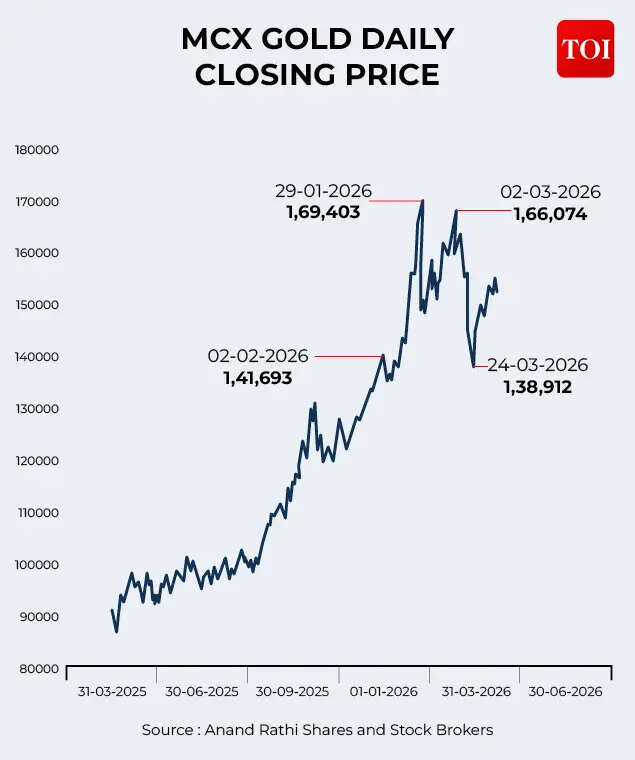
Buying gold in India is not only about its safe haven status, it is also traditionally considered auspicious. Festivals throughout the year become prime days when gold buying peaks. According to Jatin Trivedi, Vice President Research Analyst – Commodities & Currencies, LKP Securities, returns over the past few years suggest that both physical gold and MCX gold have remained structurally bullish, especially during periods of global uncertainty, high inflation and currency volatility.Gold and silver prices have risen strongly in the past few years, reaching new highs in January of this year. However, since then the prices of both precious metals have declined. Recently, gold’s safe haven status has come into question with the collapse in prices since the beginning of the US-Iran war. According to a recent report by Motilal Oswal Wealth Management, from a historical perspective, Akshaya Tritiya has consistently proven to be a favorable entry point for long-term gold investors. Gold and silver have achieved gains of about 10% and 5% year to date. respectively. Gold prices have fallen from their recent highs, but are still on the higher side. In this context, should you buy this Akshaya Tritiya Gold? We asked five experts – but before that let’s take a look at how gold has performed compared to other asset classes like silver and stocks in the past 10 years.
Akshaya Tritiya to Akshaya Tritiya: How do gold, silver and Sensex returns compare?
Experts point out that silver has outperformed gold and Indian stocks since Akshaya Tritiya last.
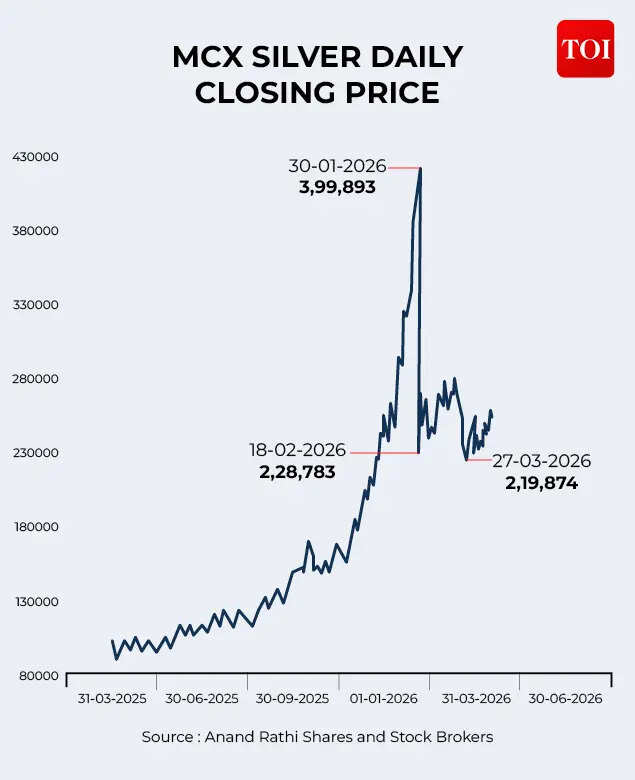
It has delivered excellent, multiple returns of approximately 158-160% since the last Akshaya Tritiya (April 30, 2025), significantly outpacing gold’s gains of approximately 60%. Silver prices rose from just under Rs 1 lakh per kg during the last Akshaya Tritiya to around Rs 2.50 lakh per kg by mid-April 2026, driven by rising industrial demand and investment inflows. Not only that, the white metal was seen rising to a high of over Rs 4.25 lakh per kg in futures contracts during the first month of the current year!
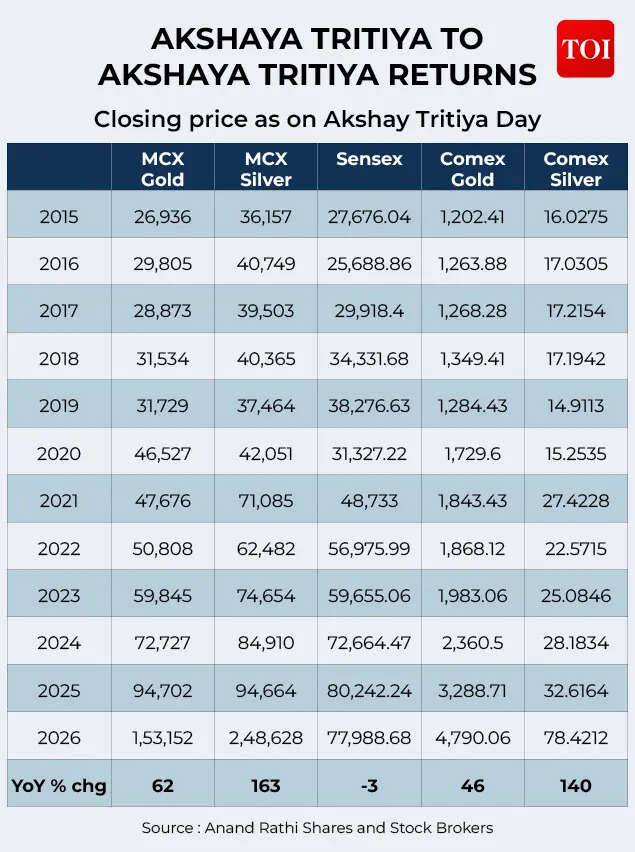
On the other hand, stock markets bled last year due to foreign inflows, rupee depreciation, and a host of other factors. The BSE Sensex has fallen since the last Akshaya Tritiya close. Longer-term data reveal a more telling story. Over the past 10 years, gold has consistently delivered positive returns from one Akshaya Tritiya to the next, with 2017 being an exception with negative returns. On average, over the past 10 years, gold has returned around 19%, while the Sensex has returned 13%, and silver 27%.
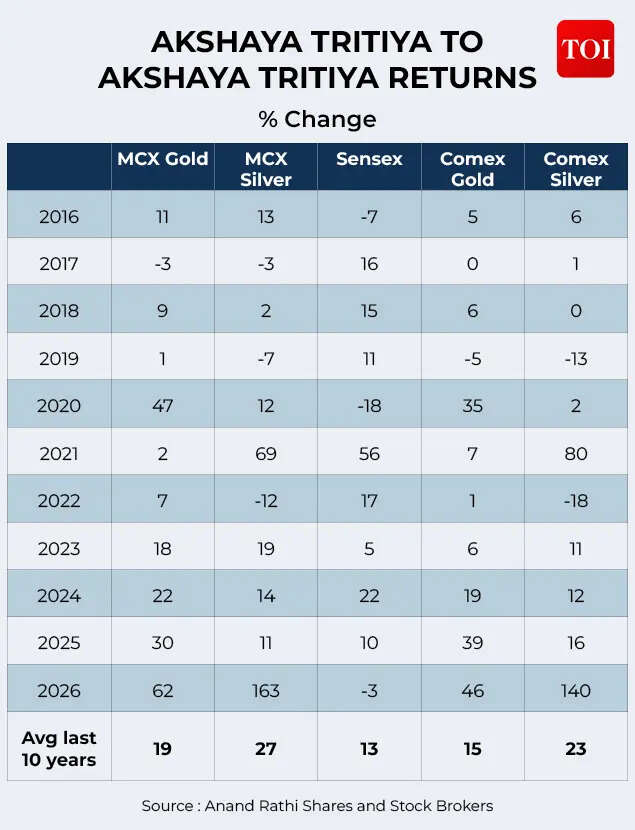
However, it is also worth noting that there are several periods of single-digit returns, and others with exceptional performance, such as last year, which pushes the average higher. The Sensex, on the other hand, has provided more consistent returns.What should your Akshaya Tritiya investment decision look like? Here’s what 5 experts say:Vedika Narvekar, Research Analyst – Commodities & Currencies, Anand Rathi Stocks & Stock BrokersLooking ahead, the outlook for Akshaya Tritiya gold remains positive, but investors should approach it with a balanced, long-term mindset rather than expecting quick gains.
This is because gold is currently facing resistance from several factors.Energy supply disruptions are likely to continue after the conflict ends, keeping inflation risks high. This may push central banks to tighten monetary policy, causing bond yields to rise, which in turn reduces the attractiveness of gold, because it does not offer any interest income. At the same time, some of gold’s key support factors may weaken in the near term. Although central banks – especially the People’s Bank of China – have been strong buyers, purchases typically slow in the second quarter. Over the past 20 years, spot gold has risen by an average of 1.2% in the second quarter, compared to 5.2%, 2.9%, and 2.5% in the first quarter, third quarter, and fourth quarter, respectively. While many global banks remain positive on gold in the long term, near-term gains may remain limited.However, the broader structural drivers supporting gold, such as central bank buying, global uncertainties, and concerns about inflation and currency stability remain.
Gold prices are expected to remain strong over the next year, but with significant fluctuations. Akshaya Tritiya offers a good opportunity to gradually start accumulating gold as part of a long-term strategy, but it is advisable to accumulate the same amount in 3-4 tranches at every 3-4% decline.MCX gold has the potential to rise 18-20% till the next Akshay Tritiya (CMP: Rs 153,100 per 10 gram). On the downside, you may find prices flooring around INR 1,30,000, while INR 1,65,000 acts as an immediate resistance level.
A sustained move above this level could open the way towards Rs 1,85,000. Internationally, COMEX gold is expected to trade in a range of $4,000 to $5,750 per ounce.
Praveen Singh, Head of Commodities, Mirae Asset ShareKhan
- Just eight weeks ago, markets were counting on more than two interest rate cuts by the Fed. However, the escalation of the Iranian conflict has turned this narrative on its head. The sharp rise in crude oil and fuel prices has reignited inflationary pressures, pushing inflation expectations higher. As a result, central banks have become more vigilant, and the Bank of England and the European Central Bank are now seen as likely to raise interest rates – a sharp shift from the rate-cut expectations of just a few weeks ago.
- The stronger US dollar and tighter liquidity conditions amid rising oil prices also stimulated some sovereign gold selling and swapping activity. Meanwhile, US labor market data remains resilient. This data should ease the Fed’s concerns about labor market weakness, at least in the near term.
- Gold may face periods of volatility and further corrections in the short term, as central banks remain focused on containing inflation caused by tensions in the Middle East that have pushed actual crude oil prices to record levels. However, the medium to long-term outlook for gold remains constructive over 2026-2027, as structural fundamentals continue to provide strong support.
- The continued elimination of the dollar m Driven by geopolitical frictions and sanctions, the global sovereign debt burden estimated at $340 trillion, the increasing weakness of government bonds under fiscal dominance and inflation risks are all strong tailwinds for both gold and silver. Over time, continued high oil prices are likely to slow global economic growth, which could eventually revive expectations of interest rate cuts. Any slowdown or stagnation in growth would further deteriorate debt-to-GDP ratios, enhancing the strategic attractiveness of precious metals.
- Overall, the outlook for gold remains strongly constructive, with prices expected to move towards the $6,000 to $6,500 range over the next year, supported by macro uncertainty, financial pressures, and structural shifts in the global monetary system.
Manish Sharma, commodity and currency expertShort-Term Gold Outlook: The decline in gold prices since the beginning of the US-Iran geopolitical situation was seen as a temporary response to the liquidity shock as central bank purchasing slowed in the February-March period.
Gold and silver ETFs in India also witnessed outflows in the February-March period which impacted sentiment towards precious metals. Meanwhile, there remains a strong fundamental backdrop for the yellow metal in the coming years driven by macroeconomic uncertainty. However, for the coming months, the gold outlook remains highly sensitive to shifts in US Federal Reserve interest rate policy expectations amid developments surrounding the US-Iran conflict.
Any gains in global stocks could keep the upside limited again in the near term.Historically, during the period from May to June, gold has had a seasonally weak performance Performance is average in the last 50-year time frame, often representing a period of consolidation after spring highs. However, the latter half of the year is still expected to remain positive given fears of a slowdown in economic growth as predicted by the International Monetary Fund in its latest World Economic Outlook released this week. Should you buy it? What are the expectations? One should consider investing in gold and silver in a portfolio of assets with the investment mix remaining at around 60:40 with 40% allocated to silver. However, new investment in gold requires a phased approach starting with Akshaya Tritiya, as declines of 5-10% in prices in the coming months should be seen as an opportunity to accumulate the yellow metal. Total returns of 18-25% can still be expected from gold until the next Akshaya Tritiya.Silver, which has outperformed gold since the last Akshaya Tritiya, is still seen as a metal with higher potential for returns but with significant volatility as the silver market heads into a sixth year of structural deficit in 2026.
Jatin Trivedi, Vice President Research Analyst – Commodities & Currencies, LKP SecuritiesBuying gold on Akshaya Tritiya carries cultural significance and financial logic, especially for long-term wealth protection.
However, the current price levels are high after a sharp rise. Hence, a gradual accumulation strategy is wiser than buying with a lump sum.One-year forecast and strategy• Approach: Small Quantity Procurement (SIP / Tiered Purchasing)• Better Accumulation Area: Near INR 1,30,000 (on corrections)• One-year forecast: Positive bias supported by* Geopolitical uncertainty* Inflation risk* Central bank purchase* Currency fluctuationsTarget Levels (1 Year)• Upside target: INR 1,75,000 – INR 1,85,000Gold is expected to remain in a long-term uptrend, although temporary fluctuations and corrections are expected.
Gold remains an essential portfolio hedge, but at current high levels, investors should focus on disciplined accumulation rather than chasing prices, using declines as opportunities.
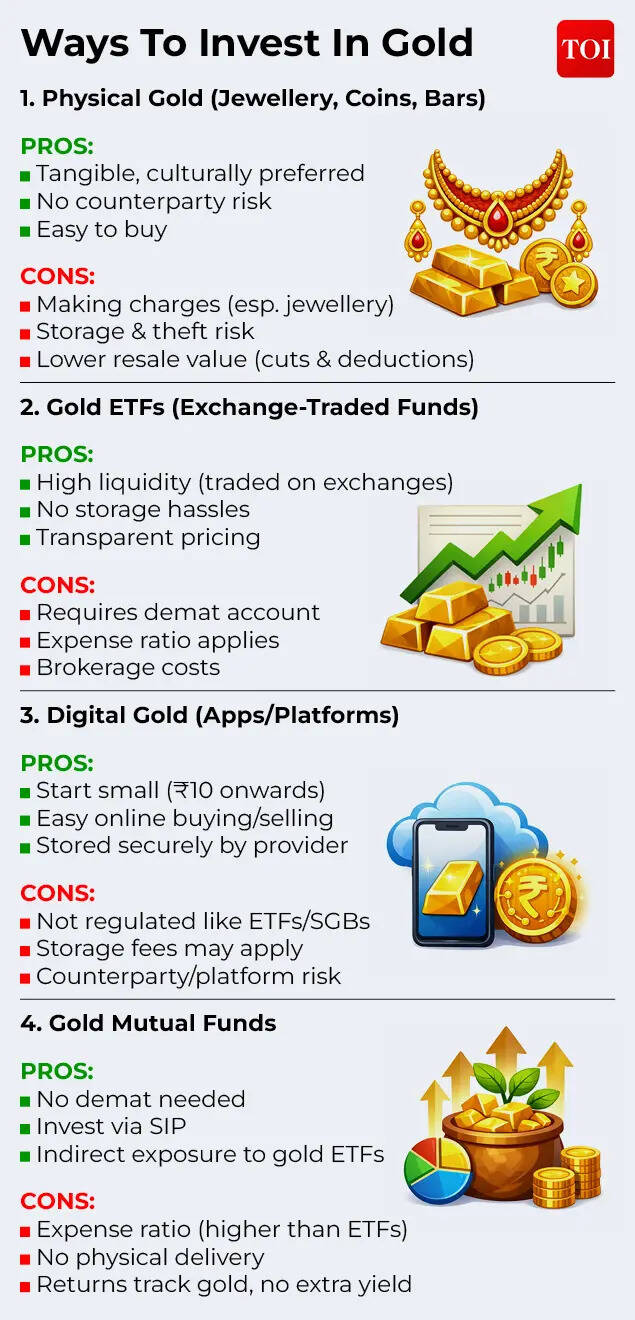
Kaveri More, Commodity Analyst, Commodity Technical Research at Choice BrokingYes, because the bullion market remains strongly influenced by macroeconomic uncertainty, concerns about global growth, and central bank actions, with three main drivers highlighted by ongoing geopolitical tensions in the Middle East (Iran and the United States), China and Taiwan, the conflict between Russia and Ukraine, slowing growth in Europe and parts of Asia, and shifting monetary policy expectations, especially from the US Federal Reserve.Given these dynamics, buying gold from Akshaya Tritiya still makes sense but not in a lump sum and peak manner. A “buy the dips” strategy of staggering around key support areas best aligns with a one-year horizon and reduces the risk of entering near record highs. Reasonable target ranges over the next 12 months could be between Rs 169,000-180,000, with a support zone near Rs 146,800-136,300.
reconnaissance
Are you thinking of buying gold on Akshaya Tritiya?
(Disclaimer: Recommendations, opinions regarding stock market, other asset classes or personal finance management tips given by experts are their own. These opinions do not represent the views of The Times Of India)