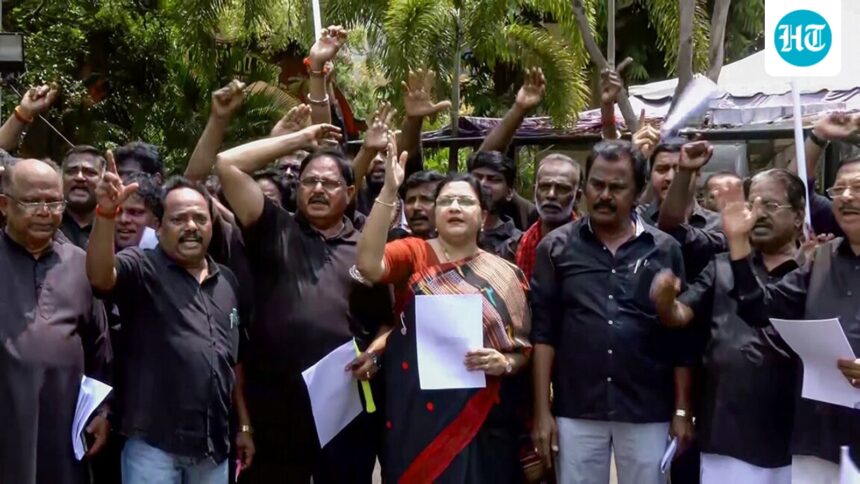
When Parliament met this week in special session to discuss three bills related to redrawing India’s electoral map to increase seats in the Lok Sabha – thus reserving a third of the seats for women – the opposition was keen to make one thing clear from the start: it was not against a women’s quota.

Congress member Gaurav Gogoi said, “We support women’s reservations wholeheartedly.” The Lok Sabha said during the discussion on the Constitution (131st Amendment) Bill, 2026, the Delimitation Bill, 2026, and the Union Territories Laws (Amendment) Bill, 2026.
Gogoi stressed that what the opposition objects to is that the government’s real intention behind the border demarcation process is to manipulate the boundaries of electoral districts for political gain.
The G word – Fraud – is at the heart of these concerns.
In its simplest form, gerrymandering means drawing electoral boundaries not to fairly represent voters, but to determine in advance who will win.
The government has categorically denied this charge.
However, to understand why the Opposition is not convinced, here’s a look at what Prime Minister Narendra Modi’s government has promised, and what the bills actually say.
We will return to Fraud and its origins, in a few.
Basic fear
The Lok Sabha number was last updated to 543 in the 1970s, and was subsequently postponed twice for 25 years.
The fear has always been that states with higher populations, such as Uttar Pradesh and Bihar in the Hindi belt, would get a larger share in Parliament.
The South, which has been more progressive in controlling its population, will end up with a smaller share of seats, a kind of punishment for being good at controlling the population.
For this reason any change in the total number has been postponed for five decades. The country’s political system was unable to discuss and decide what to do.
The government has now proposed to increase Lok Sabha seats to create a larger chamber So that the women’s quota can be accommodated.
The women’s quota law had already been issued in 2023, but its implementation was linked to the upcoming population census and determination of borders. The government wants to change this association to say that any census can be used, such as the last one from 2011, and boundaries are demarcated accordingly.
According to the Constitution, the country’s borders are in any case scheduled to be demarcated after 2026 according to the latest population census. After that year. That would have been the 2031 census according to the 10-year cycle. The 2021 Census itself has been postponed due to Coronavirus and some unexplained reasons, and has only now begun. This means we could conduct a new census sooner than 2031 as well.
But the government now wants powers to use the 2011 census to redraw the Lok Sabha. In fact, the proposed amendments and bills say that the government can obtain the necessary powers to use it any Enumeration it chooses, in the future too. This means that the South’s fear of losing its share of seats could be realized if the borders were demarcated according to census or population numbers only. Because the population of the North continues to grow faster and larger.
Government “guarantee”.
Union Home Minister Amit Shah sought to stifle this fear in Parliament, presenting what he claimed was a Distribution of seats at the state level. This data indicates that southern states will not lose out, as all states will receive a flat 50% increase. Therefore, no change to anyone’s share of the pie. His figures said the South’s relative share would remain stable at around 24%.
Prime Minister Narendra Modi, speaking in Lok Sabha, offered a “guarantee”. He told the House of Representatives, reassuring the southern states: “No one will be wronged.”
But these are political commitments made before Parliament. It is not written in the invoices.
DMK MP Kanimozhi Karunanidhi pointedly asked about the basis of Shah’s numbers.
“Since this formula (promised by Amit Shah) has not been codified as an immutable constitutional or legislative safeguard, it can be easily done away with or changed by a simple parliamentary majority, providing no assurance that it will survive beyond the very short term,” Congress member Shashi Tharoor said in the Lok Sabha on Friday.
What the bills actually say
The Constitution (131st Amendment) Bill, 2026 raises the maximum Lok Sabha seats from 550 to 850 – with up to 815 members from states and up to 35 members from union territories. This means that the numbers can reach a maximum of 850.
Shah said the number would now rise to 816 seats, adjusting for the fixed 50% increase.
Most importantly, the bills remove the current constitutional provision that linked the demarcation of boundaries (change in the number of seats) to the last census.
The new bill stipulates that the government – by a simple majority in the Lok Sabha – can decide when delimitation will be implemented, and which population census will be used for it.
This is the long-term provision in the actual bill, regardless of what the current government says.
What happened in Assam and J&K
Limited demarcation has already been implemented in two places under the current government – Assam (2023) and Jammu and Kashmir (2022). This will only change the boundaries of electoral districts, not the total number, as the number has been frozen since the 1970s.
An analysis of Hizb ut-Tahrir’s data in Assam showed that after delimitation in 2023, the smallest assembly constituency had just 50% of the state’s average voter turnout – worse than the pre-delimitation figure of 63%. This pattern also applies to parliamentary constituencies. Similar trends were found in Jammu and Kashmir.
In short, the demarcation process under the current government has not brought constituencies closer to equality; I moved some of them away.
The 2008 delimitation, conducted under the Congress-led United Progressive Alliance government, also showed differences in the number of voters and was therefore incomplete. But in most large states, the gerrymandering declined after 2008; This means that electoral districts are becoming more equal, not less. And these are just numbers.
There are real concerns about how different communities, religions and support groups will be divided in different seats.
In Assam, if fair representation is the principle, each Lok Sabha seat should have approximately 17.5 lakh voters. Instead, the Muslim-majority seat of Dubri had about 10,000 additional voters. This means that a vote in Dupree is worth much less than a vote elsewhere in the state. The additional voters for Dhubri were drawn from neighboring Barpeta district, from which Muslim-majority areas had been removed.
This turned Barpeta into a Hindu majority constituency overnight. The BJP-led NDA has won the 2024 Lok Sabha elections for the first time. “The delimitation has secured the Barpeta Lok Sabha seat for the Hindu majority in the future as well,” a student union leader allied with the NDA was quoted as saying.
This is where the term gerrymandering becomes relevant.
Explain G-Word correctly
The term “Gerrymandering” was coined in 1812, when an American newspaper Boston Gazette He published a political cartoon of the Massachusetts electoral map, which had been redrawn to favor the Democratic-Republican Party under Governor Elbridge Gerry.
The shape of the map resembles a salamander Legendary, it resembles a lizard Amphibian. A poet at a Boston dinner party combined the governor’s name “Gerry” with “salamander” to produce the term. It entered dictionaries by 1848.
Gerrymandering works in two ways that the opposition has cited specifically in the Indian context.
The first means concentrating opposition-leaning voters in the smallest possible number of seats. This means that they are able to win those seats by a large margin, but their influence outside of those seats is minimal.
The second method that is feared is to distribute opposition voters narrowly across multiple seats, such that they are unable to form a majority in any of them.
Legal expert Srinivas Kodali has analyzed Assam’s 2023 delimitation maps to point out that constituency boundaries are divided by roads, rivers and mountains. At least one assembly segment does not contain a continuous map. “Mangaldoy is not even spatially connected,” he noted in one thread. X.
Long-term questions: ‘Population alone cannot be the basis’
India The demarcation law never imposed equal electors for each electoral district; It only calls for approximate parity among the population.
In this technical gap between the total population and the number of voters, manipulation can occur, as when the number of voters increases or decreases in a process like the Special Intensive Review (SIR) conducted in West Bengal and other states.
The government’s promises are big, and it seeks to address some concerns. But they are based on the assumption that the border demarcation committee, appointed by the central government, will draw the borders without any political calculations.
The bills do not create any legal obligations to address these concerns. It gives the current government powers to decide when and with what data future border demarcations can be made.
“If the government wanted reservation for women, it could have done so in 2023,” Tharoor said, noting that the quota had already been approved three years ago with support from all parties.
He said: “We will support not demarcation of borders, but only the women’s reservation bill.”
“The way you are demarcating the borders – the way you demonetised notes (notes in 2016), without thinking – we don’t want this political abolition. There has to be a big debate on what the formula should be. Population alone cannot be the basis. Talk to the small southern and north-eastern states,” said Tharoor, the Kerala MP.
“There is a need for a detailed discussion on demarcation, but for now, there must be immediate implementation of women’s reservation. We will support that,” he added.