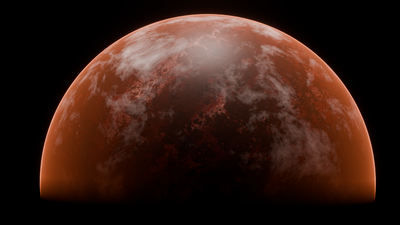
Mars was long considered an inhospitable planet, characterized by frigid temperatures and a constant bombardment of cosmic radiation. However, some recent studies conducted in laboratories have put this idea to the test in surprising ways.
Researchers were able to reproduce conditions similar to those found on Mars in terms of intense shock waves and toxic soil, and discovered that some microorganisms can withstand harsher environments than previously thought. The implications of such research are important because they reveal that life on other planets may actually be a possibility.
Mars simulation experiments reveal surprising cell survival
According to recent research conducted in the study “Runonucleoprotein (RNP) condensates modulate survival in response to a Mars-like stress state,” published in PNAS Nexus, scientists were able to replicate two of the biggest threats to existence on Mars, namely the intense shock wave generated by a meteorite impact and the presence of toxic perchlorate salts on the Martian surface.Even with such a dangerous atmosphere on Mars, scientists were surprised to discover that simple yeast cells could survive in both environments. According to the study, “yeast cells survived Martian shock waves and toxic perchlorate salts,” a discovery that was completely unexpected.The test was conducted by replicating the conditions of frequent meteorite impacts on Mars and the chemical composition of the planet’s surface.
How microorganisms survive the harsh conditions of Mars
How did these little creatures manage to survive? This was due to the impressive nature of biology itself. Studies suggest that organisms were able to form molecular shields that protect basic biological processes from damage.According to the study, these shields “protect vital cellular functions in response to stress,” ensuring survival where it would otherwise “decline to near-zero levels.” This is not without precedent either. Other studies show that bacteria are able to survive on Mars, where there are high levels of radiation, cold and lack of oxygen. The experiments conducted showed that the bacteria were able to survive in “cold temperatures, an environment devoid of oxygen, and radiation.” Some have even adapted by changing their physical structure or entering a state of hibernation, and pretending to be dead until they can return to life.
What does it mean to Life on Mars And beyond
The findings have important consequences for astrobiology and the search for extraterrestrial life. If simple cells are able to withstand such inhospitable conditions in laboratory environments, it opens up the possibility that microbial life exists or may have existed at some point on Mars.It has been proven that terrestrial life can thrive under extreme conditions. However, there are similarities between conditions on Earth and those on Mars.
However, experience shows that life does not require comfort, but rather flexibility.However, while surviving adverse conditions is one thing, succeeding in them is quite another. Scientists say life would not be able to thrive on Mars.However, the lesson here is clear: life turns out to be a lot harder than we thought. Each subsequent experiment expands our concept of the habitable zone. Each discovery brings us closer to accepting the existence of life elsewhere in the universe.