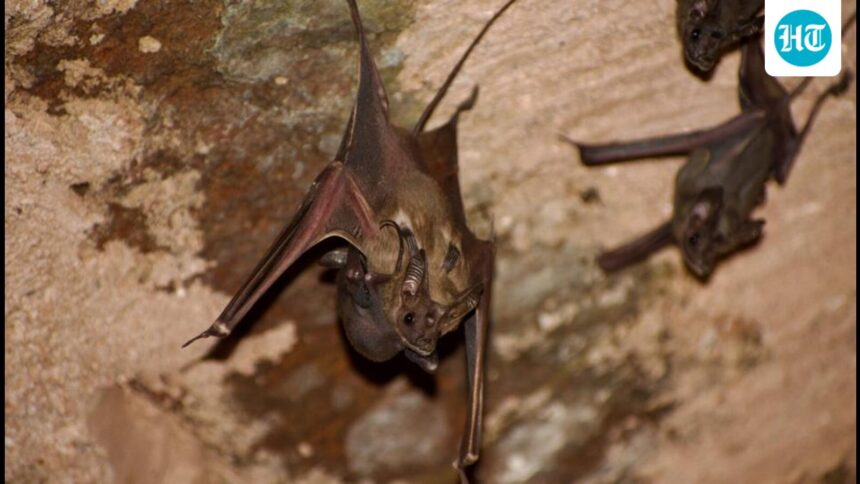
India is home to 135 species of bats, including 16 endemic, but they are among the least studied mammals, with 35 species still missing in data or not assessed, even as habitat loss, tourist pressure and urbanization reshape their roosts across caves, monuments and cities, a study has found.

Thirty-four experts from 27 institutions conducted the two-year study titled ‘State of Bats in India’. The Nature Conservation Foundation (NCF) and Bat Conservation International (BCI) released the report on Tuesday in collaboration with the World Wildlife Fund (WWF) in India.
The study found that West Bengal (68 species), Meghalaya (66 species) and Uttarakhand (52 species) are the regions of bat diversity in India. Punjab and Haryana had the lowest diversity among the states, with each reporting only five species. There are 15 species of bats in Delhi. The previous national assessment, conducted nearly two decades ago, found 120 bat species.
The report said only seven species were classified as threatened with extinction, but warned that this was an undercount, due to data gaps in bat coverage across the country. “Despite their critical ecosystem roles as seed dispersers, pollinators, and insect predators, bats receive little attention from the nation’s research and conservation communities, and little recognition in government policies and programs,” the study said.
The study noted that there are less than 50 bat researchers across India, each trying to study and conserve these “misunderstood animals” with limited resources and support compared to those available.
Of the 16 species endemic to India, four (the sooty bat, the Meghalaya thick-thumbed bat, the tube-nosed rainforest bat and the tube-nosed Peter’s bat) are found endemic to the Himalayas and the North-East. Four species endemic to the Western Ghats include Salim Ali’s fruit bat (Latidens salimalii), Pomona’s leaf-nosed bat (Hipposideros pomona), Piton’s whisked bat (Myotis peytoni), and Srini’s long-toed bat.
Data gaps and lack of knowledge about bats, especially government data, remain a challenge, experts said. “We have very limited government data. When a sighting is made, or when we need information, most bat researchers communicate with each other,” said Aditya Srinivasulu, research coordinator at Zoo Outreach (Hyderabad), who was part of the study.
The stigma associated with bats is linked to a lack of research on the species, even though bats are key pollinators, seed dispersers, and natural pest controllers, and play an important role in the ecosystem, said Thangswanlian Nolak, a doctoral student and bat researcher. “They are considered like pests or rats in the sky,” Nolak said. “After Covid-19, this stigma has increased.”
The report said that India hosts several bat species that suffer from a lack of data (such as Peter’s tube-nosed bat and Roton’s free-tailed bat). She added that there is not enough information about its classification, distribution, population size and/or environment. “These species are often neglected in conservation planning due to a lack of basic data, and addressing this requires targeted surveys and research to fill knowledge gaps.”
The place where bats live has been identified as a major structural vulnerability. Most species are found roosting outside protected forests, in caves, temples, forts, tree hollows, and urban structures, from ancient buildings to sewer pipes.
The report said that the largest bat colonies in India are often found in man-made structures, especially historical monuments. She points to recurring conflicts between bat conservation and archaeological management. The report noted that the Archaeological Survey of India (ASI) has removed the bats over the years by installing bright lights and conducting chemical cleaning.
ASI is responsible for the management of historic monuments, which has often criticized bats on site. “At sites such as the Qutub Minar, Khirki Mosque, Feroz Shah Kotla, and Agrasen Ki Baoli in Delhi, and Daulatabad Fort in Maharashtra, restoration efforts included installing bright lights and closing roosting sites, disrupting resident bat colonies,” the study said.
In some cases, she added, chemical cleaning was used to remove bat guano, preventing roosting. Only in rare cases were bats allowed to roost, for example in Hyderabad’s Golconda Fort, or Delhi’s Zafar Mahal, in unused rooms, the report said.
Rohit Chakravarti, director of the Indian Bats Project of NCF and BCI, called for the need for coexistence. “The report highlights how limited roosting spaces for bats, including monuments, are, but in many cases, they are being removed from these places. The study wants to highlight how data is lacking for 35 species, which essentially means there is limited data about them. A number of these species are endangered and difficult to find and, therefore, require attention,” Chakravarty said.
“Unlike the State of India’s Birds report, which has bright pictures and data on which bird species are increasing or decreasing, we have no such comparison with bats, because we have very little data on these species.”
The report called for expanding surveys, improving taxonomic clarity, and incorporating bats into environmental policy, impact assessments, and tourism planning.