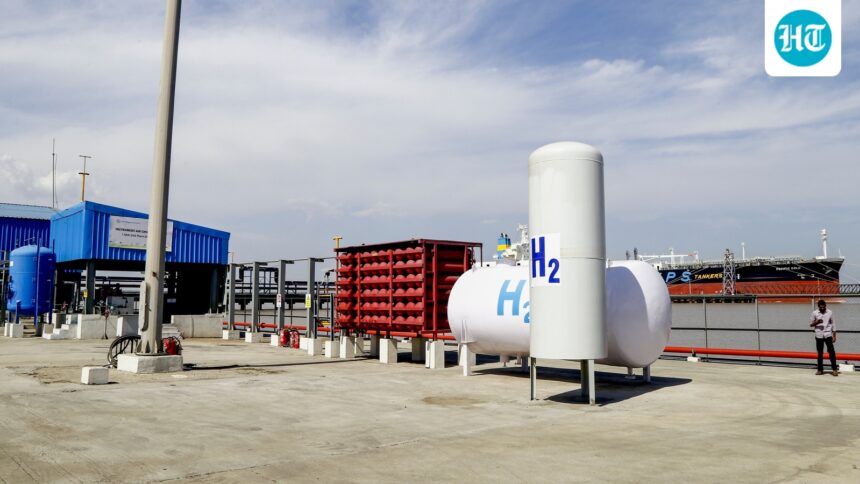
India had commissioned about 8,000 tons per annum of green hydrogen as of February, against a target of 5 million tons per annum by 2030, achieving about 0.16% of the ambitious achievement envisaged under $Rs 19,744 crore – National Green Hydrogen Mission approved by the Cabinet on January 4, 2023.

The wide gap between the allocation of annual budgets under the National Green Hydrogen Mission (NGHM) and the use of funds indicates lagging progress. According to data submitted to the Lok Sabha on March 25 by Minister of State for New and Renewable Power and Energy Shripad Yesu Naik, 68% or $203.75 of $The Rs 300 lakh crore allocation was used in 2025-26 (revised estimates), although this was an improvement over 15.42% or $Rs 46.26 crore $300 lakh crore allocated in 2024-25 (RE), 0.11% or $11 lakh from $Rs 100 lakh crore has been allocated in 2023-24 (RE).
Also Read: Babloo to Balmukund: Raj govt pushes to change ‘inappropriate’ names for babies
India’s progress on the green hydrogen front has come under the microscope in the wake of the current energy crisis, triggered by the war in West Asia.
While Naik provided only revised estimates, budget documents showed that the Budget Estimates (BEs) were more ambitious, indicating gaps in ambition, annual planning and implementation. The budget estimate (BE) for the green hydrogen mission was in 2023-24 $297 crore, which was later reduced to $100 crore in renewable energy phase. Likewise, the mission’s budget was Rs 600 crore in BE for 2024-25, which has been reduced to $300 crores in renewable energy phase. In 2025-26 BE, the allocation was made under the head again $600 crore, but in the renewable energy phase it was again reduced to $300 Crores. Now, in the current fiscal year, the BE of the mission has been maintained at $600 Crores.
Also read: Southern states ‘misled’ before, will ‘win’ seats, says Kiren Rijiju amid row over demarcation exercise
According to people aware of the developments who spoke on the condition of anonymity, the Union Finance Ministry has allocated $Rs 600 crore for green hydrogen in 2026-27 budget despite push by Mission Administrative Ministry – Ministry of New and Renewable Energy (MNRE) $800 Crores. One of them said: “It is clear that funding has been allocated less because the money allocated in previous budgets remained unspent and progress on the mission was slow.”
Read also: Maldives canceled Moizu’s meeting with the US Ambassador to India last month
An MNRE spokesperson said that green hydrogen is an “emerging industry” that is simultaneously developing technology, reducing costs, building the ecosystem, and creating the market, and therefore, at the global level, the transition from large-scale demonstration to large-scale commercial production follows a well-established development path.
“India is ahead of the same curve. So the limited commercial production at present is not an India-specific anomaly, it reflects where the sector stands internationally in terms of technology and market maturity. What is unique about India’s position is that it has moved decisively on policies, incentive structures and capacity grants within a relatively short time frame, laying the foundation for the commercial scale that lies ahead,” this person added.
Also read: Decibel levels peak in Bengal campaign as leaders criticize ahead of polls
Structural issues and an expensive electrolyzer increase the cost and lead time of the project, according to a spokesperson. Moreover, there are many challenges on the demand side that affect the economics of the project and the feasibility of the investment. “The government is fully aware of these constraints, and the design of the National Green Hydrogen Mission addresses each of them head-on in a structured and phased way,” the spokesperson said. One such measure is the Strategic Interventions for Green Hydrogen Transition (SIGHT) programme, which is similar to the Production Linked Incentive (PLI) scheme. It has two distinct financial incentive mechanisms – targeting local manufacturing of electrolyzers and green hydrogen production.
Electrolyzers use renewable energy to split water into oxygen and hydrogen.
The spokesperson said pilot projects in the steel, transportation and shipping sectors are currently generating the real-world operational data needed to de-risk larger business investments. The standards and certification framework being created builds the regulatory confidence that investors and financiers need in the long term, this person added. The critical challenge on the demand side, in an emerging sector, has been addressed proactively.
According to the spokesman, since the beginning of the mission, a number of developers have sought to establish small factories to create different technologies and business models to demonstrate the potential of hydrogen. “The main approved routes are (1) electrolysis route and (2) biomass route. As of March 2026, production capacities of around 8,000 tons per annum have been reported at various locations,” the person said.
According to the ministry’s data, about 20 companies have established a total capacity of 7,968.87 tons across the countries. Some of the companies are, JSW Steel with a capacity of 3,600 tpa in Vijayanagar (Karnataka), GAIL India (1,752 tpa in Vijaypur, Madhya Pradesh), Adani New Industries Limited (876 tpa in Kutch, Gujarat), and Bharat Petroleum Corporation Limited (780 tpa at Bina Refinery).
The Green Hydrogen Mission was first mentioned in Prime Minister Narendra Modi’s Independence Day speech on August 15, 2021. “To achieve the goal of Green Hydrogen, I announce the National Hydrogen Mission today with this tricolor as a witness,” the PMO said in a statement quoting him.
“We have to make India a global hub for green hydrogen production and export in Amrit Kal. This will not only help India make new progress in energy self-reliance but will also become a new source of inspiration for the transition to clean energy across the world,” the statement added, quoting the Prime Minister once again.