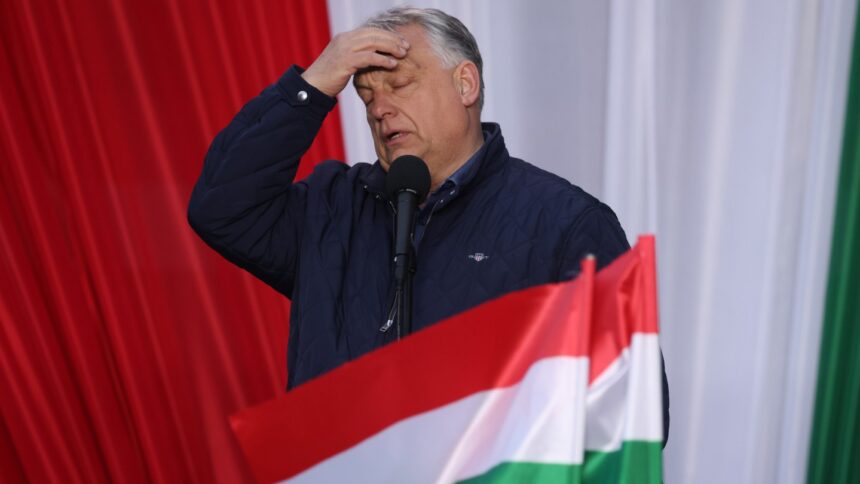
On Sunday, Hungary’s far-right leader Viktor Orban fell in the election after 16 years of the most intolerant and corrupt rule in post-Soviet Eastern Europe.
Perhaps a documentary helped achieve this.
Peter Magyar’s center-right TISA party beat Orbán’s Fidesz party in the parliamentary elections by a margin of nearly three to one, a stunning turnaround after many years of Orbán consolidating his power with extrajudicial tools such as gerrymandering, court packing, and co-opting independent media. Tisza won 135 of the 199 seats (Fidesz got only 55), which gave the former party an overwhelming majority that would allow for constitutional changes.
Many factors contributed to the polarizing prime minister’s loss, including an economy that became among the weakest in Europe and fatigue with the ruling party’s demagoguery, which is often deployed to cover up his alleged corruption.
But Tessa also had a secret weapon: an independent documentary called Voting price It was released just two weeks before the election.
Clocking in at just under an hour, the film makes up for with investigative power what it lacks in formal polish. The filmmakers travel through Roma villages in the country’s rural countryside — hardline Fidesz strongholds — to uncover a vast network of bribery and extortion.
As a series of whistleblowers have revealed, a highly sophisticated network of agents based in Budapest prepares (and delivers) everything from food packages to 20,000 forints (about $75) to those who will vote for Fidesz. Agents accompany people to the voting location and, using a loophole that allows them to accompany them while voting, ensure that the vote is cast for the right candidate (Fedizian). The film states that other parties attempted this as well, but it was nowhere near the level of scale or deception.
Meanwhile, at the local level, the film claims that pro-government mayors often go further: they threaten public servants and others to vote for Orbán’s party.
“You can’t get public work, you can’t go to work, you can’t do this, you don’t get that, they deny you housing benefit,” says one whistleblower who used to bribe and intimidate on behalf of the party. A second informant added: “There are so many things they can do to hurt these families.” The most cruel of them is the kidnapping of their children.
These paintings help explain how Orbán remained in power for so long. The revelation of these facts, especially on the eve of the election, may have ensured that time is now up.
Voting price It was shown in a cinema in Budapest last week and was also released on YouTube; The two platforms cleverly circumvented Orban’s largely state-controlled television news. In just two weeks, the film achieved 2.2 million views on YouTube. (You can watch it below.)
While there is little evidence that it stopped the criminal network from operating again, the film may have helped motivate people to vote against Orbán who would otherwise have stayed home. Turnout in Hungary on Sunday reached an astonishing post-Iron Curtain record of 74%, or about 6 million people, meaning up to a third of all voters saw the film (a figure equivalent to more than 50 million people in the United States).
The film was directed by a group of about 20 people from a group called DeakcioKozosseg, which roughly translates as Counter-Community Action. Arun Taimar, a young software engineer who is among the filmmakers, did not respond to a request for comment at the time of publication. “When we started filming six months ago, we only intended to produce a documentary about vote buying,” the group said on its YouTube channel. “We received information from 14 provinces, conducted more than 60 interviews, and traveled 20,000 kilometers. According to those interviewed, people’s lives and votes in rural areas are affected not only by money, but also by drugs and intimidation.”
Orban’s defeat represents a blow to Donald Trump’s administration, which has long been allied with the extreme Hungarian populist. Last week, with Orban’s chances waning, US Vice President J.D. Vance traveled to Hungary to meet and endorse the leader. He repeated the extreme nationalists’ line that it was the European Union, not the Fidesz leadership, that had destroyed Hungary’s economy. While Vance was there speaking at a Fidesz rally called by Trump, he said, “I love Viktor… He’s a great guy.”
Both the loss and the potential role of Voting price I can’t help but draw attention to the attempt by American documentaries to change the course of the elections here, especially to confront the conservatives. These efforts go back to Michael Moore’s “Fahrenheit 9/11” to stop the re-election of George W. Bush in 2004, to the release of Errol Morris’s anti-Trump immigration policy document. separate The former president will run again in 2024.
Both Trump and Bush will continue to win, despite the enormous popularity of Moore’s film. But on Sunday, a Hungarian doctor did what no American could do.