Dear reader,

A woman full of thought
He comes home
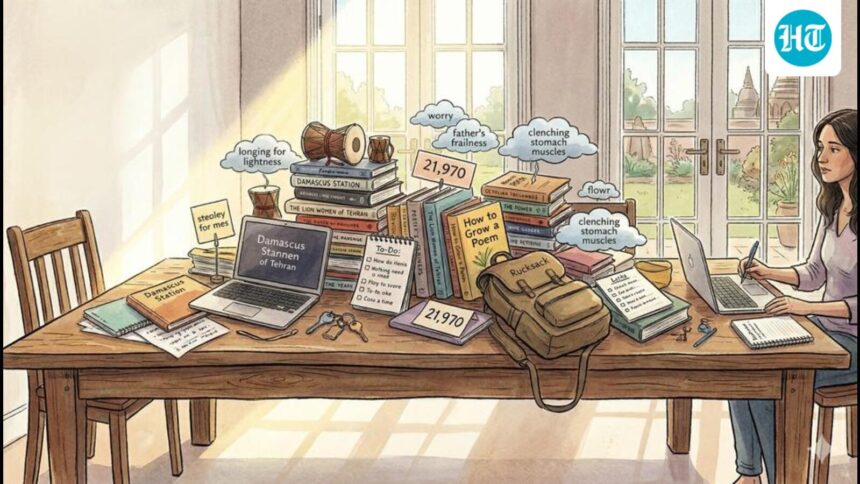
She puts her bag on the dining table
Her set of keys, her laptop, her notebook
You put them on the table.
It puts sunlight streaming in from French windows
The hum of the grass-cutting machine, the beating of the temple drums
Comforting the patchwork quilt, chewing bread
Wooden stairs creak
She lays there
Books I’ve read
Damascus station and
Lion women in Tehran.
On the table lays a woman
Things that happened in her mind
What she wants to do with the rest of her life.
Her mother’s illness and her father’s weakness
Worried that her daughters would be okay
Find the right person
I wish you a happy life
She extends her hand and places it on the table eagerly
For days she wanted to be light
She lays on the table contracting her abs
Her to-do lists, the doorknobs she needed to buy
Total Rs. 21,970 should have been paid to the Electricity Commission
All this piles up on the table.
The table stands just like that, steady and strong
That’s the power of this table.
He does not complain about pregnancy
It wobbles once or twice, then stands still.
The pile continues to grow.
As I write this poem, sunlight is streaming in from the French windows. Next to me, on my grandparents’ cedar dining table, is How to Grow Your Own Poem by Kate Clanchy. Here I find a collection of poems, selected as tips to help you write your own poems.
I write my poem with Clanchy’s help. The first chapter of her book takes me to “The Table” by the Turkish poet Edip Cancivir. “This poem will not let you down,” Clanchy says. “If you use its framework to hold your own experience, you will create something beautiful.”
Earlier this year I wrote about William Sigart. Sigart, editor of Poetry Pharmacy, spoke of rescuing poetry from the dusty shelves in the corner of a bookstore and bringing it into public life. Since then, I’ve been reminding myself why I love poetry and looking for ways to bring it back into my life.
I love poetry for its diverse images, such as “Three houses in the village/A pregnant woman/And two cows/Their names are Gopi and Brinda” by AK Ramanujan.
Poetry forces me to slow down and listen to the sound of the words and their music, to go beyond their superficial meanings. He strips things down to the basics – “I remember the night my mother was stung by a scorpion / Ten hours of continuous rain drove him / To crawl under a bag of rice,” from Nissim Ezekiel.
The poems sing to me songs of unlikely heroes in faraway lands where “the wind was a torrent of darkness between the stormy trees / the moon was a ghostly sailing ship tossed over the cloudy seas” from “The Highwayman” by Alfred Noyes.
So, this April, celebrated globally as World Poetry Writing Month, here are three things I’m doing:
1. Read a poem out loud daily once, twice, or even three times. Yesterday it was ‘Yashwant Rao’, a poignant and stunning poem by Arun Kolatkar, thanks to my friend B who posted it on his book club WhatsApp group.
2. I write a poem every day, and I thank Kate Clanchy for helping me do it in such a rewarding way.
3. Immerse yourself in the world of poets, watch the Dickinson web series on Emily Dickinson, read my friend R Substack’s newsletter called Lines From a Logophile which has stories on scholar poets, Sanskrit poets, and Western poets, and read poets’ memoirs like Journeys by AK Ramanujan.
When I get up from my hair break to go back to my day, I look at my grandparents’ cedar table, and I see it up close, with its rough, matte finish, the ancient grain of its lines. And I realize how poems take over all of our lives, how they make our private worlds feel shared. Because we each have our own tables.
What are you piling on your table today? Can writing or reading a poem, once, twice, or even three times, help your table be more stable?
(Sonia Dutta Chowdhury is a Mumbai-based journalist and founder of Sonya’s Book Box, a personalized book service. Every week she brings you books specially curated to give you a comprehensive understanding of people and places. If you have any reading recommendations or reading dilemmas, write to her at sonyasbookbox@gmail.com. Views expressed are personal)