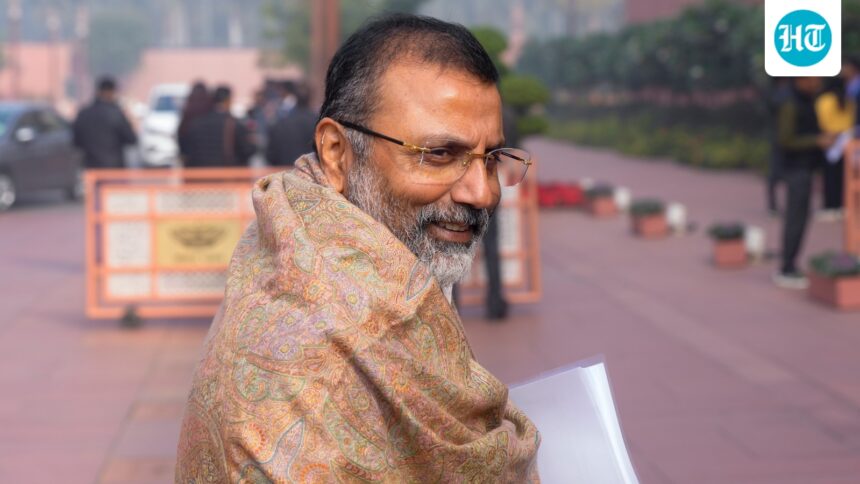
NEW DELHI: A parliamentary committee has observed that features like Community Notes, on social media platforms like X, should be treated as a publishing activity, making the platform itself a publisher and not an intermediary, the committee chairman said in a social media post on Saturday.

According to Bharatiya Janata Party (MP) Member of Parliament Nishikant Dubey, who chairs the Parliamentary Standing Committee on Communications and Information Technology, the Ministry of Electronics and Information Technology (Meity) should either direct platforms to disable community feedback on platforms or consider imposing a “publisher tax” – in what has been interpreted as obligations similar to the Australian News Media Bargaining Code, which requires platforms to compensate news publishers.
An official in Mitte, who requested to remain anonymous, said that the ministry had not received an official recommendation from the parliamentary committee. “If we receive a formal recommendation, we will examine it,” this official said.
“Our committee, the Parliament’s Standing Committee on Communications and Information Technology, has unanimously told @GoI_MeitY that @XCorpIndia’s job is to publish community notes, not that of an intermediary, so any social media platforms must shut down their community notes, otherwise, as per Australian law, they will have to pay publisher tax,” Dubey wrote in a post loosely translated from Hindi.
Dubey’s comments come against the backdrop of heated debate over the government’s decision to amend the IT Rules 2021, which – in the proposed model – would expand the government’s regulatory oversight to include user-generated content, including features such as community feedback, when it relates to news, politics or public policy.
HT first reported on April 10 that these changes could place community feedback under the purview of the Ministry of Information and Broadcasting, potentially allowing authorities to order the removal of feedback, including those that add context to or challenge government officials’ claims.
The report has since sparked reactions from opposition parties.
Karnataka IT Minister and Congress leader Priyank Karg posted on X, “Community feedback on
Shiv Sena (UBT) Member of Parliament, Priyanka Chaturvedi, wrote on
Digital rights advocacy group Internet Freedom Foundation (IFF) questioned the procedural and factual basis of Dube’s claim, noting that no parliamentary committee report before the House mentioned community feedback.
She also noted that committee proceedings are usually confidential until they are formally introduced, and said the statement contained a “fundamental inaccuracy”, particularly in invoking the Australian News Media Bargaining Code, which “operates in a completely distinct field” and does not treat features such as community feedback as a publishing activity.
The IFF also argued that under Indian law, including the precedent set in Shreya Singhal v. Union of India, merely hosting or labeling user content does not strip platforms of the protection of intermediaries, warning that expanding this interpretation could have broader implications for freedom of expression online.
Dube’s post refers to the “publisher tax”, and conflates it with Australia’s News Media Bargaining Code, which requires certain digital platforms to negotiate and pay news publishers for the use of their news content, rather than levying any tax.
The post also attaches an image of a document explaining the role of “intermediaries” in the Australian criminal justice system, which refers to trained professionals who assist witnesses in court, rather than digital platforms or social media services.
MeitY published the revised IT rules on March 30 and requested comments by April 14.
However, following objections from industry and civil society following consultations on 7 April, the Ministry extended the timeline for the call for comments by two weeks, allowing stakeholder comments until 29 April.
HT reached out to X and BJP Nishikant Dubey for comment but did not receive any response.