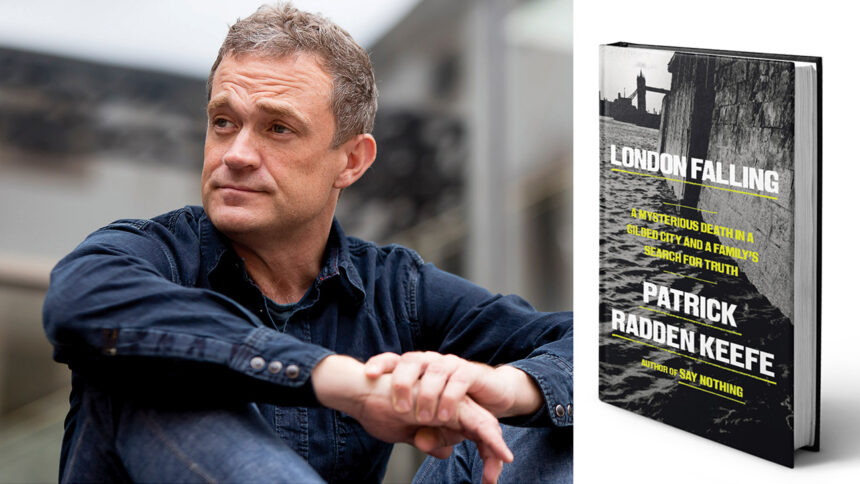
Screenwriters secretly envy book authors’ intellectual prestige and creative control, and authors secretly dream of working in Hollywood. Few writers blend the two worlds as confidently as Patrick Radden Keefe. To give you an idea: he found the idea for his new book, Fall of Londonwhile he was set to adapt the FX of his 2018 best-selling book, Say nothingAbout the Troubles in Northern Ireland.
Or rather, the idea found him. Keefe, the series’ executive producer, was in London, sitting in the director’s chair between settings in a mock-up of Scotland Yard, when the episode’s director’s guest began chatting with him. The man told Keefe about a family he knew whose 19-year-old son had jumped to his death into the River Thames under mysterious circumstances, and after his death, they discovered he had posed as the son of a Russian oligarch and was sleeping with notorious members of the London underworld.
Kev was hooked. He believed that this tragedy could serve as a lens through which to tell the story of how London, the city he loved and lived in, had changed in recent years, becoming a magnet for dirty money and a scene of reinvention.
When he returned home that night, Keefe Googled the incident. There was no trace of her on the internet – just the way he liked it. “I knew that if my family was up for it, this would be the next thing for me,” he says. “I’ll sweep the decks.”
Rachel and Matthew Brettler, parents of Zach Brettler, the boy who jumped, were hesitant at first. But the investigation conducted by the Metropolitan Police in London led to nothing. They decided that Keefe had the sensitivity required to tell the story and the acumen to uncover details that lesser investigators had missed. His track record spoke for itself.
As an author, Keefe specializes in untangling shadowy networks, be it the Provisional IRA or the Sackler family, whose role in the opioid crisis through its ownership of Purdue Pharma is the subject of his book. Empire of pain. The 2021 best-selling book led to his work as an executive producer on the Netflix miniseries Pain relieverMore importantly, it contributed to the Sackler family having to pay a $7.4 billion settlement to the victims. Subtitle for Keefe’s 2022 press kit, Scammersmay also have printed on his business card: “True Stories of Crooks, Murderers, Rebels and Swindlers.”
Fall of London It began like most of his six books: as an essay by L The New Yorkerwhere Keefe has served as a staff writer since 2012. It ends the way his last two books ended — as a television series. In March, before the book was published on April 7, A24 emerged victorious after a heated competition for the editing rights. At Keefe’s insistence, all serious suitors zoomed in with the Brettlers. “The plan is to move forward not only with the family’s blessing, but also through their active consultation,” Keefe says.
At 49, the Dorchester, Massachusetts, native has joined the unfortunately dwindling group of celebrity investigative journalists. His name was so recognizable that it was chosen as himself in the final scene of the HBO hit industry. “I had a lot of fun acting,” he says. “I was joking with a friend of mine at FX who did it Say nothing That I would shoot him in the head. He could simply give his friend a portion of his 2025 campaign for J.Crew, photographing him wearing a coat and suit, coffee cup in hand.
When the music stops in the suburban New York café where we meet, Keefe’s voice drops to a whisper. It is unclear whether this is out of consideration for our fellow pastors or out of concern for those who might be listening. Given his line of work, and the unsavory people he writes about, it pays to be cautious. That’s why he doesn’t want to reveal which New York suburb his family calls home.
“When I was writing the Sackler book, we had a private investigator parked in front of our house,” he says. Keefe has also received his share of legal threats and has learned to shake them off. “At a certain point, you get enough of it, that your fears become less manageable. In fact, sometimes you feel like if you’re not getting legal threats, you’re not doing your job.”
qualitative The New Yorker Fellow David Grann, author Bet and Moonflower Killers“He’s just a reporter,” he says, “and that’s why he’s able to get the exact details about the people he’s writing about and the events he’s writing about, to bring them to life, to make them feel real.”
Keefe treats all this research lightly, careful not to let it weigh down a good story. “His books are incredibly cinematic,” says Eric Newman, the show’s director. Narcos Who collaborated with Keefe years ago on a project, since aborted, about organized crime in Asia’s Golden Triangle. “I remember reading the editorial for Say nothingWhen these men come into this house and drag this woman in front of her children, it has that flair that really draws the viewer in. (The scene was largely recreated in the FX edit.) Fall of London It starts off just as dramatically. But Keefe says he never thinks about the possibility of adjusting the screen when writing journalism. If anything, the effect goes the other way. His occasional work as a screenwriter over the years — all on unproduced projects, including Jo Nesbo’s adaptation of Channing Tatum — taught him the value of narrative economy.

“Part of what I’ve learned from screenwriting is how to take, say, a 300-page court script and turn it into two great paragraphs. I have to take the best things and condense them onto one page,” he says. Having grown up in the 1990s, which he calls “the golden age of movies,” he is as likely to turn to movies for inspiration as his real-life predecessors. Take the opening pages to Empire of painabout the testimony of a Sackler family member: “What could be more boring than a bunch of lawyers sitting at a table?” He remembers how he thought. “How do you give this a real sense of drama? And I found the answer in the opening scene of the movie.” Michael Clayton“, where the lawyer suffers a mental breakdown.
Despite his devotion to realism in nonfiction, Cave has proven to be more flexible when it comes to scripted screen adaptations of his works. “He’s also a great screenwriter,” says Nina Jacobson, who produced the film with Brad Simpson. Say nothing“So he could have easily said, ‘I want to adapt it myself.’ But it actually gave me more respect for Patrick as a producer when I saw how smart he was to step back and encourage someone else’s composition.

Even as he continues to write The New Yorker – I caught him between trips to New Orleans, the site of his latest investigation – Keefe digs deeper into Hollywood. Jacobson and Simpson, riding on their success with love storyare once again collaborating with Keefe on a series inspired by his work. And with the English production company Bad Wolf industryHow he adapts Everything that glittersa non-fiction book about an art-world hustler, for HBO.
He is still getting used to his dual identity. “I find screenwriting very painful compared to non-fiction writing,” he says. “Even when you modify something, you’re kind of inventing it out of whole cloth. When I sit down, it’s as if anything could happen, like ‘I am a god’. I find that very difficult.”
This story appeared in the April 8 issue of The Hollywood Reporter magazine. Click here to subscribe.