

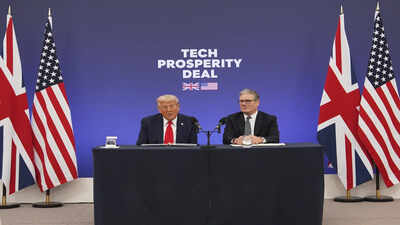
President Donald Trump and British Prime Minister Keir Starmer attend a business roundtable at Checkers near Aylesbury, England. AP/PTI (AP09_18_2025_000277B)
There is a recurring joke in Yes Minister (and Yes Prime Minister) which usually involves the Prime Minister of Great Britain discovering, with increasing alarm, that he is not as sovereign as he thought he was.
At some point, the joke ends: for all the rhetoric about independence, Britain still depends on America for protection from external threats. Humor lies in the gap between the situation and reality. The country that once ran an empire now politely waits for Washington to answer the phone.This gag recently resurfaced in a sketch that imagines Keir Starmer in a state of hyperventilation before making a call to Donald Trump, as if the “special relationship” were less of a partnership and more of a performance review.
The joke is simply an analogy to the true nature of Albion’s relationship with Uncle Sam. Starmer’s discomfort with Trump was unusually clear for a British prime minister. “I’m fed up,” he said, directly linking rising energy costs to decisions made by Trump and Vladimir Putin. This line, gentle as it sounded, was a shift in tone. What may seem like a minor inconvenience to outsiders is largely a paradigm shift, because British leaders rarely speak of American presidents as causes of domestic pain.
They assimilate, distort, reformulate – or in Tony Blair’s case wholeheartedly support wars over non-existent weapons of mass destruction.
Starmer took the blame, at least briefly.
He watches
Yes, the Minister 3×2 – BBC2 – “It is to protect us from the French”
On the other hand, Trump did not treat Starmer with the diplomatic politeness that usually fuels transatlantic relations. He called him “unhelpful”, said the UK was “not our best ally”, and publicly mocked him for consulting his team before making military decisions.
At one point, he mocked Starmer’s warning in a cartoonish voice: “I have to ask my team… We’ll meet next week.”Trump has treated the UK the same way he treats Europe, NATO and anyone else he believes does not hold its waters. In contrast, Starmer tried to draw a line. He said that Britain would not repeat “Iraq’s mistakes” and would only act on a “legal basis.” But even that pales in comparison to the rudeness coming from Europe.
French President Emmanuel Macron has publicly mocked Trump’s inconsistency, saying: “You have to be serious” and warning that the leader “cannot contradict himself every day.
In contrast, Starmer’s discomfort sounds less like a challenge and more like annoyance.
He watches
Sir Keir makes tough cold open phone call SNL UK
When the United States launched its strikes, the United Kingdom did not join. Instead, it allowed the United States to use British-controlled bases, positioning them as a defensive or logistical engagement rather than an offensive one.This is the language of a lawyer and a prime minister: qualified, qualified, process-based. It is also the language of restriction.Because this was not a challenge to the way it was sold. The hesitation was within limits. Britain did not say no to America. It’s said not yet, not completely, and not on your terms. The distinction is important at Westminster. It barely registers in Washington.For Starmer, the political opportunity is clear. In the face of Trump’s volatility, he can present himself as the adult in the room.
In the face of American impulsiveness, he can show persistence. In front of the scene, he can deliver efficiency. Allies have begun to portray this as a decisive moment, an opportunity for a prime minister often accused of drifting to appear decisive by making little effort.But this is only half the story.Because while Starmer may be gaining ground abroad, he is losing ground at home.British politics is now going through an unprecedented situation, as the two traditional parties, the Conservatives and Labour, are being eaten by their offspring in the new era.
UK Reform on the right and the Green Party on the left are no longer a marginal nuisance. They are structural threats.Nigel Farage, head of the UK’s Reform Party, presents himself as Trump’s ideological counterpart in Britain. His policies are not just inspired by Trump. Its authenticity is verified by him. Every moment of American assertiveness turns into an electoral argument. Every hesitation in Downing Street becomes a weakness.On the other side, the Green Party is consolidating a progressive bloc that is not only anti-Trump but increasingly skeptical of Starmer himself.
To these voters, Starmer’s rebuke seems procedural. Too late, too little, too careful.Which leaves Starmer stuck in the middle.Very cautious for a country drifting towards clearer choices. Too administrative for a moment that requires narration.This is the irony of his prime ministership. He looks more like a prime minister than the problem. War gives him clarity because it forces him to make decisions. Domestic politics exposes him because it requires condemnation.And Trump, for all his vagaries, understands this instinctively. His policy is based on projection. Power is declared, not demonstrated. The work gets done, even when it contradicts itself. Starmer, by contrast, is waiting for alignment: legal, political and institutional. Makes it safer. It also makes it slower.In a fragmented political landscape, slowness is read as absence.There is also a deeper irony. Brexit has been promoted as a restoration of sovereignty. Trump’s presidency exposes the limits of that sovereignty.
Britain remains linked to America’s security architecture, intelligence networks and military infrastructure in ways that cannot be easily separated. The basic access question made that clear. It turns out that independence is often conditional.That is why Starmer’s instinct to look towards Europe, however cautious, is important. Not as a big pivot, but as a hedge. Energy cooperation, defense alignment, and regulatory proximity.
These are attempts to reduce exposure to fluctuations emanating from Washington.Ironically, Trump may be pushing Britain closer to Europe.But this also comes at a political cost.Because for a large portion of voters, the debate is no longer about bias. It’s about control. Neither Brussels nor Washington feels in control.Which brings Starmer back to the problem he cannot avoid.And he could be right about Trump. He can be justified in his caution. It can even be justified by events. But unless that translates into something tangible – lower costs, greater stability, a clearer sense of direction – it remains abstract.Politics does not reward what is right. It rewards the result.The result, at the moment, is demanded by those who offer certainty rather than calibration, clarity rather than caution, and anger rather than restraint.Starmer is betting that the country still prefers efficiency to chaos.Early signs suggest the country is not so sure.
He watches
Uninstall Trident | Yes, Prime Minister Comedy greats
Which is why the old joke sounds less like satire and more like a diagnosis. That a British Prime Minister, caught between the language of sovereignty and the reality of subordination, performed independence while negotiating his borders is the reality of the empire on which the sun never sets. Or to borrow a line from Yes, Prime Minister, which is a bit PG-13 but perfect for describing the situation in Downing Street and the Prime Minister of one of the world’s last great empires: Responsibility, without authority, is the prerogative of a eunuch for the ages.