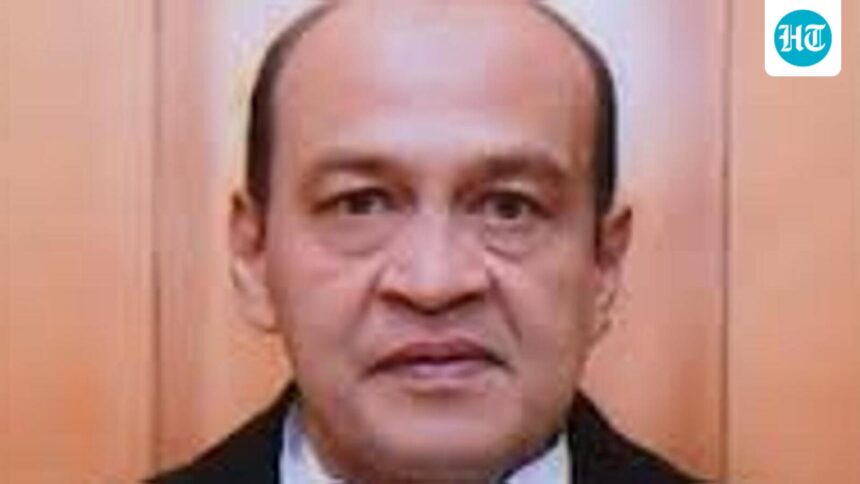
Allahabad High Court judge Justice Yashwant Varma on Thursday tendered his resignation to President Draupadi Murmu, effectively ending the ongoing parliamentary probe into allegations of unaccounted cash being discovered at his official residence in Delhi last year. People familiar with the matter confirmed the development to HT.

“Although I do not propose to burden your honorable office with the reasons which have compelled me to submit this letter, it is with great anguish that I hereby tender my resignation from the office of Judge of the Hon’ble High Court of Judicature, Allahabad, with immediate effect,” the letter dated April 9 said.
Justice Varma also sent a letter to Chief Justice of India Surya Kant on Thursday evening, apprising the CJI of his communication with the President.
The resignation is set to render ineffective the proceedings initiated under the Judges (Inquiry) Act 1968, as the legal mechanism of removal, triggered by a motion in Parliament, ceases to operate once a judge leaves office. Justice Varma was facing deportation proceedings after accepting a Lok Sabha motion in August 2025, with a three-member probe committee set up by Speaker Om Birla to probe the charges.
Read also: Lok Sabha Speaker Om Birla reconstitutes Justice Yashwant Varma’s inquiry committee
This development marks an abrupt end to a closely watched, procedurally complex impeachment process that had already faced delays. Last February, the Lok Sabha Speaker reconstituted the inquiry committee after one of its members, Madras High Court Chief Justice MM Shrivastava, retired before the proceedings were completed, necessitating a fresh start under the statutory scheme.
Justice Varma was at the center of controversy after allegations surfaced that burnt amounts of unaccounted cash were discovered at his official residence in Delhi following a fire incident in March 2025, when he was serving as a judge of the Delhi High Court. An internal inquiry committee of the Supreme Court found his explanation unsatisfactory, prompting then Chief Justice of India Sanjeev Khanna to recommend action to the executive.
This led to the initiation of removal proceedings in Parliament, with notifications being moved in both Houses in July 2025. While the Lok Sabha recognized the motion and proceeded to constitute an inquiry committee, the Rajya Sabha refused to accept a parallel motion, citing procedural flaws.
In January this year, the Supreme Court rejected Justice Varma’s impeachment challenge, allowing the inquiry to move forward. A bench of Justices Dipankar Datta and Satish Chandra Sharma held that the judge was not entitled to any relief and rejected arguments that the process was legally flawed.
The court stressed that the constitutional guarantees available to judges cannot be used to “paralyze” the isolation mechanism, stressing that the Judges (Investigation) Law provides “detailed guarantees” to ensure justice. These include the formulation of specific charges, the right to cross-examine and cross-examine witnesses, and the full opportunity to defend.
Importantly, the court also upheld the authority of the Speaker of the Lok Sabha to proceed independently after the Rajya Sabha refused to accept the proposal, holding that the Senate notification never came into legal existence.
Following the court ruling, Justice Varma appeared before the investigating committee on 24 January, and several closed hearings were held thereafter. The Group has indicated its intention to move forward on an almost daily basis, particularly in light of the impending retirement of one of its members.
Despite these efforts, the investigation was not completed in time, leading to the committee being reconstituted in February. The proceedings were subject to strict confidentiality standards, with all hearings held behind the scenes, and participants prohibited from discussing the matter publicly.
With the resignation of Justice Varma, the continuation of the investigation under the Judges (Investigation) Act has become unacceptable. The law aims to facilitate the removal of a judge by Parliament due to “proven misconduct” or incompetence. Once the judge stepped down, the question of impeachment no longer arose.
The resignation thus brings an abrupt end to a rare case of impeachment against a Supreme Court judge – a case that has raised major questions about judicial accountability, parliamentary procedure, and the balance between independence and oversight within the supreme judiciary.