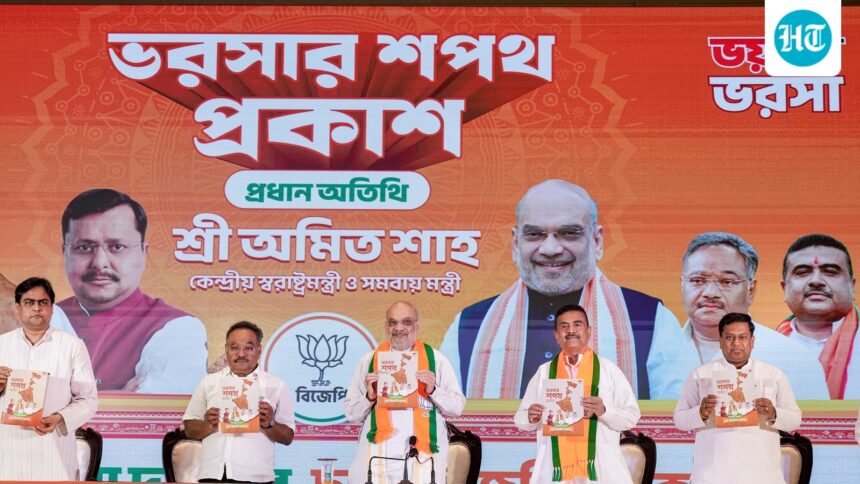
The Bharatiya Janata Party (BJP) on Friday unveiled its manifesto for the West Bengal Assembly elections, with special focus on women, youth and state government employees.

While the BJP’s favorite issues, such as infiltration and the Uniform Civil Code, figure prominently in the statement issued by the union home minister Amit Shah, one of Prime Minister Narendra Modi’s promises to state government employees in West Bengal, was also mentioned in ‘Sankalp Patra’.
Shah described it as a roadmap for Sonar Bangla and launched a fierce attack on the region The Mamata Banerjee government claimed that the last 15 years of TMC rule were a “nightmare” for the people of the state.
“Bengal, fed up with the TMC, now wants change,” he said, seeking to turn the elections into a referendum on corruption, political violence, infiltration and unemployment.
The BJP promises 7th pay commission for Bengal government employees
An attempt to exploit long-standing resentment among state government employees West Bengal on dearness allowance Amit Shah promised to parity dearness allowance (DA) with the Center and implement the Seventh Pay Commission within 45 days of assuming office in the state.
“DA will be ensured to all government employees and pensioners and the seventh pay commission will be implemented within 45 days,” Shah said.
Prime Minister Narendra Modi also promised the seventh pay commission while addressing an election rally in Purba Medinipur on Thursday. He made this promise as part of his six “guarantees” to voters.
“The moment the BJP government is formed here, we will implement the 7th Pay Commission,” PM Modi said.
This promise comes at a time when the buzz around the 8th Central Pay Commission (CPC) is already high. Over 1 crore central government employees and pensioners have been eagerly waiting for the implementation of the eighth recommendations of the CPC, which may take more than a year. While the Center was working on the eighth pay commission, West Bengal was still working on the sixth pay commission.
This is because it is not necessary for the state government to align its wage commissions with the central government. So some states, like West Bengal, are lagging behind the Center on this issue, while others, like Kerala, are miles ahead, with the Eleventh Pay Commission already in place.
BJP’s welfare push in Bengal
In its strongest attempt yet to defeat the social coalition that has kept the current TMC in power for over 15 years, the BJP’s manifesto was laden with welfare promises aimed at penetrating Mamata Banerjee’s strongest stronghold – women voters.
Amit Shah announced that every woman in Bengal will receive the award $3000 every month if BJP comes to power. He also promised 33% allocation for women in all government jobs, including the police, in addition to freedom of travel on public transportation.
This promise is politically significant in a state where women now make up nearly half of the electorate.
The high turnout of women and the popularity of TMC government schemes, such as Lakshmir Bhandar, have become among the ruling party’s strongest electoral shields.
Last month, the Transitional Military Council announced $500 increase in Lakshmir Bhandar in its statement, bringing the monthly payment to $1500 for the general category of women $1,700 for SC and ST beneficiaries.
The BJP manifesto also sought to exploit discontent among unemployed youth, promising a monthly allowance of ₹100,000. $3000 and more $15,000 to help them prepare for competitive exams.
The BJP promised those who lost their jobs due to school recruitment scam and other corruption-related issues, will be given age relaxation of up to 5 years.
She also pledged transparent, merit-based recruitment and said deserving candidates would get permanent jobs.
For farmers, the BJP promised increased assistance under the PM-Kisan scheme $9000 annually by addition $3000 from the state government to the current centre $6000.