Few, if any, modern plays maintain their searing currency decade after decade as Arthur Miller’s heartbreaking commentary on the hollowness of the American dream, Death of a salesman. Joe Mantello’s Broadway revival takes place more than ever inside the head of its weary protagonist Willy Loman, played by Nathan Lane in an expertly textured performance that hits every pathos note without denying the character’s self-deceitful aggression or completely silencing the actor’s innate humor. He is surrounded by a brilliant ensemble in a stunning production directed with supernatural clarity.
In addition to being a play strangely linked to whatever period it is performed in, vendor It is also a work that touches different nerves depending on the age of the audience. I’ve seen productions across four different decades, all with formidable casts, but I can’t remember a production in which the jagged collision between past and present was so unsettling, or the dissonance between comforting illusion and cold reality so harsh.
The tragedy of the common man represented in the play is all around us if we want to look at it, and the failure of four decades of neoliberalism has laid waste to entire sectors while lifting up others to create huge gaps of wealth inequality. vendor It contains no overt political theatrical discourse, yet it is inherently political, exposing the pits into which ordinary Americans can easily slide, dragging entire families down with them.
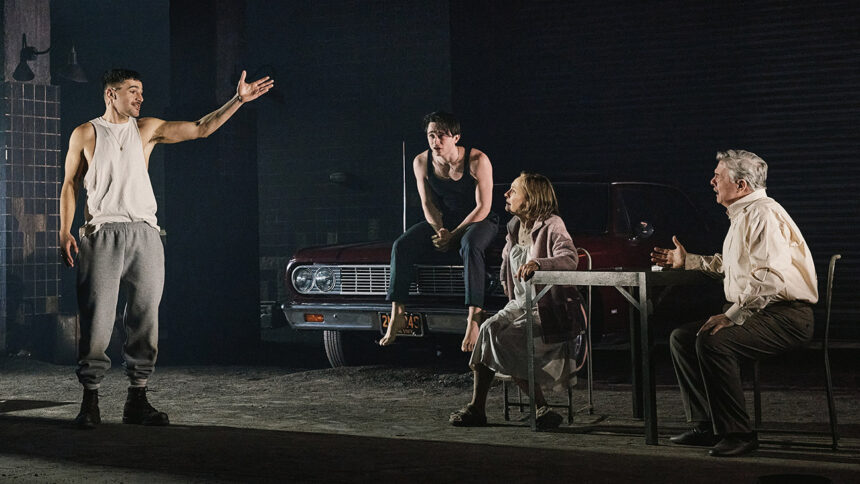
Mantello advances the time frame to the early 1960s, an era of postwar prosperity during which the middle class became wealthier while lower-wage earners often fell behind. Marketing for the revival centers around the image of the Chevy that Willie parks, at the play’s beginning, in set designer Chloe Lamford’s dark, cavernous industrial garage—a drab warehouse containing the many prisms of the protagonist’s fragmented mind, blanketed in sepulchral gloom by Jack Knowles’ lighting.
The house in Brooklyn is evoked with minimal furniture and few props, but the family perched precariously there is brought to life with surprising emotional and physical verve. The car—like the house, the refrigerator, the vacuum cleaner, and everything else of value the Loman family owns—leads Willy to think that once he desires something he is paid off in time to claim ownership before it breaks down or before its rooms are given away. The car is also the means by which Willy takes decisive action at the end of the play, one of the most devastating conclusions in American drama.
While the production is open to interpretation, Mantello appears to have reconceptualized it as a rush of thoughts flowing through Willie’s mind in the moments before his death. Happy memories sit alongside turbulent memories, stubbornly optimistic hope alongside crushing defeat, and self-aggrandizement alongside abject failure and humiliation. Lane pours himself into this role with a forensic attention to detail — which is both infuriating, heartwarming, and pathetic in equal measure.
Willie’s tragedy is not limited to any specific point in time. As reflected in the small but important design choices that are outdated, he is an unreliable narrator, a quality dictated more by impotence than dishonesty. The subtle ways in which Lin shows the man being prodded, knocked aside, or just plain battered by the conflicting thoughts colliding with him are a big part of why your eyes stay glued to the actor even when you want to turn away from him out of discomfort.
The great Laurie Metcalfe puts a unique spin on Willie’s devoted wife, Linda. She is kidding her husband—and perhaps even somewhat fooling herself—by going ahead with his grand plans, regardless of her initial standing in the world of possibilities. The gradual extinguishing of that shred of hope, until its devastating final scene, is masterful. Linda loves her two sons, Biff (Christopher Abbott) and Happy (Ben Ahlers), but becomes angry when she feels that their recklessness shows little concern for their father’s diminishing mental health.
Although it harkens back to Miller’s original conception, the casting of younger actors set in Loman’s boys’ high school years — Joaquin Consuelos as Biff, and Jake Termaine as Happy — doesn’t add anything significant. But it doesn’t hurt either, and helps distinguish the play’s present from its recent and distant past.
Abbott is a wonderful stage actor with an unpredictable presence. He makes us feel Biff’s struggles as a young man drawn to working outdoors with his hands, struggling under the weight of his father’s never-ending expectations. The path Willie charts for him, from golden boy soccer player to dynamic startup executive—so likable and full of charm—couldn’t be further from Biff’s bitter assessment of himself as an underachieving loner. Like Linda, he sometimes gives in to the old man’s insistence and nurtures a distant dream. But Abbott never lets us lose sight of Biff’s awareness that his glorious future is a myth.
The extent to which Biff absorbs his mother’s pent-up hurt when Willy constantly interrupts her in conversation, dismisses her opinions and keeps her out of his grand plans for the boys, is sad. This goes double when he realizes in a painful scene his father’s betrayal with a drunk from head office (Tasha Lawrence). Willy’s dismantling in his son’s eyes is almost as distressing as the brief flashes of sincere self-loathing that punctuate his father’s dreams.
In what deserves to be an outstanding performance, The Gilded Age Ahlers’ regular (“blink of the clock” to loyal viewers) gives Happy substance that is often out of reach for the character in other productions. He is like a child in a crowd, shaking his head wildly and waving his arms in an attempt to attract the attention of his idolized father. But he is also too superficial and selfish to take Willy’s mental decline seriously and too arrogant to see that his ambitions have no realistic basis. Despite this, he is never disdainful of Ahlers’ nuanced performance; His belief that he and Biff can team up again like in the good old days and make their father proud is truly touching.
Of course, that could never happen. Biff knows it, Linda knows it, and deep down in his tired bones, Willie knows it too, as he pulls his samples from his car and enters the house for the last time.
Miller’s powerful play, perhaps like no other, exposes the dirty tricks of a capitalist system in which not everyone is destined to survive, where every self-made man suffers a similar failure, is chewed up and discarded.
This dichotomy manifests itself in Willie’s visits—whether real or imagined—from his wealthy, reclusive brother Ben (Jonathan Cake), or even in exchanges with his kindly neighbor Charlie (K. Todd Freeman) and the latter’s adult son Bernard (Michael Benjamin Washington). Willie is quietly mystified at how Bernard’s path to success was deviated so sharply by his childhood friend Biff. That Charlie and Bernard are played by black actors heightens the maddening pride with which Willy repeatedly rejects his neighbor’s offer of paid employment.
Down to the smallest roles, this production is intelligently cast, and its attractive design elements add an appropriately threadbare grandeur to the play’s stark vision of America’s broken promises. Mantello does some of his best work in a heartfelt revival that will be remembered for Lane’s respected, career-crumbling performance. It’s wonderful theatre.
Location: Winter Garden Theater, New York
Cast: Nathan Lane, Laurie Metcalfe, Christopher Abbott, Ben Ahlers, Jonathan Cake, John Dre, K. Todd Freeman, Michael Benjamin Washington, Joaquin Consuelos, Jake Termin, Carl Green, Tasha Lawrence, Jake Silberman, Katherine Roman, Mary Neely.
Director: Joe Mantello
Playwright: Arthur Miller
Music: Caroline Shaw
Set designer: Chloe Lamford
Costume designer: Rudy Mance
Lighting designer: Jack Knowles
Sound design: Michal Suleiman
Hosted by Scott Rudin, Barry Diller and Roy Foreman