There was a moment, after he foiled an attempted boardroom coup just before Thanksgiving 2023, when Sam Altman played like a hero, fending off the dark forces of anti-progress. Here he is the great conqueror, ushering in an era of prosperity when petty, doomsday-minded advisors stand in his way!
There was also a moment, after he stepped in to take over the Defense Department’s humanitarian deal in early March, when Sam Altman played the villain, embracing the dark powers of surveillance. Behold, the Archangel, wiping souls and privacy data in the name of government contracts!
Whatever the full truth of either description (anyone paying attention to November a few years ago would quickly realize that only Wall Street welcomed him back), I argue that at this point in the evolution of popular culture Altman has transcended those labels and any spectral pauses in between. Now the OpenAI leader has landed on something else, something that may or may not be a problem but is unavoidable, and whose primary goal is its unavoidability: pure cinema.
I mean, of course, cinema in the literal sense of the word. Luca Guadagnino currently sits in publishing industrial, Amazon MGM has remastered that episode for 2023, starring Andrew Garfield as Spider-Man. The film, backed (without obvious irony) by a company with an untold pre-tech personality, arrives in theaters later this year and will provide Altman with the tech mogul’s indispensable 21st-century accessory to a passing film festival speech.
But by cinema I also mean another Kurosawa-like sense, where “painting, literature, theater and music come together” – where trying to evaluate Altman as good or bad, or even as what he is at all, becomes somewhat secondary. Which It is so, and strangely enough it has always been so. (Try pinpointing the first time you heard him; you’ll likely find it difficult.) Altman represents so many sentiments and modes of expression that any moral judgment we might apply fades beneath the point: He is here and very likely always will be, and we will forever be unable to turn away. Simply calling Altman out as someone to cheer for or oppose seems insufficient, even when some people do (especially the latter). He’s basically voicing these forms of Kurosawan, a character we’ve looked up to so intensely for so long that we stop even wondering if we should.
The immediate reason for this impression comes from Ronan Farrow’s Andrew Marantz The New Yorker An article published on Monday, in which an 18-month investigation led to the artwork “Sam Altman May Control Our Future – Can He Be Trusted?” Over the course of 11,000 words, no answer followed (although it leaned toward no) precisely because the answer lay beside the movie character’s point: He would survive all attempts to take him down, even the article that might have come to do so, because our realtor always sublets space to him even at the mere thought of that takedown.
Altman preemptively tried to deflect attention from the article’s impact by dropping his publication on the same day, a 13-page guidance document titled “Industrial Policy for the Age of Intelligence: Ideas for Keeping People First.” Some proposals have been laughably naive and provocative (“a 32-hour work week”?); Some felt astonishingly hypocritical (“Developing and testing playbooks coordinated to contain dangerous AI systems once they’re released into the world” from a company famous for doing so little testing before?) However, the divided reception demonstrated Altman’s cinematic ambiguity.
In this recipe, we had a CEO who “did not just talk about the future, he tried to redesign it,” as analyst Uttam described in Artificial Intelligence Bulletin. Or alternatively, as Ars Technica deputy editor Nate Anderson wrote in response to the word salad throw, “You don’t have to, fortunately, follow every statement Sam Altman, CEO of OpenAI, makes around the world. Many of these statements sound more like ‘hustle’ or ‘pitches’ than attempts to talk thoughtfully about the future. Even if they are genuine statements of faith, they often read like a teen’s first sci-fi novel, written under the influence of weed.” And way too much Star Trek“.
But the usefulness of his suggestions was misplaced for us and, more importantly, for him. What mattered was that people were talking about it, not about other reams of published text. The entire strategy felt like a Netflix limited series; You can almost imagine the scene in the script, where Altman and his media men, indecisive about how to handle the incoming shards, gather to figure out how to deflect it: “Aha! A well-timed social statement at the same time.” Have you heard about art washing? Now we have a paper washing policy.
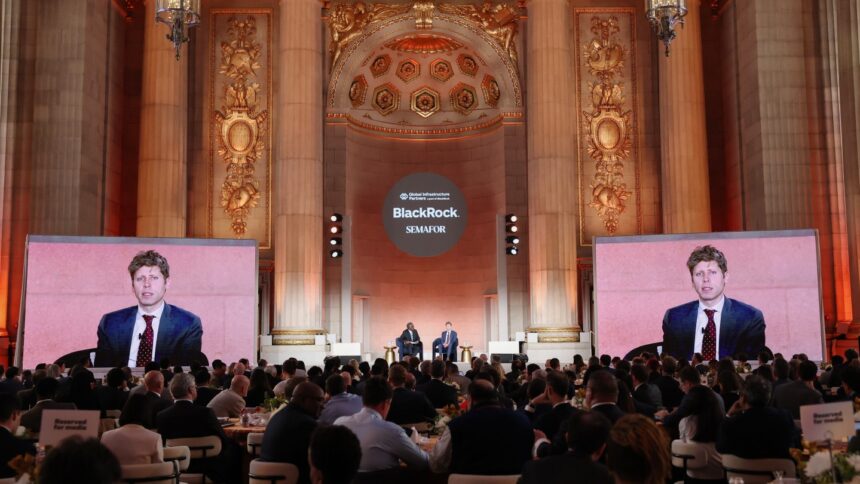
To Altman’s right and speaking loudly at the live stream meeting: Chris Lehane, OpenAI’s chief global affairs officer (he might want Rob Lowe but I’m thinking Woody Harrelson). On Zoom and at the bottom table, there was a group of agreeables sitting where Ilya Sutskever and the opposition voices once sat. And at the head of the room was Vito C himself, who took it all into his own hands and decided that this was the moment, finally, to shift the narrative from the fantasy of utopian tech hucksters (universal basic income) to the fantasy of more righteous tech regulator Bernie Sanders (“robot tax”).
In fact, Coppola’s comparison rings true, but on the contrary: where the director’s main character was a loyal and upright character in a bad fantasy world, Altman reads as a cunning and traitorous character in a good, real world. But either way it doesn’t actually matter. No one is watching The godfather To draw conclusions about the moral worth of the protagonist – we watch him because we cannot not. cinema.
If this seems abstract, conjure your mental image of Altman. It’s probably on stage, because that’s how often we see him. But think about his face. What do you look like? Pleading? volatile? Reassuring? Kaji? Or somehow all these modes and none of them, like the animation of The New Yorker A piece in which the designers faked dozens of faces and made him think of them and dispose of them as masks.
Even in entertainment, Altman has achieved a status that transcends evaluation into fantasy. Back in the summer of 2024, Ari Emanuel called the OpenAI leader a “fraud” at the Aspen Ideas Festival. Altman would then follow more than a year of initiatives in Hollywood as executives slowly warmed to him. No one embodies this story better than Bob Iger’s Disney, which went from suing GenAI to putting $1 billion in Altman’s pocket.
Now he’s suddenly ended Sora’s deal and that with Disney and we can’t decide what to think about it. Altman couldn’t kill Hollywood if he didn’t even try to work in it. Yet it lingers in the city’s collective nightmare, a speckled specter that hangs above us like Big Brother in the 1984 Apple Super Bowl ad, one way or another representing all of GenAI’s industrial threats that will in fact be implemented by many others.
Ridley Scott directed this commercial, and he seems to be the most apt auteur for this metaphor. Will Altman become the Matt Damon who solves our problems? Or John Hurt, who convulsively gives birth to an alien? Or maybe — and it’s a third possibility we don’t think about much — Geena Davis is just driving her car off a cliff and knocking just herself and her closest pals. Even now, with everything he’s done and everything we know, it remains legally difficult to predict where Altman’s novel will end up in the canon. Will he become the most powerful and dangerous man on the planet, a combination of Elon Musk, DOGE/Last Phase
Or will he become a symbol of Silicon Valley’s fallen arrogance, a combination of Elizabeth Holmes and Adam Newman supercharged by Nick Bostrom’s TED Talks? Somehow everything becomes mysterious. We just sit in this dark auditorium and watch it there on the screen, unable to even remember why we bought the ticket .