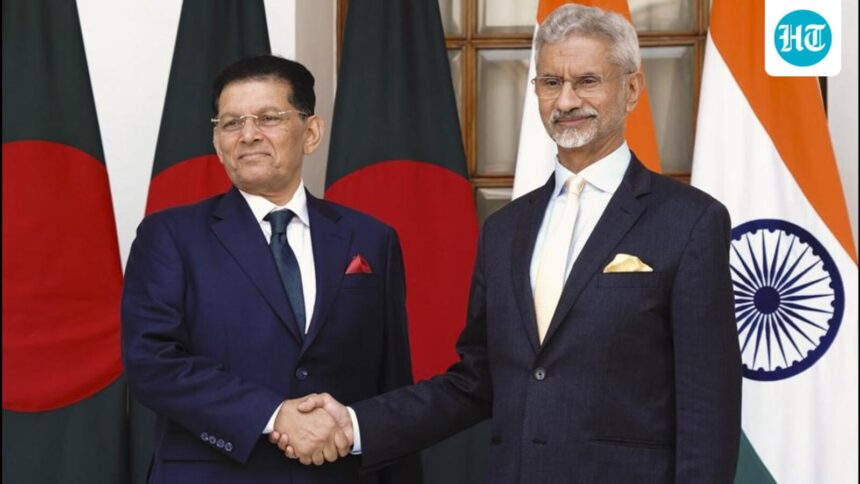
India and Bangladesh agreed on Wednesday to move forward with the normalization of relations after a period of unprecedented tensions, including resuming existing mechanisms to address differences and enhance trade and energy cooperation, as Bangladesh Foreign Minister Khalilur Rahman met his counterpart S. Jaishankar and other senior leaders.

Rahman, who stopped in New Delhi on his way to Mauritius to participate in the Indian Ocean Conference, is the first minister to visit India since Tariq Rahman’s Bangladesh Nationalist Party won the general elections in February. The Indian side has made coordinated contact with the Bangladesh Nationalist Party to rebuild relations, which reached an all-time low under the interim government led by Muhammad Yunus.
During Rahman’s meetings with key Indian interlocutors, the two sides decided to address contentious issues — such as former Prime Minister Sheikh Hasina’s presence in India and the arrest of two Bangladeshi nationals in West Bengal state for their alleged involvement in the killing of extremist leader Sharif Usman Hadi — in a way that would not hinder progress in other aspects of the bilateral relationship, people familiar with the matter said.
“The focus was on strengthening key aspects of the relationship, including people-to-people ties and trade, and this will be done by resuming communications through existing mechanisms,” one of the people said on condition of anonymity.
Rahman reiterated Dhaka’s request to extradite Hasina and former Interior Minister Asaduzzaman Khan Kamal, after they were sentenced to death by the International Crimes Court, according to a statement issued by the Bangladesh Foreign Ministry. He also thanked the Indian government for arresting Hadi’s suspected killers.
The Bangladeshi statement said, “The two sides agreed to return the detained individuals to Bangladesh in accordance with the procedures stipulated in the extradition treaty between the two countries.”
No reading from the Ministry of Foreign Affairs addressed these issues, although the above-mentioned people acknowledged that the issues of Hasina and Hadi figured in the discussions. Hasina and Kamal have been living in self-imposed exile in India since fleeing Bangladesh after the Awami League government collapsed in August 2024 following weeks of student-led protests.
Gunmen shot Hadi in Dhaka last December and he later died while receiving treatment in Singapore. The attack sparked violent protests across Bangladesh that took on an anti-Indian tone due to unconfirmed reports of an Indian link to his killing. Two Bangladeshi nationals have been arrested by Kolkata Police for their alleged involvement in Hadi’s murder in March, and they have been handed over to the National Investigation Agency (NIA).
In his meeting with Rahman, Jaishankar noted India’s “desire to engage constructively with the new government” in Dhaka and strengthen relations, according to a Ministry of External Affairs statement. The statement added, “The two sides agreed to explore proposals to deepen the partnership through relevant bilateral mechanisms. Formal follow-up meetings are expected to be held early.”
Jaishankar said on social media that he and Rahman discussed enhancing various aspects of bilateral relations and regional and global developments. The Bangladeshi Foreign Ministry statement quoted Rahman as saying that the BNP government will pursue a foreign policy based on the principle of “Bangladesh First” and on “the basis of mutual trust, respect and mutual benefit.”
The Bangladesh statement also quoted Jaishankar as saying that Indian visas, especially medical and business visas, “will be relaxed in the coming weeks.” Easing visa restrictions, imposed by India when relations deteriorated during the interim government, was a key demand of Dhaka.
During his meeting with Petroleum and Natural Gas Minister Hardeep Puri, Rahman expressed thanks for India’s recent diesel supplies to Bangladesh and requested increased supplies of diesel and fertilisers. Puri noted that the Indian government would “readily and positively examine the request,” the Bangladeshi statement said.
Puri said on social media that he and Abdel Rahman discussed bilateral cooperation in the energy sector, but did not provide details. Indian officials had earlier said that Bangladesh’s request for additional supplies of diesel and petroleum products would be considered keeping in mind availability and market conditions. Bangladesh has sought additional supplies after being hit hard by power outages due to conflict in West Asia.
Bangladesh Prime Minister’s Foreign Affairs Advisor Humayun Kabir was part of Rahman’s delegation and participated in most of the meetings with the Indian interlocutors. Kabir also held a separate meeting with Vijay Chothaywale, head of the BJP’s external affairs department, and handed over a letter from Chief Minister Abdul Rahman addressed to BJP president Nitin Nabin.
Rahman began his visit on Tuesday with a one-on-one meeting with National Security Advisor Ajit Doval.