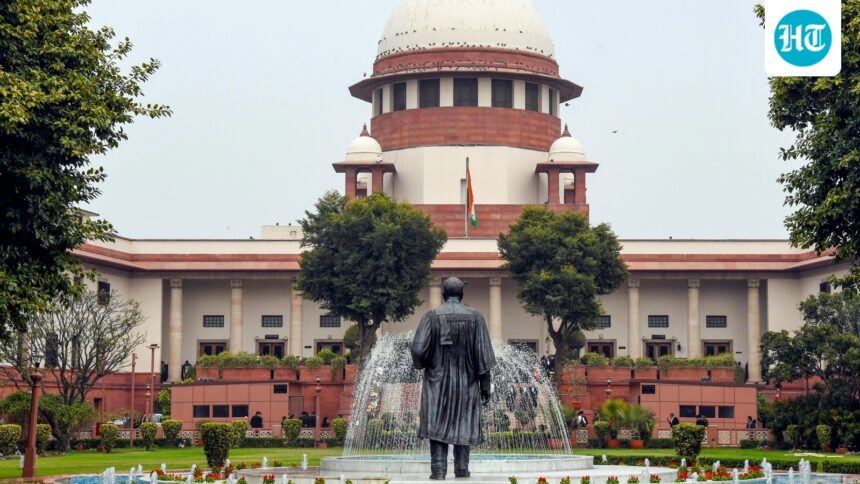
The Supreme Court emphasized that belonging to a backward community in itself cannot tip the balance in favor of a candidate, holding that public office cannot be dispensed with for considerations of sympathy or social background.

A bench of Justices Dipankar Datta and Satish Chandra Sharma said that “grace, benevolence or mercy must be kept at a distance” in matters of public employment if we are to ensure a fair and equal playing field for all aspirants.
“A person’s mere belonging to a backward community cannot be the deciding factor in tipping the scales,” the court stressed in its ruling issued on April 4. The court’s observations came while allowing the appeal filed by the Delhi Police against the orders of the Central Administrative Tribunal and the Delhi High Court ordering it to give a second chance to a candidate who failed to appear at a crucial stage of the recruitment process. The case concerns a candidate who passed the initial recruitment stage for a police constable position but did not appear for the Physical Endurance and Measurement Test (PE&MT), due to illness in January 2024.
Read also | The Supreme Court will hear the challenge to the law appointing the Central Election Commission in May
Despite this, the CAT directed the Delhi Police to allow him to take the test with subsequent payment – a decision that was later upheld by the Delhi High Commission in September 2025.
But the Supreme Court found this approach untenable. Describing the case as a “classic example” of irresponsibility, the court noted that the candidate “wasted a golden opportunity” by choosing not to show up on time. The court stressed that recruitment operations, especially those involving large-scale public functions, must strictly adhere to the stated conditions. “When opportunities are scarce, one has to grab them with both hands,” the court observed, stressing that relaxing the criteria for a single candidate would undermine the integrity of the entire selection process.
The bench noted that with nearly a thousand candidates participating, the respondent was the only one seeking rescheduling. Even assuming the candidate’s submissions requesting postponement were received, the court found that the nature of his illness did not require any exceptional treatment.
Read also | “Why women’s bodies and choices persist so deeply controlled”: Supreme Court
“Not showing up and expecting a second chance clearly shows lack of motivation and initiative,” the bench observed, adding that at the very least, the candidate should have been present at the place and seeking accommodation.
Notwithstanding the orders of the CAT and the Delhi High Court, the Supreme Court held that the candidate had no enforceable right to seek rescheduling of the examination.