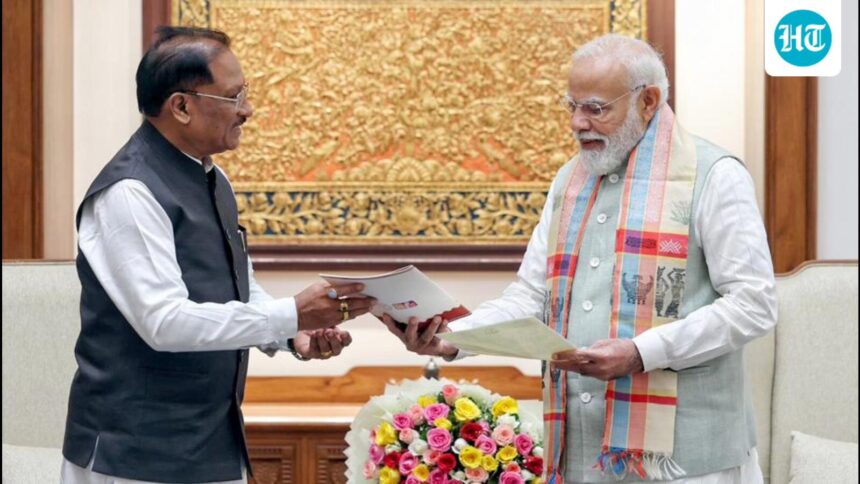
Chhattisgarh Chief Minister Vishnu Deo Sai met Prime Minister Narendra Modi on Tuesday and presented a roadmap that envisions education centres, a medical college, irrigation projects, adventure and eco-tourism, including canopy walks and a glass jungle bridge, for the former Maoist stronghold of Bastar, people familiar with the matter said.

The Modi-Sai meeting came days after Union Home Minister Amit Shah told Parliament that the March 31 deadline to end left-wing extremism across the country had been met. Shah said 4,839 Maoists surrendered, 706 others were killed, and 2,218 people were arrested and imprisoned during three years of anti-Maoist operations.
For decades, Bastar, Dantewada, Sukuma, Bijapur, Narayanpur, Kondagaon and Kanker districts were known as the epicenter of the Maoist insurgency in Chhattisgarh.
Officials familiar with the details of Sai’s road map said it refers to the government’s plans to set up two major educational centers in Jagargunda (Sukma) and Geedam (Dantewada district), the scene of major Maoist attacks.
In April 2021, 21 security personnel were killed in an ambush in Jagargonda in Sukma district. Ten reserve district guards were killed in an explosion in Geidam two years later. Maoist leader Mandvi Hidma, who was killed in November 2015, was from Bovarthi village in Sukma.
Povarti was once a Maoist center in Bastar district. Outsiders were not allowed to enter the village for 24 years before security forces set up a camp there in 2024. Several large ambushes of security personnel were planned in Buvarti.
Sai’s roadmap proposes setting up a medical college in Geedam as the government plugs long-standing gaps in health infrastructure, an official said. “The Maoists have prevented the construction of colleges or hospitals in these areas,” the official said.
The roadmap highlights plans to build two barrages on the Indravati River, which runs through Bastar and its surrounding areas, and was once considered the core of the so-called “Red Corridor”. Such projects were previously seen as futile. “For many years, the Maoists have exploited the river as a natural barrier, especially during the monsoon, when movement of security forces was difficult. Several major confrontations have occurred.” [with Maoists] The incident occurred in and around Indravati National Park along this stretch, the official said.
The roadmap indicated plans for adventure tourism, canopy walks and a glass bridge in the jungle to attract visitors to Bastar. “The Prime Minister was briefed about the job opportunities and scope of eco-tourism in Bastar now that there are no Maoists and the area has become safe for visitors,” the official said.
The government plans to open the interior of Bastar for eco-tourism once the area is cleared of mines. Inspector General (Bastar) Sundaraj Pattilingam said last week that security forces were involved in clearing the mines.