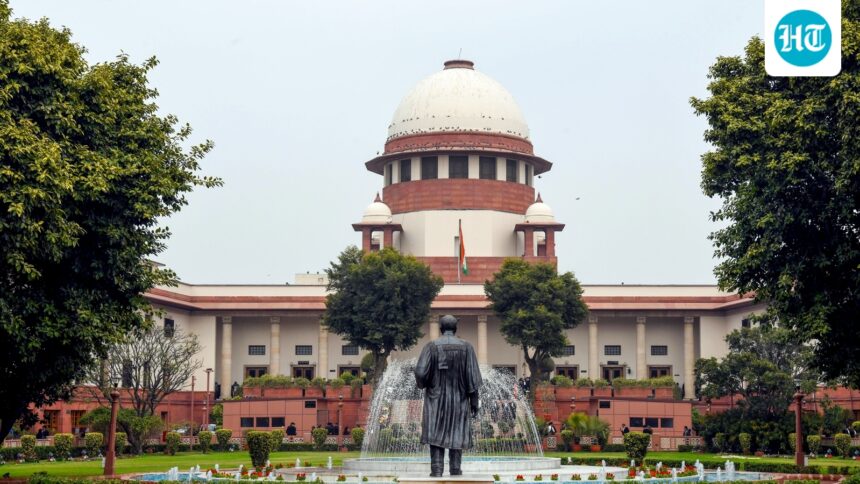
NEW DELHI: The Supreme Court on Tuesday expressed its displeasure over the Center’s nomination of an undersecretary-rank officer to attend a high-level meeting on installation of CCTV cameras in all police stations across the country, and then excused Union Home Minister Govind Mohan from appearing in person in the next session after Attorney General R Venkataramani agreed to resolve the matter.

With the Home Minister present in the court, Justices Vikram Nath and Sandeep Mehta said: “You (centre) should know whom to send for the meeting when the Supreme Court constitutes a committee.”
In response, Attorney General R Venkataramani said, “I am evaluating all the issues. The ‘police’ issue is a state issue. We will need a lot of coordination. At the same time, we do not want to cross federal boundaries.” Venkataramani sought two weeks’ time to hold an amicus curiae meeting and work out modalities to resolve the issues arising out of the implementation of the court’s ruling.
The previous day, the court had summoned the Union Home Minister to appear in person after noticing a casual approach by the Center in meetings conducted by amicus curiae comprising the Centre, states and union territories to identify loopholes in the mandatory implementation of CCTV cameras at all police stations and central investigation agencies as stipulated in the 2021 judgement.
The 2021 ruling directed that CCTV cameras be installed at all entry and exit points, main gate of the police station, all locks, all corridors, lobby/reception area, all balconies/outbuildings, inspector room, sub-inspector room, areas outside the lock room, station hall, in front of the police station complex; Outdoor (not indoor) bathrooms/toilets, the duty officer’s room and the back area of the police station.
Senior advocate Siddharth Dave who is assisting the court as amicus was also present in the court. He had submitted a report on Monday in which he stated that the centre’s engagement “was largely ineffective and disappointing.”
He had informed the court that in the first meeting held on February 21 this year, the Center did not attend and a month later, the Undersecretary of the Ministry of Home Affairs (MHA) represented the Union government in the meeting. This officer failed to provide any effective response to the queries raised by Dave and sought time to consult and discuss the matter with his superiors.
Again on the next occasion, he informed that the “Feasibility and Data Security” aspects have to be examined by the States/Union Territories and the MHA can only be a facilitator to provide technical expertise, support and operation of the central dashboard or software system.
“It is clear that there is no effective response at all by the Union of India with regard to the queries and directions of this court,” Dave said, which made the court observe: “You have brought your own home secretary. He does not seem to be listening to what you are saying.”
The bench noted that of all the states, the amicus curiae found Kerala to be the best model. Kerala has a program that allows senior police officials to access what is happening at any police station at the click of a button, the amicus curiae said. He also expressed satisfaction with the implementation in Rajasthan and Madhya Pradesh.
“Why can’t you have the same program that Kerala has,” the bench asked the AG.
“The prosecutor stated that within two weeks he will ensure the resolution of all cases by holding regular meetings with amicus curiae and all relevant officials,” the council said, when scheduling the next hearing on April 28.
In light of these guarantees, the order exempted the Minister of Interior from attending in person on the date of the next session.
The order was passed in a litigation that began last year when cognizance was taken of a news report from Rajasthan showing non-functional CCTV cameras in Udaipur, according to which the court sought compliance reports from the Centre, states and union territories. Along with this order, the court proceeded to implement its 2021 judgment in Paramveer Singh Saini v. Baljit Singh.
Dave had informed the court that some states face strange challenges in implementation due to difficult terrain, adverse weather conditions, lack of funds and frequent power outages. This was by having a central control board or a district-level control board. This was more evident in the hill states or north-eastern states.
While taking up the matter suo motu in September 2025, the court noted that while the directions in the 2021 judgment are comprehensive, there is a need for an oversight mechanism to ensure that CCTV cameras installed at police stations are not manually switched off. The court proposed the idea of having a central control room that could alert every time any tampering or manual intervention occurred to stop it.
The order was issued in 2021 while a custodial torture case was being heard in Punjab. The cameras are required to have night vision, record audio and video, and store data for at least one year, and preferably 18 months.