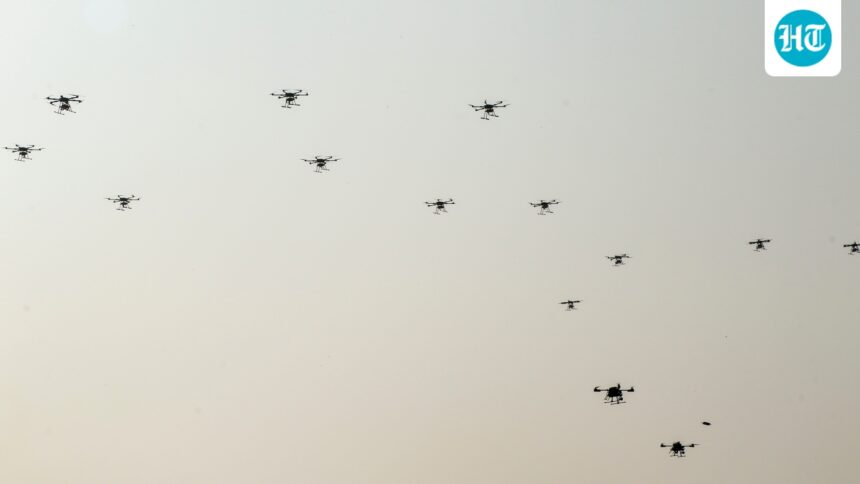
NEW DELHI: The Indian Army plans to induct tens of thousands of home-made unmanned aerial systems and loitering munitions over the next five years to enhance its battlefield capabilities, given the growing impact of these systems on military operations and how they have reshaped modern warfare as evident in ongoing global conflicts including the US-Israel war with Iran, officials familiar with the matter said on Tuesday.

The Army’s requirements include 80 different types of unmanned systems for specific roles including intelligence, surveillance, reconnaissance, precision strike, munitions drop, air defense, jamming, mine warfare, data transfer and logistics, an official said, a day after the Army released its “Technology Roadmap for Unmanned Aerial Systems and Loitering Munitions.” It provides a long-term view of the Army’s unmanned systems requirements for industry, academia and the nation’s research and development institutions.
A second official said: “We are looking at this capability arriving in phases over the next five to five years. Internal studies that have taken into account lessons learned from ongoing conflicts have indicated a need for 30 types of unmanned aerial systems (UAS) and loitering munitions for five broad roles. If subsectors are counted, we are talking about 80 different types of drones.”
Lt. Gen. Rahul R. Singh, Deputy Chief of Army Staff (Capability Development and Sustainment), unveiled the technology roadmap weeks after Defense Minister Rajnath Singh said India must take steps to position itself as a global drone manufacturing hub by 2030 to meet the country’s defense needs and maintain its strategic independence. He said ongoing conflicts, including the war in West Asia, have shown that drones and counter-drone technologies will be key in future wars.
The army said the roadmap aims to harness local capabilities to achieve an advantage on the battlefield.
“By clearly outlining technological and operational priorities, the document seeks to serve as a critical bridge between operational requirements and technological evolution, ensuring that India’s drone ecosystem evolves in an orderly and demand-driven manner,” it added in a statement.
Systems needed by the Army for surveillance include long-endurance high-altitude UAS systems, long-endurance medium-altitude UAS systems, high-altitude dummy satellites, and coastal unmanned aerial systems (UALs) for long-, medium- and short-range surveillance, according to the roadmap.
The Army is seeking loitering munitions for long, medium, and short range strike, swarms of UAVs (for surveillance and strike), and FRV (first person perspective) UAVs with strike capability. It also wants to deploy unmanned systems in special roles, including UAL systems configured for hunter-killer, and systems with guided/unguided bombs.
The roadmap is consistent with India’s plans to increase its drone force under another roadmap, Defense Forces Vision 2047, released in March.
The country is preparing to embark on far-reaching military reforms to ensure its armed forces are ready to meet future battlefield challenges, with the proposed establishment of a drone force, a data force and a defense geospatial agency, standing out among a host of goals it seeks to pursue and achieve by 2047 when it marks the centenary of its independence.