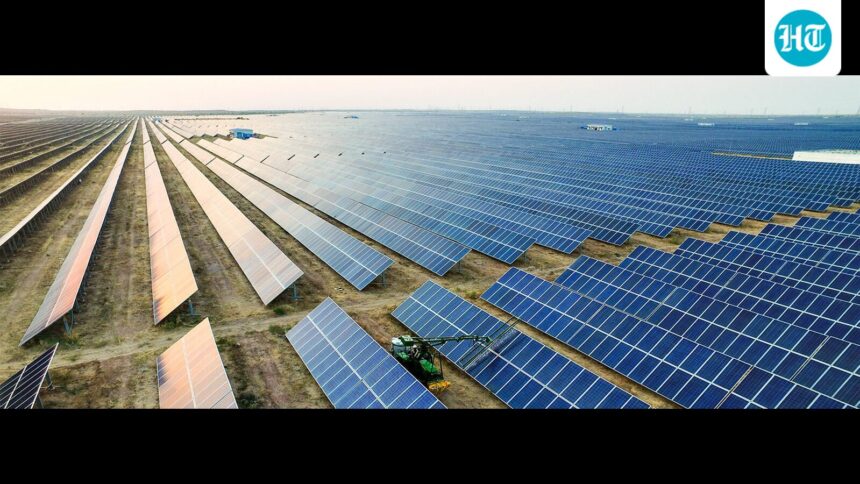
A new study finds that battery storage is now cheap enough in India that solar can meet 90% of the country’s energy demand at lifetime costs below current average purchase rates in most states, a finding that could signal a future buffer against global energy shocks.

Basically, solar energy can power India day and night for most months at a reasonable cost, especially in states with high solar irradiance (a measure of solar energy intensity).
Modeling by energy research center Ember showed that India could have met 90% of its electricity requirements in 2024 using solar and battery power at equal cost of electricity (LCOE) – a measure to evaluate the average cost of power generation over the life of power assets – from $5.06/kWh, assuming no grid constraints. HT reported on April 2 that the government is taking several measures to reduce dependence on LPG imports and enhance energy security in the medium to long term. This includes prioritizing the development of pipelined natural gas and renewable energy, including solar, wind, bioenergy and green hydrogen.
This would have optimally required 930 gigawatts of solar power and 2,560 gigawatts of battery storage. Ember chose 2024 because it was a particularly hot year with extreme heatwaves, which increased demand for electricity. India’s power demand reached a record high of around 250 GW in May 2024.
The main supply challenge is long periods of low solar output, especially during the monsoon, rather than a lack of battery capacity, the authors said.
“Solar and batteries already provide power below prevailing power purchase costs in many countries, while competing with coal in terms of reliability. From here, the economics become more compelling,” said Dattatreya Das, Asia energy analyst at Ember.
“The dramatic improvement in battery economics over the past two years has provided the missing piece that turns sunlight into reliable electricity day and night,” said Costantsa Rangelova, global electricity analyst at Ember.
“The question is no longer whether solar energy can power India’s electricity system, but how quickly it can scale up,” she said in a statement.
Ember’s modeling showed that seven of the top ten states – Tamil Nadu, Karnataka, Andhra Pradesh, Maharashtra, Telangana, Gujarat and Uttar Pradesh – could purchase at least 83% of their electricity needs from solar plus batteries at a lower lower cost of energy (LCOE) price than the current APPC.
The government expects the country’s peak power demand to reach a record high of 270 gigawatts this year, even as the global energy crisis unfolds. The US-Israeli war against Iran disrupted global gas supplies. While gas-based power accounted for only 6.2% of India’s electricity mix in the 2024-25 fiscal year, the government relied on it to meet peak demand during short periods in the summer months. This year, India will rely on coal, including imports, even as key record prices for fossil fuels rise, Imber said. She added that improving economics of solar plus batteries provides a natural buffer against such energy shocks in the future.