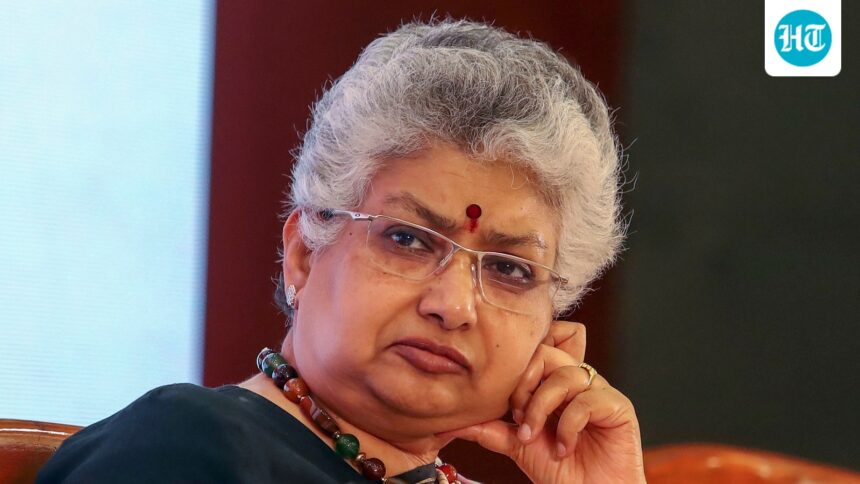
A woman cannot be treated as an “untouchable” for three days in a month and then stop doing so on the fourth day, High Court judge P V Nagaratna pointed out while hearing petitions related to discrimination against women in religious places.

This included the Sabarimala temple in Kerala, where the petitions also raised questions about the scope and scope of religious freedom practiced by multiple faiths, news agency PTI reported on Tuesday.
Her reference was to menstruation.
Justice Nagarathna is the only woman in the nine-judge bench, which also includes Chief Justice Surya Kant, and Justices M M Sundresh, Ahsanuddin Amanullah, Aravind Kumar, Augustine George Masih, Prasanna P Varali, R Mahadevan and Joymalia Bagchi.
Read also | Question of faith beyond judicial review: Government before Supreme Court over Sabarimala
What did Justice Nagaratna say?
While hearing the petitions, Justice Nagarathna said: “Section 17 in the context of Sabarimala, I don’t know how it can be argued. Speaking as a woman, there can be no ban on touching for three days every month, and on the fourth day, there is no ban on touching.”
Justice Nagaratna was expressing doubts about the application of Article 17 in the case, saying it had become a fundamental right in the context of the long history of untouchability.
Justice Nagaratna made the remark when Solicitor General of India Tushar Mehta, representing the Centre, asserted that he had a strong objection to an observation made in the 2018 Sabarimala judgement.
He objected to the rationale that excluding women in the age group of 10-50 years from the temple was a form of “untouchability”, which violated Article 17 of the Constitution, Live Law reported.
In the Sabarimala case, Justice DY Chandrachud noted that excluding women from entering a Kerala temple on the basis of age or menstrual status was a form of “untouchability”, putting them in a “subordinate” position. Chandrachud further stated that this perpetuated “patriarchy” and was “insulting” to women’s dignity.
Read also | Just like that: a Sabarimala temple debate on faith, equality and the path to reform
What did Solicitor General Tushar Mehta say?
Mehta argued in court that India is not “patriarchal or gender stereotyped in the way the West understands it.” He said the ban on entry of women into Sabarimala had nothing to do with menstruation, adding that it was on the basis of age group only.
“Let us be clear. Sabarimala is only for a certain age group. There should not be any confusion. Temples of Lord Ayyappa across the country and the world are open to women of all ages. It is only one temple that has this restriction. It is a unique case,” Mehta was quoted as saying by PTI. He added: “I will defend Sabarimala in my different way. It does not mean 4 days, but rather it means a certain age group.”