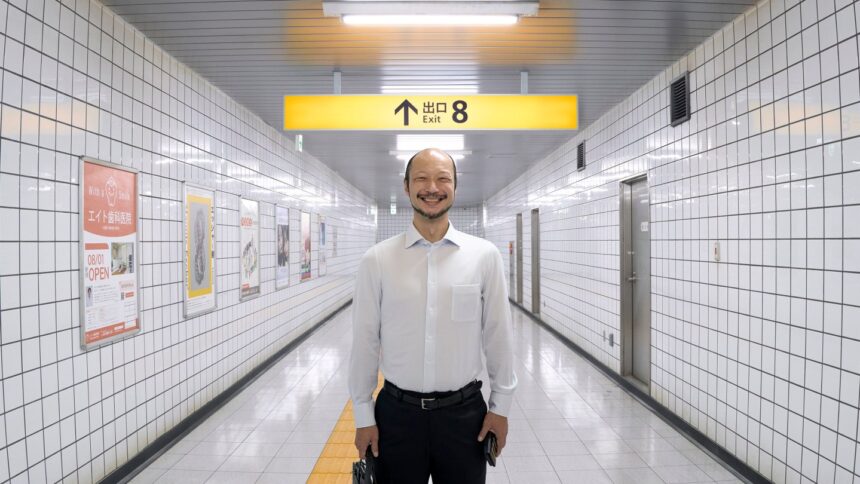
The press notes the high-concept, stand-alone Japanese thriller Exit 8 He explained that the film is a “big screen adaptation of the viral indie video game sensation.”
You can call me old, or jaded, or maybe both, but I was completely unaware of the game’s existence before sitting down to watch the movie. This is both a good and a bad thing: good, because the film’s major plot twists came as a surprise to me, making up for the lack of interesting characters or a real story; Bad, because you probably have to be a fan of the game to like a movie that doesn’t give you much more than the original, even if the filmmakers try to insert more narrative into the action.
Exit 8
Bottom line It’s probably more fun to play than to watch.
release date: Friday, April 10
ejaculate: Kazunari Ninomiya, Yamato Kochi, Naru Asanuma, Koton Hanase, Nana Komatsu
exit: Jinki Kawamura
Screenwriters: Kentaro Hirase, Genki Kawamura, based on the video game by Kotake Krit
1 hour and 35 minutes
The setup is simple: a character known only as “The Missing Man” (Kentaro Hirase) leaves the Tokyo subway and finds himself stuck in a hellish loop, walking through the same tunnels while trying to find his way out of the station. He soon discovered instructions written on a wall sign indicating that if he saw an anomaly in the tunnel, he was to turn back. If he doesn’t, he should move on. The right turn takes him to the next level, while the wrong turn sends him backwards. The goal is to reach… Exit 8.
If that doesn’t sound like enough material for a feature film, director Genki Kawamura and co-writer Kentaro Hirase try to up their content by including a backstory involving the man’s unseen girlfriend, who calls him at the beginning of the film to announce that she’s pregnant. In a way, what happens in the tunnel is a reflection of the man’s twisted thoughts as he comes to terms with a life-altering decision: Take the right path and you will continue; Make a mistake and you end up in hell.
most Exit 8 It plays more like extended purgatory. This is certainly the case for the lost man (and frankly, sometimes, for the viewer), who continues down the same path, trying to choose his next step wisely. The experience is no different than that old “What’s wrong with this picture?” The drawings used to appear in children’s magazines, but here the concept is enhanced with the eerie atmosphere of Japanese horror films.
If the Lost Man remains the only protagonist, he encounters two others as he wanders: the first is an NPC (Yamato Kochi) – or NPC for those who aren’t playing there – who keeps passing until at some point he briefly becomes the protagonist himself. The second is a young boy (Naru Asanuma) who has been separated from his mother and proves to be a more perceptive player than the adults.
These additions add something extra to the plot, though not enough to keep us on the edge of our seats. The problem with Exit 8 is that it’s certainly more fun to play interactively than to watch passively, even if the filmmakers do a good job of maintaining a tone of surreal dread from beginning to end, with the occasional scare thrown in.
There have been many other video game adaptations over the past decade or two, underscoring how the gaming industry has ballooned into a media giant on par with, if not bigger than, Hollywood itself. Most of these films were blockbusters, starting with Minecraft to Super Mario Bros. to Vampire A franchise that turns game world characters into action heroes. More ambitious features, like Doug Liman Edge of tomorrow Or Harmony Korine’s artistic experiments Pay Dr1ft and Child invasionthey tried to transform the gaming experience into the concept of a movie itself, blending the two into a hybrid game movie.
Exit 8 It belongs to the latter category, resulting in innovative filmmaking early on, especially during the opening scene shot from the point of view of the lost man as he rides on the subway and gets off at the cursed station. Kawamura plays with the story of an FPS – or first-person shooter – at this point, but soon switches angles to capture the action in a more traditional way. Which is too bad, because more innovation could have gone a long way here, allowing us to escape the repetition in the maze.
“Do you think we’re dead?” someone asks during another tour through the tunnels, though the most disturbing aspect is Exit 8 is that the never-ending rat race often feels like a metaphor for life itself – an idea confirmed by an early snapshot of countless Japanese Salary Heading to work wearing the same colorless suits. Kawamura is wise enough to keep this idea alive until the final scene, making us wonder if any of us ultimately have control over our destinies. It’s all in the game.