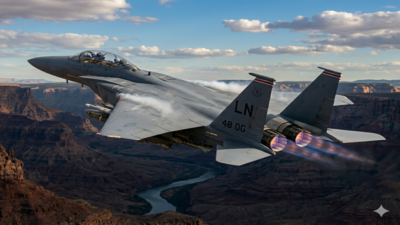
Military aviation experts have determined what it took for a fighter pilot shot down behind enemy lines to hide, survive and be rescued by extraction forces, as U.S. crews conduct search and rescue operations after Iran shot down a U.S. Air Force F-15E Strike Eagle on Friday.According to reports, one of the crew members, most likely the pilot, was rescued, and the search is still ongoing for the second crew member.
He watches
On camera: Iran shoots down an Israeli F-16 fighter jet after hitting 4 American planes and helicopters?
Read also | An American plane was shot down in Iran: Israel says that one pilot was rescued, and is searching for another“You’re like, ‘Oh my God, two minutes ago you were on a fighter plane going 500 miles per hour, and a missile exploded 15 feet from your head,’” Houston Cantwell, a retired US Air Force brigadier general, recalled to AFP.Cantwell explained that pilot training — known as Survival, Evasion, Resistance and Escape (SERE) — would likely begin before parachuting to the ground.
“Your best view of where you might want to go or where you might want to avoid is while you’re parachuting,” he added.Read also | Iran announces a $60,000 reward for American pilots after shooting down the fighter planeHe warned that skydiving carries the risk of foot, ankle and leg injuries. “There are many stories of Vietnam survivors who suffered serious injuries — compound fractures — just from being ejected,” the former pilot noted.Once they reach the ground, pilots must quickly assess their condition. “Take inventory to see what state I’m in? Can I even move? Am I even mobile?” Cantwell noted.
They then determine their location, whether they are behind enemy lines, and how best to hide or communicate. “Try to avoid enemy capture for as long as possible. If you’re in a desert environment, I’ll try to find some water,” he added.Read also | Can anyone find our pilots? Please?: Iran mocks the United States after the loss of the American planeCombat search and rescue (CSAR) teams play a crucial role. “It gives you tremendous peace of mind… They will do everything in their power to come to you. At the same time, they are not coming on a suicide mission,” Cantwell noted.For the missing crew member, concealment is the top priority. “I want to try to get to a place where I can extract it.” Movement is usually safer at night, using rooftops in cities or fields in rural areas suitable for helicopter capture.Cantwell also stated that pilots often carry personal weapons, such as a handgun, to increase their chances of survival.“Extraction forces are always on standby.”Meanwhile, Scott Fallis, a retired sergeant and former CSAR member, noted that extraction forces are always on guard when U.S. aircraft operate over enemy territory.Read also | ‘One by one’: Iran shoots down another US plane after F-15E crash in Hormuz; He watchesValles, who worked as a skydiver, played a key role in the 1993 “Black Hawk down” in Mogadishu, Somalia.“Before any operations are carried out… there is always a CSAR plan,” he told AFP.Meanwhile, intelligence teams are collecting and analyzing all the details related to the missing pilot. “Everything from human intelligence to imagery intelligence to all the different drones that we’re looking at points to signals intelligence,” Valles explained.
“All of this is being used to try to find this guy.”Once the pilot is located, a real-time rescue plan is developed inside the helicopters. He added: “These gunners are monitoring and searching for threats; the pilots are looking for a place to land, and we are communicating with that downed pilot.”On the ground, crews confirm the pilot’s identity and compare threats to medical needs. Valles described the process: “What kind of immediate threat do we have? How much time do we have to get this person out? What kind of injuries does he have? And then we’ll decide what kind of treatment we need at the scene and how much — or grab and go depending on the threat?”With a fellow soldier missing in southwest Iran, Valles remains cautiously optimistic.
“I hope friendly people found him and hid him, or he’s still on the run,” he said.During the ongoing US-Israeli military campaign against Iran, which the Trump administration has dubbed “Operation Epic Fury,” the United States has suffered multiple air casualties. In early March, three F-15Es were shot down in a friendly fire incident over Kuwait, although all six crew members were safely recovered. Days later, a KC-135 Stratotanker crashed in western Iraq, killing all six crew members.