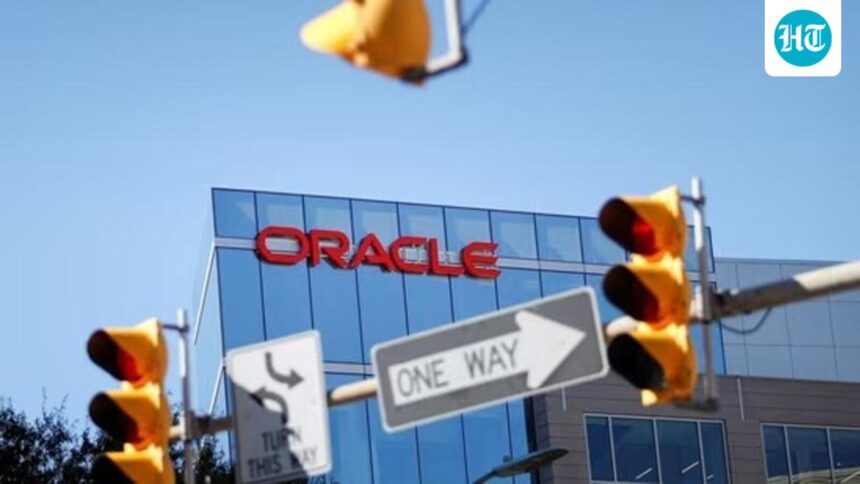
Thirty thousand jobs have just been cut from Oracle’s rosters. Of these, 12,000 were in India. Engineers, analysts, and back-office staff were faced with a stark reality: they were disposable items on the balance sheet that needed to be cleaned up. Politely labeled as “unfortunate layoffs in a time of AI transformation,” this is actually the unfolding narrative of a company in the midst of a reckoning. To understand why 12,000 households in Bengaluru and Hyderabad are staring at blank screens today, we must look beyond software. It should instead look to the company’s billionaire promoter, Larry Ellison.

“I think Larry was distracted,” the founding president of one of India’s most prominent technology companies told me. An assessment by Akhil Handa, a man deeply involved in the AI ecosystem and former chairman of Bank of Baroda, puts this in stark perspective: “In a regulated environment, Oracle has been a dominant player, with minimal competition for on-premises deployments. There are platforms that are closely tied to their technology. They are very difficult to replace on the fly.”
But when they are incentivized, the developer ecosystem offers another judgment: They don’t like Oracle. “In an environment where it is the biggest seller, it cannot be ignored,” said a developer in Bengaluru. The data is in Oracle pipes. Exiting the Oracle ecosystem is not an option because the cost of “copying and replacing” these pipelines would be catastrophic for any entity. So, in theory, it is a digital tool. It’s necessary, but deeply resented.
Staying basic in legacy software means continuing to engage in labor-intensive, low-margin work. It takes thousands of people to maintain it. But as we move into the era of artificial intelligence, humans are viewed as low-productivity assets which leads to a decline in company valuation. When viewed from the top floor of Oracle’s headquarters, where Ellison sits, the logic is simple: a company would be more valuable with 130,000 employees than with 162,000.
The strategy then is to trade people for servers. While a human engineer requires a salary, a server cluster only requires electricity. In turn, they generate high-margin, capital-intensive revenue around the clock. For him, this is not a layoff; It’s a drill. Labor is emptied out to make room for capital.
But the timing of this move points to something more urgent than a shift in business strategy. Which explains the previously mentioned “distraction”: a $111 billion media empire.
The Ellison family office is currently in the final stages of a massive merger involving Skydance Media, Paramount Global and Warner Bros. Discovery. To finance this Hollywood ambition, Ellison used his underlying assets – 1.16 billion shares in Oracle Corporation – as collateral. As of April 2026, markets have become volatile. Oracle stock has fallen from a 2025 peak of $345 in September 2025 to roughly $145 now. When the value of collateral drops by more than 50%, the banks offering the financing show no sympathy. They issue a margin call. They look at credit default swap (CDS) spreads, which is the market’s way of pricing default risk. What they see is the “risk meter” flashing red. They see a company that borrowed $100 billion to build AI data centers while its president is busy with CNN and HBO.
From 10,000 miles away, it’s safe to assume the company has had to implement radical operational discipline to appease lenders and compress CDS spreads. In effect, the layoff of 12,000 workers in India was a mass sacrifice for the bond market. By cutting human costs, Oracle is artificially inflating its profit margins and signaling to Wall Street that “distracted” leadership remains focused on the bottom line. This protects the stock price, locks in the collateral, and ensures the Paramount deal gets to the finish line. The Indian tech worker, once celebrated as the backbone of global software, has been turned into a tactical pawn in the billionaire’s personal finance game.
The question that remains is: Can Oracle really grow in an AI-driven world? The suspicions of industry veterans suggest that it may not be in a position to innovate its way into the future. Oracle lacks the native AI power to power the new age players who are actually inventing intelligence; Instead, it appears to have settled into the role of high-tech landlord, renting out floor space and silicon to those who really innovate.
Even more troubling are industry whispers that this 30,000-person cut is just the first tranche. More rounds of layoffs are expected as the company continues to shed its intellectual capital to manage its debt. How this novel plays out is anyone’s guess. Right now, it seems that thousands are out of work so that the billionaire can stay in the movie business.
(Charles Assisi is co-founder of Founding Fuel. He can be reached at assisi@foundingfuel.com)