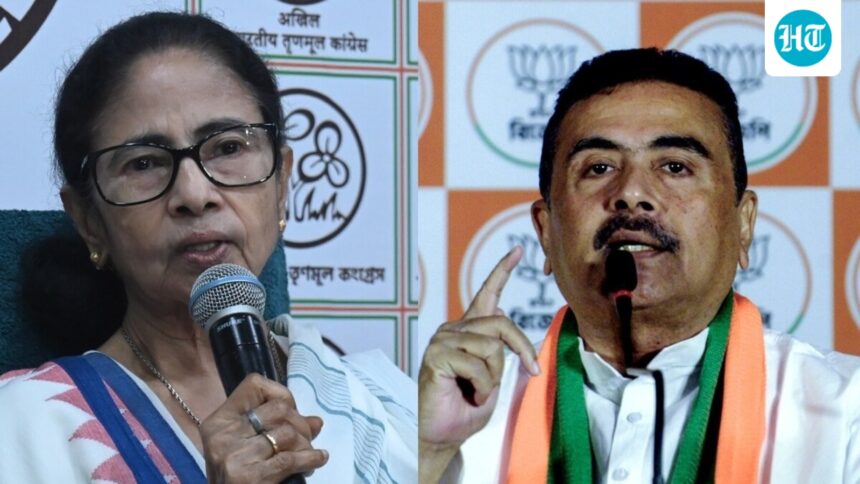
The TMC wants to win back Nandigram from where Mamata Banerjee lost in the last elections, while the BJP wants to beat her this time from Bhabanipur as well.

The political battle in West Bengal has intensified ahead of the legislative elections scheduled for April. The Indian Election Commission had previously announced that voting in the Bengal elections would take place in two phases on April 23 and 29. The first phase in the state will cover 152 electoral districts, and the second phase will cover 142 seats.

The battle will be, largely, between the Bhartiya Janta Party (BJP) and the All India Trinamool Congress (TMC), to claim the prime minister’s seat. Since the announcement of the voting dates, the leaders of the two parties have exchanged harsh words against each other.
Speaking at a summit in Delhi last week, Prime Minister Narendra Modi attacked TMC chief and incumbent Chief Minister Mamata Banerjee, saying the ruthless state government was constantly working to curb development in Bengal. “West Bengal was once a hub of culture, education, industry and trade. In the last 11 years, the central government has invested huge amounts in the development of West Bengal, but unfortunately, there is a ruthless government working to curb the development,” Modi said.
Meanwhile, Mamata alleged that the BJP is trying to include illegal voters from NDA-ruled Bihar, Rajasthan, Haryana and Uttar Pradesh in the state electoral rolls to shift the poll result in favor of the saffron party.
While the war of words continues, let’s take a look at the five seats that could be the most contested in the upcoming elections.
Read also: Mamata Banerjee accuses BJP of trying to register outsiders as voters
Nandigram
Nandigram remains a key political battleground, represented by two-time BJP MLA Suvendu Adhikari, who is also seen as one of the party’s key faces in West Bengal and a potential prime ministerial candidate.
Adhikari maintained a strong grip on the constituency. In the 2021 Lok Sabha elections, he received nearly 49 percent of the votes and significantly defeated Mamata. In 2016, his vote share rose, reportedly at between 65% and 67%, confirming his dominance of the seat.
In a strategic encounter, TMC has fielded Pabitra Kar against Adhikari this time. Kar is a former BJP member and was once considered close to Adhikari. He joined the TMC just hours before announcing his candidacy, adding an extra layer of suspense to the contest.

TMC wants to win this back seat. Their second-in-command and general secretary Abhishek Banerjee is personally following the developments regarding this seat. “Nandigram is my responsibility. You all have responsibility for the next 25 days. I will be responsible for Nandigram for the next five years.” Banerjee said while addressing a workers’ meeting in Nandigram on March 25.
Bhabanipur
Bhabanipur has been a TMC stronghold since 2011, with Mamata representing the seat several times as an MLA.
After the 2021 Assembly elections, where Banerjee lost from Nandigram, she needed to get a seat to continue as chief minister. To make this happen, the TMC MLA from Bhabanipur vacated his seat, paving the way for by-elections. Banerjee contested and won the by-poll, thus becoming a member of the West Bengal Vidhan Sabha while already serving as the Chief Minister.
Bhabanipur will be the most watched seat in this election, not only because it sees a CM fighting from there, but the BJP has put Adhikari ahead of her again after defeating her in 2021 in Nandigram. Adhikhar is fighting from two seats, Nandigram and Bhabanipur.
Murshidabad
Murshidabad is one of the few constituencies in West Bengal where the Indian National Congress continues to maintain a significant presence. Chauni Singha Roy won this seat in 2011 and 2016 on a Congress ticket, underscoring the party’s traditional base here.
However, the Congress lost the constituency in the last assembly elections, when the BJP’s Gauri Shankar Ghosh emerged victorious. Let’s not forget that in 2021, Roy fought for this seat on a TMC ticket and this year also with Trinamool. She is expected to have a tough battle with Ghosh. Congress nominated Siddiqui Ali from this seat. This is one of the rare seats where Congress can also raise hopes of winning. With the TMC, BJP and Congress in similar presence, Murshidabad is expected to witness a very competitive battle.
Read also: BJP’s 4th Bengal list: Union minister’s wife and former Congress leader among 13 candidates
Jadavpur
Jadavpur has long been a bastion of the Left, with the Communist Party of India (Marxist) controlling the seat from 1967 to 2006, winning several successive elections over nearly four decades.
The TMC broke this stronghold in 2011, with Manish Gupta winning from there, marking a major political shift. However, the Left managed to make a comeback in 2016, with Sujan Chakraborty winning the seat despite the decline in CPI(M) influence across the state. In 2021, TMC regained control again as Debabrata Majumdar won from there.
Jadavpur is now shaping up as a direct competition between the TMC and the Left. For the Communist Party of India (Maoist), which has struggled to regain its foothold in West Bengal, this constituency represents one of the few remaining pockets of hope for revival. The fight will be between TMC’s Majumdar and CPI(M)’s Bikash Ranjan Bhattacharya, a former mayor of Kolkata and Rajya Sabha MP.
Kharagpur Sadar
Kharagpur Sadar will witness a high-profile contest between two leaders known as ‘Dada’ within their parties – Dilip Ghosh of the BJP and Pradeep Sarkar of the TMC.
In the 2021 Assembly elections, Hiran Chatterjee of the BJP won the seat, defeating Sarkar in a close contest. Ghosh, who had earlier bagged victory from this constituency in 2016, is now looking to win it back.
Sarkar, who also has political ground in the region, is once again back in the fray, making this a highly contested battle. While the seat remains open, Ghosh may have a slight advantage, given his rising popularity and his tenure as the BJP’s West Bengal state president from 2015 to 2021.