[Thisstorycontainsspoilersfrom[ThisstorycontainsspoilersfromDark winds Until Season 4, Episode 7, “Nániikai (We’re Back)”.]
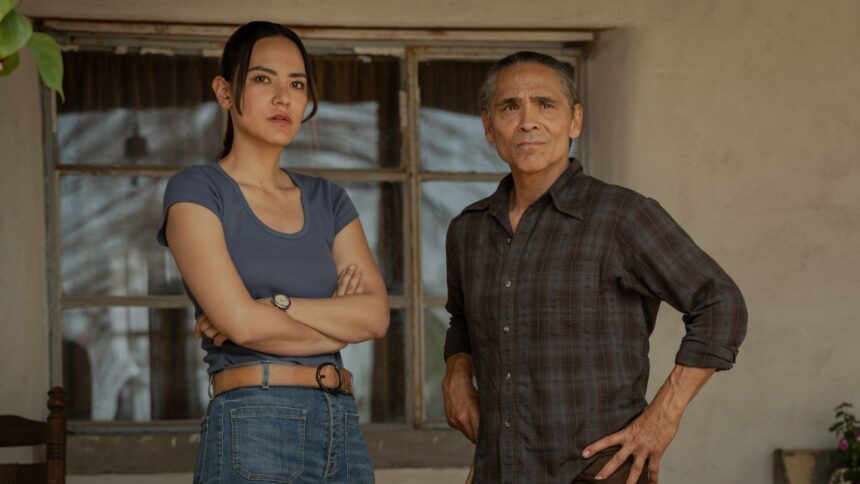
Since the beginning of this season Dark windsLieutenant Joe Leaphorn had plans to retire. He handed in his notice and appointed his successor in Bernadette. But by the end of Episode 7, it looks like he may never get that chance.
the reason? Erin Fagan.
In the latest episode that aired Sunday, Leaphorn (Zahn McClarnon) and his team were pursuing Vaggan (Franka Potente), but the killer was always one step ahead. After threatening Emma (Diana Allison) in the hospital parking garage in last week’s episode, Fagan now strikes at the police to find Billie (Isabelle Deroy Olson) and kidnap her, wounding an FBI agent in the process.
Joe puts the pieces together to find Billy’s cousin – Leroy – only to be outdone by Fagan once again, as she has already killed the real Leroy and placed another young man in witness protection in his place, with the goal of exonerating her employer of his false testimony. Just as he begins to see through the deception, Fagan attacks Joe from behind, knocking him to the ground – then tying him up and putting him in the trunk. The episode concludes with her triumphantly declaring: “You’re mine now, Joe.”
Despite the extreme difficulties Billy and Joe find themselves in, episode seven also explores the strained relationship between Joe and Emma, and deepens the relationship between Bernadette (Jessica Matten) and Chi (Kiwa Gordon) after they have struggled as a couple for most of the season. And it seems like Chi has finally turned the corner regarding the ghost illness that has plagued him both physically and emotionally.
THR I recently sat down with the cast to talk about those emotional moments, as well as the episode’s tribute to actor Udo Kier. Read below to find out what Zane McClarnon, Jessica Matten, Kiowa Gordon, Diana Allison and Franca Potente had to say before next weekend:
Emma’s quiet strength

Dark winds He has a tendency to slopes. But last week’s episode took a break from that format: After Fagan threatens Emma in the hospital parking garage, the audience gets the cathartic release of seeing Joe find her, stressed but generally unharmed, and comfort her in his arms.
Emma’s gentle, maternal presence — which has been a constant on the show since Season 1 — is absent in the first half of this season, underscoring the impact of her breakup with Joe. But since the team’s arrival in Los Angeles, Emma has been there to provide guidance to Bernadette on her relationship with Chi and uses her knowledge of Navajo traditions to finally help Chi deal with the ghost illness.
Alison says THR She strongly identifies with Emma’s embrace of Navajo cultural traditions. “It stands firm and incorporates its core values and morals. As a Navajo woman, that’s something that naturally resonates with me,” she says, adding that while the cast and crew represent many different cultures and tribes, “it fits beautifully with all the other cultures and actors who have different backgrounds. We’re in a time where there’s very limited representation overall as Indigenous actors, and I feel like it adds another element to the world of Indigenous storytelling.”
When asked about Emma’s role as a mother, she noted, “This is one of the foundations and principles of the Navajo lens and culture, which is respect for the mother, the woman, and the home. This is what Hogan [traditional Navajo home] The roundness of the stomach represents the roundness of Mother Earth. But there is also a deep respect for male energy, as we described [last season with the story of] The hero twins, so there’s respect for both of them [male and female] To replenish the Earth and always be that balance for each other.
“Whether you’re an aunt or an elder or a mother or a sister, Navajo women really have that responsibility where men, women, children and elders go for support and love, and they will always have someone who cares deeply for them,” she continues. “That’s the powerful role of Navajo women. I’m so lucky to have women like that in my life, so I’m just emulating what I grew up with, and these strong mothers have helped me be the woman I am today.”
“I love that behind every Navajo man, no matter whether you live on the rez or off the rez, whether you’re going to war or living a life of service as a lawyer or a community leader, there’s always a Navajo woman praying for her son, for her husband, for her brother, for her cousins. That’s the beauty of Navajo mothers that we truly revere,” she adds.

Ever since Emma left, Joe has been trying to be the man she wants him to be, so after her confrontation with Fagan, he says he will let the others continue working the case while he stays with his wife to protect her. But to his surprise, Emma insists she’ll be fine, and Joe needs to find Billie, the runaway teen who Fagan eventually goes after.
“She just believes in her husband,” Alison explains of Emma’s reaction. “She sees the good man, he’s the leader, he’s that pillar. She married him because he’s the ultimate protector. She sees that, she knows his potential, she knows his fight. So, she never tries to ask him not to be who he is. She knows exactly the man she married. And after that attack hit so close to home, she said, ‘Wow, this just got personal.’
In addition to the immediate threat to their families, Emma is acutely aware of how small the indigenous community is. “She works with women and children. She was a mother. We can’t have children missing and displaced. For her, if there was anything, she would be there with him to help find [Billie]. “She wants Joe to find this little Navajo girl who lives alone and needs support,” Allison says.[Emma’s thinking] “Joe, you’re the only one. You can’t stop. You’ve come this far, you have to keep going. You’re going to be okay, it is.” He was fine. She went alone for months. Navajo women are very resilient. They’re very resilient, but that doesn’t mean they don’t need these protectors to really help the community.
“Man Chi” moment.

After Fagan kidnapped Billy, Bernadette went to the hospital to tell Che, and he finally opened up about the feelings he was experiencing, telling her the story of his mother’s illness and his failure to return her to the reserve before she died. say Matten and Gordon THR For them, this scene was among the most challenging and rewarding aspects of the season.
At the beginning of Season 4, Bernadette was in a vulnerable place after returning from the Border Patrol, and Che was trying to be there for her, Matten recalls. But as he faces his own demons, exacerbated by the ghost illness, she notes, “the roles are actually reversed, where you start to see what Che is going through and how he’s put into this crazy spiral of his own PTSD and how Bernadette is there for him,” she says, “which I think reflects the dynamics of relationships in the real world, and they’re passing the baton to each other.”
“It’s just being able to be intimate with each other and be a safe space for each other, and embrace each other with love and patience,” Gordon says of the dynamic.
Matten recalls that the episode’s director, Chris Eyre, helped them explore the underlying emotional truth of the scene. “When we need help recording an emotional tone, and we don’t know what it is but we’re trying to figure out, ‘What tone are we missing?’, then we really rely on the director to help us,” she says.
“We’re from that generation, and our parents were, where it wasn’t cool to be Native, so it was about feeling ashamed of being Native,” she continues. “Chi’s character was going through that, and Chris said, ‘Do you remember what that felt like?'” And I delved into my own life, and I remembered how I was always trying to hide that side of me growing up. I was lying about who I was and the shame I felt behind it, and I remembered the shame my grandfather felt, too. He wouldn’t be able to go to the hospital because they’d be like, “Oh, he’s a drunk Indian, there’s nothing wrong with him.” “So, these things are really real.
“It changed my whole perspective of the scene, so when Kiowa was delivering his lines about Chi bearing this shame, it was like ‘boo’. I saw my grandfather, I saw my mother, and I saw myself as that little kid. And then Kiowa and I, we’re so lucky because we naturally bounce off each other. Everyone was quiet and crying after that.”

“It was a special moment. I don’t think you can just write that down or capture it, it has to be a very sensitive, very real moment. You have an emotional connection with everyone in a 20-foot radius,” Gordon adds.
After they finished the scene, McClarnon broke the tension by telling them, “That was great, guys,” Matten recalls with a laugh. “Yes, it brought us back down to earth,” Gordon says.
The emotions are universal, Matten says, even though the scene is filtered through a specifically local experience, “because we all have moments of doubt in our sense of self-worth. I think that’s why the whole room is crying. Not just as actors, but anyone who works behind or in front of the camera, we live in these moments that are a true reflection of the human experience. We experienced that on set.”
Shortly after their heart-to-heart conversation, the characters return to the sanctuary, where they begin planning a much-needed traditional healing ceremony to rid Chi of the ghost disease.
“It’s a disease that takes hold of your open insecurities and your wounds and feeds off of that and can eat you alive if you let it, but fortunately you have the Man Chi and Leghorn team. They have this ancient wisdom and knowledge where they have ceremonies and medicine for that,” Gordon says. “It takes a whole season for Che to figure it out, but happily he finally comes around,” he adds with a laugh.
In memory of Udo Kier
As mentioned in the closing credits, episode seven is dedicated to Udo Kier. The German actor who also appeared in the Oscar-nominated film Secret agent Before his death in November at the age of 81, he played Potente Erin Fagan’s evil grandfather on this season. His character, an elderly Nazi suffering from dementia, got his send-off from the show this week, with Erin running him over with her car in a fit of frustration after he wandered away from the nursing home she admitted him to.
Potente and McLernon talked about the joy of working with the actor known for Gus Van Sant’s films My IdahoIn addition to collaborations with filmmakers Lars von Trier and Wim Wenders.
“He was a great guy,” McClarnon says. “He was fun to be around, that’s for sure. Franca was a little closer to him than me, though [I enjoyed] Being around him and his energy and he’s so eccentric.
“He was very free,” Potente adds. “He would suddenly start reciting in one scene village. Or he’ll just sing, you know? and [McClarnon and I] We just kept saying to each other, If only we could be half this liberated and free. He’s just exploring at the moment. You could feel that when he got bored of the scene, he was like (He sings). What that means is a reset, it’s an invitation for everyone to join.
In terms of Kier’s role in the story, Vaggan’s greater fate seems to serve as confirmation that even when Irene is on the cusp of victory—overcoming it after she captures Billie and shortly before gaining the upper hand on Leaphorn—she doesn’t necessarily make the most logical decisions, introducing factors of danger and chaos into the plot.
And it’s sure to continue doing so in next week’s finale.
Dark winds It airs on AMC and streams on AMC+, with new episodes airing weekly on Sundays. In case you missed it, you can find more coverage at The first episode is here, Episode three is here and Episode five is here. Check back for more insights from the show’s team as the season progresses.